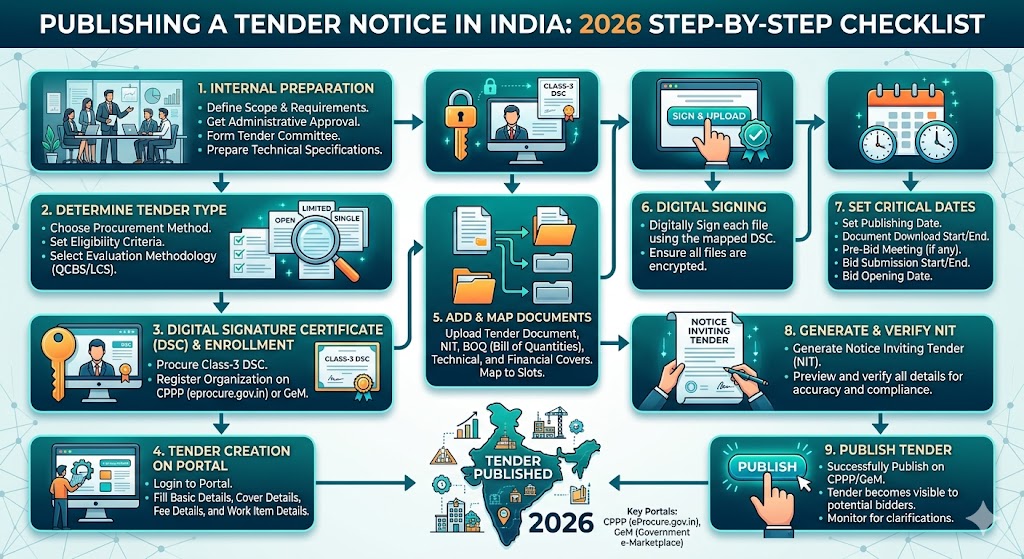
A Complete Checklist for Publishing a Tender Notice in India (2026 Updated Guide):
By sahil Singh, Senior Legal Media Consultant |public-noticeads.in
Introduction to Tender Notices in India:
A tender notice refers to a notice that is issued publicly by a government or even a non-governmental organisation to attract competitive bids in a particular project or contract.
A tender notice, which is legally viable, is an important process that should be carried out in procurement in India. It provides transparency, fairness, and accountability, which is consistent with the General Financial Rules (GFR) and state procurement rules.
This one-stop guide will guide you throughout the publishing of a tender notice in the Indian newspapers. It discusses tender notice format, ad rates, documents required, legal compliance, and procurement rules, plus tips of the experts when it comes to publishing your tender without any huddles, be completely compliant, and find the qualified bidders without confusion, regardless of whether it is a small company, startup, or a government agency.
Table of Contents
- 1. Introduction to Tender Notices
- 2. What Is a Tender Notice?
- 3. Types of Tender Notices
- 4. Newspaper Publication Requirements
- 5. Tender Notice Format
- 6. How to Publish (Step-by-Step)
- 7. Documents Required
- 8. Newspaper Ad Rates 2026
- 9. Expert Legal Tips
- 10. Real User Experiences
- 11. Frequently Asked Questions
Get an instant quote →public-noticeads.in | Call: +91 98219 84000.
What Is a Tender Notice? (Definition & Legal Meaning):
A Tender Notice (also called a Notice InvitingTender (NIT)) is a legally requiredpublic document that:
- Announces the availability of a contract or project.
- Invites qualified vendors, contractors, or suppliers to submit bids.
- Establishes a transparent bidding process under Indian procurement law.
Tender notices follow the rules set by the Central Vigilance Commission (CVC), GFR2017, and the procurement guidelines of each state government.
Related terms you should know:
- Notice Inviting Tender (NIT).
- Request for Proposal (RFP).
- Expression of Interest (EOI).
- Limited Tender Enquiry (LTE).
- Global Tender Notice (GTN).
Types of Tender Notices in India:
The first step to staying compliant is to clearly understand which type of tender your project actually needs:
|
Type |
Description |
Who Can Bid |
|
Open Tender Notice |
Published publicly for all eligible vendors |
All registered bidders |
|
Limited Tender Notice |
Sent to a shortlisted group of suppliers |
Pre-qualified vendors only |
|
Single Tender Notice |
Issued to a specific vendor (proprietary items) |
One designated vendor |
|
Global Tender Notice (GTN) |
Open to international bidders |
Domestic + foreign bidders |
|
Expression of Interest (EOI) |
Pre-qualification of vendors |
All interested parties |
Tip: Most government contracts above₹25 lakh need an open tender notice published in at least two newspapers, one national and one regional, so that it reaches a wider audience and ensures fair competition.
Newspaper Publication Requirements for Tender Notices:
It is not a mere formality that you post your tender notice in newspapers. It is a legal requirement. According to Central Vigilance Commission (CVC), tenders should be posted in a way that is visible to all people. This guarantees competition, openness, and transparency. It also assists in minimizing corruption and favouritism and the tender process is open and transparent.
Which Newspapers Are Accepted?
- National dailies (e.g., Times of India, Hindustan Times, The Hindu).
- Regional language newspapers (e.g., Deccan Herald, Prajavani, Vijayavani, Eenadu, Lokmat).
- Trade/industry publications for sector-specific tenders.
- Online digital editions of recognized newspapers.
Minimum Publication Timeline:
|
Contract Value |
Minimum Notice Period |
|
Up to ₹5 lakh |
15 days before bid deadline |
|
₹5 lakh – ₹25 lakh |
21 days before bid deadline |
|
Above ₹25 lakh |
30 days before bid deadline |
|
Government infrastructure projects |
45–60 days |
Tender Notice Format: What Must Be Included:
A valid tender notice must include the following key details:
- Name and logo of the tendering authority.
- Tender reference number / NIT number.
- Name and brief description of the project/work.
- Estimated cost / project value (where applicable).
- Tender document fee and mode of payment.
- Earnest Money Deposit (EMD) amount.
- Date, time, and venue for bid submission.
- Deadline for receiving bids (closing date and time).
- Date of opening bids.
- Eligibility criteria for bidders.
- Contact details of the tendering officer.
- Website link where full tender documents can be downloaded.
How to Publish a Tender Notice in India: Step-by-Step:
Step 1: Determine the Type of Tender Notice Required:
Look at your project size, the work involved, and the rules in place to choose between an open, limited, or global tender notice.
Step 2: Draft the Tender Notice Document:
Prepare a notice including all the required details mentioned above. Follow the standard NIT format suggested by your state government or ministry to keep it correct and official.
Step 3: Get Internal Approvals:
Before sending the tender for publication, make sure it is approved and signed by the right authority, such as the department head, finance officer, or the tender committee.
Step 4: Choose the Right Newspaper(s):
Select newspapers based on:
- Circulation area (local, state-wide, or national).
- Language (English + vernacular recommended).
- Compliance with CVC/GFR requirements.
Step 5: Submit to a Certified Ad Booking Service:
Use a trusted service like public-noticeads.in to publish your tender notice in multiple newspapers at once. It saves time, ensures legal compliance, and reaches the right audience effectively.
Step 6: Verify Publication:
After publication, collect:
- Tear sheets (published newspaper clippings).
- Affidavit of publication (required for legal record).
- Invoice from the newspaper / ad agency.
Step 7: Upload to eProcurement Portal:
Most state and central departments now insist that you post your tender on the internet on sites such as GeM, CPPP (eprocure.gov.in), or your states eProcurement site. This renders the process quicker, clearer and more trackable.
Step 8: Receive, Evaluate, and Award Bids:
Evaluate the bids exactly as described in the notice and keep proper records for audit and compliance.
Documents Required for Publishing a Tender Notice:
- ✅ Completed Tender Notice / NIT document.
- ✅ Sanction order / approval letter from authority.
- ✅ Project proposal or Detailed Project Report (DPR).
- ✅ Bid evaluation criteria and technical specifications.
- ✅ EMD and tender fee details.
- ✅ Organization's GST registration certificate (for private entities).
- ✅ Signed authority letter for ad publication.
2026 Updated Newspaper Advertising Rates for Tender Notices:
|
Newspaper |
Classified Text (per line) |
Display Ad (per sq cm) |
Language |
|
Times of India |
₹600 |
₹2,000 |
English |
|
Deccan Herald |
₹500 |
₹1,500 |
English |
|
Prajavani |
₹400 |
₹1,200 |
Kannada |
|
Vijayavani |
₹450 |
₹1,500 |
Kannada |
|
The Hindu |
₹550 |
₹1,800 |
English |
|
Eenadu |
₹380 |
₹1,100 |
Telugu |
March 2026 rates are live! Check real-time quotes now at public-noticeads.in.
🎯 Book now and get 10% off gazette packages →Book Here | +91 96996 06000.
Expert Tips for Maximum Legal Coverage:
- Publish in both English and vernacular newspapers for broader reach and stronger legal compliance.
- Always collect tear sheets — they serve as legal proof of publication.
- File an affidavit of publication with a notary for high-value government tenders.
- Use a certified ad booking agency to avoid rejection or incorrect placement.
- Cross-publish on eProcurement portals alongside newspaper ads.
- Set your deadline conservatively — factor in weekends and public holidays.
Real User Experiences:
"I was struggling to publish my tender notice in a leading newspaper. Thanks to public-noticeads.in, I was able to get my notice published quickly and easily." — Ramesh, Bangalore
"I needed help with publishing my tender notice in a regional newspaper. public-noticeads.in provided excellent service and support." — Suresh, Chennai
"I was looking for a reliable and efficient way to publish my tender notice. public-noticeads.in exceeded my expectations." — Kumar, Delhi
Frequently Asked Questions (FAQ)
What is the meaning of tender notice and why is it legally necessary in India?
A tender notice is a call to bids in a government or private project. In government contracts which exceed stipulated limits, it is obligatory by law that it promotes transparency and fairness.
What is the procedure of posting a tender notice in a national newspaper in India?
In case you want to place an advert in a national newspaper, prepare your NIT first. Next call a good advertisement service, such as public-noticeads.in. Select the newspapers and dates, and send your ad far earlier, 30-45 days before the bid due date. Lastly, retain the newspaper cuttings or tear sheets as evidence that it was published.
How long is the shortest time necessary to publish a tender notice deadline?
The CVC and GFR 2017 require a minimum length of time during which tender notices should run based on the size of the contract: at least 15 days in case of small contracts, 21 days in case of mid-sized contracts, 30 days or more in case of contracts over 25,00,000 and 45-60 days in case of major government contracts.
What to do to advertise a government contract in local newspapers?
In case of government contracts, use a local newspaper with a wide audience such as Prajavani or Eenadu. Place your ad by a credible and certified ad service, ensure all the NIT information is added, and hold on to tear sheets and affidavits as a document.
How does an open tender notice differ with a limited tender notice?
Open tenders apply to all eligible vendors and should be applied in contracts of government exceeding 25 lakh rupees. Limited bids are only posted to a number of suppliers, typically smaller or special projects.
What would be the cost of publishing a tender notice in Indian newspapers in 2026?
The charge of printing tender is determined by the newspaper and the dimensions of the advert. Text ads that are classified typically cost ₹380-600 per line and display ads cost ₹1,100-2,000 per sq cm. You can make the reservation via public-noticeads.in and receive the most favorable price and bulk offers.
What is the process of writing a tender notice to comply with CVC requirements?
A tender notice that adheres to CVC regulations must contain NIT number, project details, cost estimates, EMD and fee information, deadline, eligibility criteria and contact information. Guidance can be found on the templates on eprocure.gov.in.
Is it possible to put a tender notice online rather than in a newspaper?
Online posting of tenders can be done in eProcurement portals in the form of CPPP, GeM or your state. However, when the contract exceeds ₹25,00,000, it still needs to be published in a newspaper as per CVC rules.
What should be the documents required to publish a tender notice in India?
Few important documents would be required to publish a tender, they include the NIT, project approval or sanction order, the bid rules, EMD or fees details and authorization letter. In case it is a private company, you will also require GST registration and company registration documents.
How can I monitor and confirm that my tender notice has been published properly?
Once a tender has been published, obtain newspaper tear sheet and publisher certificate. In the case of online tenders, capture a screenshot of the online tenders with a timestamp. Prepare notary affidavit of high-value tenders.
What is the form of Notice Inviting Tender (NIT) in India?
A typical NIT typically displays the name and logo of the organization, the number of the NIT, project title, estimated cost, EMD, and tender fee. It also states submission deadlines, bid opening dates, eligibility guidelines and contact information. Official government templates are available at eprocure.gov.in.
What is the procedure to issue a tender notice of infrastructure projects in India?
Both the national and regional newspapers should be used to publish the infrastructure tenders 45-60 days before the bid deadline. Ensure that you put up technical details, and also post the notice on the CPPP portal, as well as, eligibility of the contractor.