
- Homepage
- Public Notice
- Book Legal Notices Free Press Journal Navshakti
Book Legal Notices Free Press Journal Navshakti
 Kohelica Nag
Posted on
Kohelica Nag
Posted on
How to Book Legal Notices in Free Press Journal & Navshakti
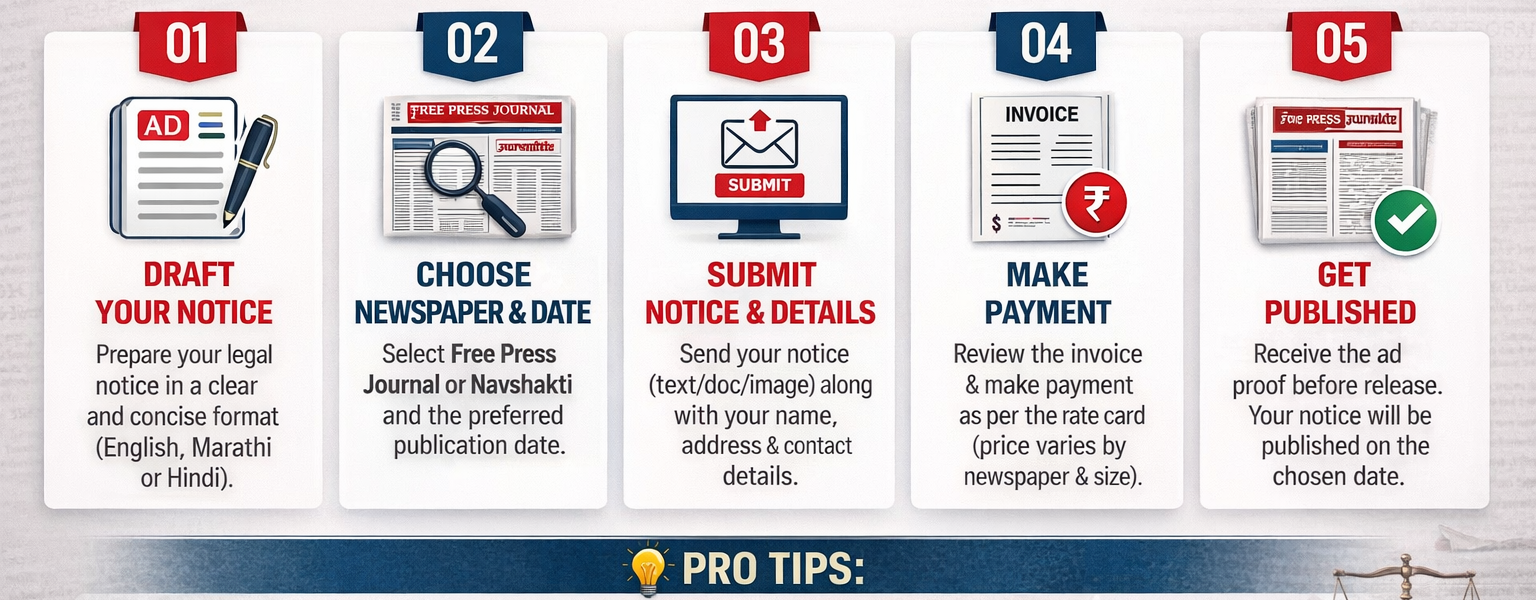
Booking a legal notice in Free Press Journal or Navshakti involves submitting your notice content, document proof, and payment through the newspaper's official ad booking portal or a DAVP-empanelled ad agency — typically processed within 1–3 working days.
Whether you need a court notice, a name-change announcement, or a property dispute publication, this guide explains the steps, costs, and basic compliance requirements for publishing in both newspapers.
📑 Table of Contents
- ➤What Are Free Press Journal and Navshakti?
- ➤Why Publish Legal Notices in a Newspaper?
- ➤Step-by-Step: How to Book a Legal Notice in Free Press Journal & Navshakti
- Step 1 — Draft Your Notice Correctly
- Step 2 — Gather Required Documents
- Step 3 — Choose Your Booking Method
- Step 4 — Get a Publication Proof
- Step 5 — Confirm Payment and Publication Date
- Step 6 — Collect the Published Tear Sheet and Certificate
- ➤How to Book a Navshakti Marathi Newspaper Public Notice in Mumbai
- ➤How to Book an Urgent Court Notice Ad in Mumbai Newspapers Online
- ➤Cost of Booking Legal Notices in Free Press Journal & Navshakti
- ➤Legal Compliance Tips
- ➤Frequently Asked Questions
- ➤Summary Checklist Before You Publish
What Are Free Press Journal and Navshakti?
Free Press Journal is a well-known English daily based in Mumbai. It is widely accepted by courts, government offices, and regulatory authorities in Maharashtra for publishing legal and statutory notices.
Navshakti is its sister publication in the Marathi language. In Maharashtra, many courts and government departments require notices to be published in both English and Marathi to be considered valid. Because of this, publishing in Free Press Journal (English) along with Navshakti (Marathi) is commonly followed.
Together, these two newspapers are a trusted and standard choice for publishing legal notices in Mumbai and across Maharashtra.
Why Publish Legal Notices in a Newspaper?
In India, several legal and administrative processes require public notice through newspapers:
- Court summons and orders — Civil and family courts may ask for notices when a party cannot be reached directly.
- Name change after marriage, divorce, or personal reasons — required by government departments and passport authorities.
- Property disputes or possession notices — often needed before starting legal proceedings.
- Lost document notices — for items like passports, driving licences, educational certificates, or company records.
- Company or LLP notices — such as changes in directors, registered address, or winding up.
- Probate and succession notices — required by courts and registrars.
- Public objection notices — for projects involving societies, trusts, NGOs, or infrastructure work.
In most of these cases in Maharashtra, publication in both one English newspaper and one Marathi newspaper is required. That is why Free Press Journal and Navshakti are commonly used together.
Step-by-Step: How to Book a Legal Notice in Free Press Journal & Navshakti
Step 1 — Draft Your Notice Correctly
Before booking your notice, make sure it includes all necessary details:
- Full name of the applicant or party
- Current address and, if relevant, previous address
- Clear purpose of the notice (name change, lost document, court notice, etc.)
- Case number or reference number (if applicable for court-related notices)
- Date and signature of the applicant
- Advocate's name and bar enrolment number (if the notice is filed through a lawyer)
Step 2 — Gather Required Documents
The documents required vary by notice type, but typically include:
| Notice Type | Documents Required |
|---|---|
| Name Change | Gazette notification copy, affidavit |
| Lost Document | FIR copy or police complaint acknowledgement, affidavit |
| Court Summons | Court order copy, advocate's authorisation letter |
| Property Notice | Title documents, legal opinion, advocate letter |
| Company Notice | MCA filing copy, board resolution |
Step 3 — Choose Your Booking Method
You have three options to book your notice:
Option A — Direct Online Booking (Recommended for individuals)
- Visit the official classified/public notice booking portal of Free Press Journal.
- Select "Public Notice" or "Legal Notice" as the category.
- Upload your notice text and required documents.
- Choose your preferred publication date and complete the payment online.
Option B — DAVP-Empanelled Ad Agency
- For bulk notices, court-required notices, or government-related work, you can hire a DAVP-empanelled advertising agency.
- These agencies manage the entire process, including submission, proofreading, publication, and issuing the certificate.
- This option is commonly used by lawyers and law firms handling multiple notices.
Option C — Walk-In at the Newspaper Office
- You can also visit the advertisement department at the Free Press Journal / Navshakti Mumbai office.
- Carry all necessary documents along with a printed draft of your notice.
- This method is helpful if you want same-day or next-day booking and prefer direct interaction.
Step 4 — Get a Publication Proof
Before the final publication, ask for a proof copy via email or in person. Carefully check:
- Spelling of names and addresses
- Correct case or reference numbers
- Publication date (must meet court requirements)
- Formatting, language, and placement
Any mistake in a legal notice may require re-publication and could lead to additional costs or legal issues.
Step 5 — Confirm Payment and Publication Date
Make the payment using:
- Online methods like credit/debit card, UPI, or net banking for portal bookings
- Demand draft or NEFT for agency or walk-in bookings
Keep the payment receipt and booking confirmation safely. These documents are often required when submitting proof to courts or authorities.
Step 6 — Collect the Published Tear Sheet and Certificate
After your notice is published:
- Tear sheet — a copy of the newspaper page with your notice, usually cut and certified. Courts and authorities often require the original.
- Publication certificate — a signed document from the newspaper confirming the notice was published on a specific date.
Make sure to request both at the time of booking. Some agencies include these in their package, while others may charge extra.
How to Book a Navshakti Marathi Newspaper Public Notice in Mumbai
The booking process for Navshakti is similar to Free Press Journal, as both belong to The Free Press Journal Group.
- When booking online, select Navshakti from the newspaper options.
- Your notice must be in Marathi. Submit a typed Marathi file (Unicode format such as Mangal or Shivaji font) or a ready-to-publish PDF.
- If you are not comfortable with Marathi, many ad agencies provide translation and formatting services at a small additional cost.
- For publishing in both English and Marathi at the same time, you can book both newspapers together. Many platforms and agencies offer combined packages at discounted rates.
How to Book an Urgent Court Notice Ad in Mumbai Newspapers Online
If you have a court deadline, follow this simple priority checklist:
- Confirm the court's deadline — check the exact date by which the notice must be published, not just submitted.
- Book at least 2–3 working days before the required publication date. While some portals offer 1 working day processing, urgent slots may get filled quickly.
- Select "Urgent" or "Priority" publication if available. This usually includes an extra charge of around 25–50%.
- Send documents by email first to the ad department, and keep originals ready if they are requested later.
- Request same-day email proof when you make an urgent booking so you can confirm everything quickly.
- After the notice is published, send a courier with the tear sheet and publication certificate to your advocate without delay.
Cost of Booking Legal Notices in Free Press Journal & Navshakti
The pricing is based on column centimetre (cm) rates and can vary depending on:
- Newspaper edition (city or state edition)
- Size of the notice (calculated in column centimetres or word count)
- Day of publication (weekday vs Sunday rates)
- Type of advertisement (classified text notice or display notice)
Approximate 2024–2025 rates (indicative):
| Publication | Category | Approx. Rate |
|---|---|---|
| Free Press Journal | Classified text notice | ₹300–₹600 per sq. cm |
| Free Press Journal | Display legal notice | ₹800–₹1,500 per sq. cm |
| Navshakti | Classified text notice | ₹200–₹450 per sq. cm |
| Navshakti | Display legal notice | ₹600–₹1,200 per sq. cm |
Always confirm current rates directly with the newspaper or your ad agency, as they change from time to time.
Additional costs to budget for:
- Translation/typesetting (Marathi): ₹500–₹1,500
- Tear sheet and publication certificate: ₹200–₹500
- Agency service fee: ₹500–₹2,000 per notice
Legal Compliance Tips
- Dual-language requirement: In Maharashtra, courts and many government authorities often require notices to be published in both English and Marathi. Wherever possible, publish in Free Press Journal and Navshakti on the same date.
- Gazette vs Newspaper: For name changes, you usually need both a Gazette notification and a newspaper publication. The newspaper notice supports the process and does not replace the Gazette notification.
- Affidavit requirement: Most legal notices must include a notarised affidavit from the applicant before submission. This affidavit is for internal compliance and is not published in the newspaper.
- Archive and self-copy: Keep copies of the published notice, tear sheet, publication certificate, and all receipts safely. These documents may be needed later for legal or official purposes.
- Advocate verification: If the notice relates to a court matter, ask your advocate to review the final draft and confirm the booking date. This helps ensure it aligns with case requirements.
- Avoid abbreviations: Always use full names and complete addresses in legal notices. Using abbreviations may lead to rejection by authorities or courts.
Frequently Asked Questions
Can I book a legal notice entirely online?
Yes. Free Press Journal and Navshakti allow online booking for most public and legal notices. However, some notices required by the court may need additional document verification, which could involve a short in-person visit or email confirmation.
How many days in advance must I book?
It is recommended to book at least 2–3 working days in advance for standard notices. If you need urgent publication, same-day or next-day options may be available at an extra cost, depending on availability.
Is a tear sheet mandatory for court submission?
In most cases, yes. The original tear sheet (the printed newspaper page) is commonly required as proof of publication in Maharashtra courts. A scanned copy may be used for initial filing, but the original is usually required before the final hearing.
Can one notice be published in both newspapers on the same day?
Yes, and it is often advised. You can book through a single ad agency or use a combined booking option offered by the newspaper group to publish in both on the same day.
What if there is an error in the published notice?
Contact the newspaper's advertisement department immediately. A corrigendum (correction notice) can be published. For legal notices, you should also inform your advocate, as a re-publication may be required if the error affects legal validity.
Summary Checklist Before You Publish
- Notice text drafted with full names, addresses, case numbers, and purpose
- Required documents assembled (affidavit, court order, ID proof)
- Booking placed at least 2–3 working days before required publication date
- Proof reviewed carefully before approval
- Both English (Free Press Journal) and Marathi (Navshakti) editions booked if required
- Payment confirmed and receipt saved
- Tear sheet and publication certificate requested at time of booking
- Advocate informed of publication date and copy sent to them
Publishing a legal notice correctly the first time saves you time, cost, and the risk of a court rejecting your proof of publication. Follow the steps above, and your notice will be legally valid and on record.