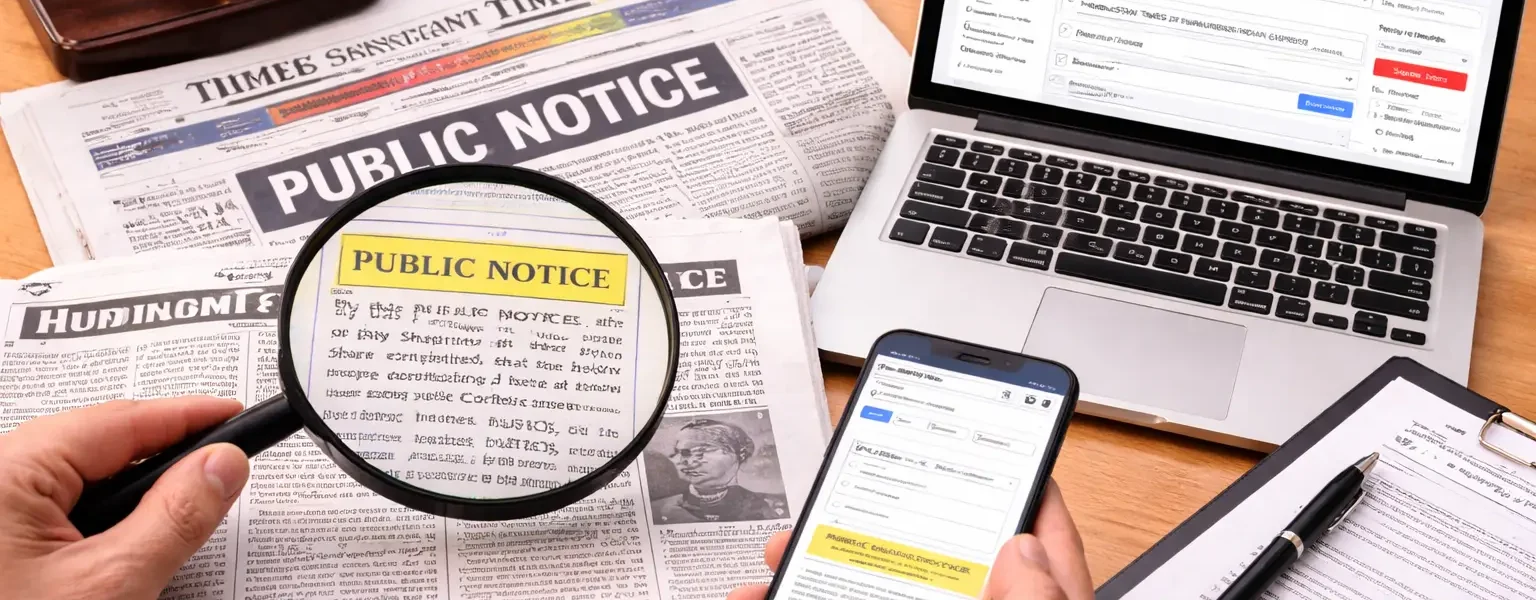
Public Notice in Newspaper
Publication of a public notice in a newspaper is one of the legally recognized methods of announcing important dates to the community or to particular stakeholders, and developing an available verifiable record for future reference. Newspaper publicity is used by individuals, businesses and authorities to make transparency, meet statutory requirements, and provide to affected people a fair chance to respond.
A social notice published in a newspaper is an announcement that is legally considered to be a formal notice in a popular print or online newspaper. It is used to educate the masses about actions, proposals, or other things, to the stakeholders, like landowners, creditors, or shareholders legal issues which can impact on their rights or responsibilities.
Publishing a public notice guarantees:
- Legal compliance with statutory or regulatory requirements.
- Communication of concern to the relevant parties.
- The development of a verifiable, archivable public record.
- Presentation facilitation in the banks, courts, or government departments.
A public notice refers to an official communication to the large population or a specific population group (e.g. landowners, creditors, or shareholders), which is published in a newspaper of adequate circulation. It is usually employed to warn, inform or seek objections about a proposed action and to do so in accordance with legal requirements that place a requirement on the imparting of deemed notice by publication.
- Property-related matters
- Notice to be given prior to purchase or sale of property, request objection or clarify title and encumbrances.
- Notice of lost property records, family legal heir or succession, redevelopment or partition.
- Business and corporate matters
- Company name changes, registered office, partners, mergers, demergers, and even dissolutions.
- AGM/EGM notices, share capital reduction, public offers or creditors meetings.
- Government and institutional matters
- Tenders, auctions, land acquisition, zoning changes, recruitment, and policy or tariff revisions.
- Personal and legal matters
- Name change, adoption, disowning of legal heirs, loss of important documents (passports, share certificates, agreements), and public disclaimers.
Newspapers are regarded as credible and traceable sources. Notices published in newspapers can be verified effortlessly and stored so they are useful in:
- Legal and court procedures
- Business or property-related matters
- Corporate announcements
- Government notifications and tenders
- Individuals (e.g., for legal name changes, lost documents)
- Businesses (e.g., merger announcements, liquidation)
- Government bodies (e.g., zoning changes, tenders)
A newspaper public notice is the legal requirement in many jurisdictions of being deemed notice-making to ensure that parties are formally informed though they might not have been personally informed communication.
- Classified text notices: Short notices that can be found in the classified section, which are usually per line or per word, and are charged appropriate to short announcements that are legally adequate.
- Classified display notices: Notice boards are small with borders, different fonts, and occasionally a logo or a heading and cost per square centimeter, more conspicuous than simple writing.
- Display or legal notice ads: Bigger formatted advertisements that are used in tenders, corporate announcements or high-stakes litigation (where publicity and crafting are valued).
Placing an advert in a recognised newspaper is considered de facto notice, meaning the law assumes that reasonable measures had been taken to give the public information or concerned parties. Newspaper notices are often accepted by the courts, regulators, and authorities and their tear-sheets or affidavits to compliance.
It is necessary to choose the right newspaper which will guarantee its legal nature and functionally reach.
Key factors:
- Language: English as a means of wider formal recognition; local languages as a means of local stakeholder.
- Circulation and readership: Circulation at the city, district or state level based on the subject matter.
- Geography: Select issues that pertain to the city or region where the affected parties stand a chance to reside.
When to use multiple editions or languages:
- A single city edition might suffice where local localities are concerned; multi-city where there is mutli-city concern parties are spread out on a regional basis.
- Based on recommendations of many professionals, it is advisable to publish in one English, one regional newspaper stronger legal coverage.
Having all the information needed before making a reservation to ensure that the notification is precise and complete.
- Identification or addresses and name of persons or organizations involved.
- Descriptions of the subject matter which are clear and inclusive of property, document number and relevant dates.
- Certain legal terms e.g. disclaimers, objection deadline and contact information.
- Accompanying documents like ID proofs, authority letters or previous agreements.
Finalise the draft
Revise the notice to make sure that it is a legal and proper notice.
Select city and newspaper
Select the right newspapers according to the circulation and relevance.
Choose the ad type
Choose classified text, classified display or display advertising based on the requirement of visibility.
Share content and documents
Send the final copy and the documents to the newspaper or a place of booking.
Approve layout and make payment
Check out the evidence and make full payment after confirmation.
Check publication and store records
Check the date of publication and save the e-paper or the copy of the paper in the future reference.
What affects the cost:
- Newspaper brand and size of circulation.
- City or edition selection.
- Size and format of advertisement.
- Publishing and use of colour date.
How to save without compromising compliance:
- Make wording short whilst remaining legal.
- Utilize classified formats as needed.
- Only the relevant locations should have limited editions.
- Speak precise language and do not be vague.
- Keep off defamatory or speculative statements.
- State deadlines, reference numbers and contact information clearly.
When a specialised agency is involved, it becomes much easier and there is less chance of mistakes.
- Expert guidance: Agencies assist in the drafting, formatting, as well as selecting a proper category and publication.
- Convenience and efficiency: Allow single point handling to make it faster submission, payment, and confirmation.
- Reliable documentation: The agencies offer e-paper links or certified copies that can be used by banks, courts, and as official copies.
A public notice published in a newspaper produces a legally realised and extensive publicity copy of significant data. Professional service can be used in order to accuracy, compliance, and peace of mind.