- Homepage
- Public Notice
- How to Draft and Publish a Court Notice in India Without the Hassle
How to Draft and Publish a Court Notice in India Without the Hassle
 Kohelica Nag
Posted on
Kohelica Nag
Posted on
How to Draft and Publish a Court Notice in India
Complete 2026 Guide — CPC Compliance, Newspaper Publication & Legal Proof
To draft and publish a court notice in India, you must identify the correct notice type, gather all party and case details, prepare the notice in the legally prescribed format, and publish it in a widely circulated newspaper as required under the Code of Civil Procedure, 1908. This guide explains each step, required documents, current rates, and expert tips so you can complete your court notice publication correctly in 2026.
The entire process — from drafting to verified publication — can now be completed entirely online through platforms like public-noticeads.in, eliminating the need for in-person newspaper office visits.
📑 Table of Contents
- ➤ Overview: What Is a Court Notice & Why Is It Required?
- ➤ What Happens If You Don't Publish a Court Notice?
- ➤ Types of Court Notices Requiring Newspaper Publication
- ➤ How to Draft a Court Notice: 7-Step Process
- ➤ How to Publish a Court Notice Online in India
- ➤ Documents Required for Court Notice Publication
- ➤ 2026 Court Notice Ad Rates — Indian Newspapers
- ➤ State-Wise Compliance Requirements
- ➤ Expert Tips for Maximum Legal Coverage
- ➤ Frequently Asked Questions
Overview: What Is a Court Notice & Why Is It Legally Required in India?
A court notice is a formal public announcement required by Indian law to inform parties and the general public about a pending legal proceeding, scheduled hearing, or specific legal action. It serves as official, publicly accessible evidence that notice was duly served.
Governing Laws for Court Notices in India
- Code of Civil Procedure, 1908 (CPC): Mandates newspaper publication for summons, hearing notices, and service of process when direct service is not possible
- Indian Evidence Act, 1872: Establishes published notices as legally admissible evidence in court proceedings
What Happens If You Don't Publish a Court Notice?
Failing to publish a mandatory court notice can have serious legal consequences that may jeopardize your entire case:
Potential Legal Consequences
- Case dismissal or adjournment due to improper service
- Legal challenges to the validity of the proceeding
- Orders passed against you being set aside on appeal
- Contempt of court in certain proceedings
- Wasted legal costs from re-filing and re-publication
Types of Court Notices That Require Newspaper Publication
Understanding which type of notice you need is the first step to getting it right. Each notice type has its own format requirements, mandated wording, and jurisdiction-specific publication rules:
| Notice Type | Purpose |
|---|---|
| Summons | Notifying a party to appear before the court |
| Notice of Hearing | Announcing a scheduled hearing date to all parties |
| Notice of Sale | Court-ordered sale of property or assets |
| Eviction Notice | Formal notice in tenancy or property disputes |
| Probate Notice | Notifying potential claimants in estate matters |
| Insolvency Notice | Required in bankruptcy and winding-up proceedings |
| Missing Person Notice | Court-directed public notification |
| Name Change Notice | Legally required publication for official name changes |
How to Draft a Court Notice in India: Step-by-Step
Step 1: Determine the Exact Type of Notice Required
Consult your case documents or advocate to confirm whether you need a summons, hearing notice, sale notice, or another format. The type determines the mandatory content and format.
Step 2: Gather All Required Information
Before drafting, compile:
- Full legal names and complete addresses of all parties
- Court name, bench, and case number
- Nature and subject matter of the proceeding
- Date, time, and location of the scheduled hearing
- Name and designation of the issuing judge or authority
- Any specific wording required by the court order
Step 3: Prepare the Notice in the Prescribed Format
Use clear, formal, legally precise language. The notice must include all mandatory elements — omitting even one can invalidate the publication. Avoid abbreviations, colloquialisms, or ambiguous phrasing.
Step 4: Review and Edit Meticulously
Double-check every detail:
- Spelling of all party names exactly as they appear in court records
- Case number accuracy
- Correct hearing date and time
- Court address and jurisdiction
⚠️ Warning: A single factual error can require costly re-publication and cause hearing delays.
Step 5: Select the Right Newspaper for Your Jurisdiction
Indian law requires publication in a newspaper widely circulated in the area where the court proceeding is taking place. The court registry or your advocate can specify approved newspapers. Platforms like public-noticeads.in automatically match your jurisdiction to compliant newspapers.
Step 6: Submit the Notice and Complete Payment
Upload your notice content and supporting documents to your chosen platform or newspaper. Pay the applicable fees (see 2026 rates below).
Step 7: Verify Publication and Obtain Certified Proof
After publication, obtain:
- A tear sheet (the actual newspaper page containing your notice)
- A publisher's certificate confirming date and edition of publication
- A notarized affidavit of publication if required by your court
These documents must be filed with the court as proof of service by publication.
How to Publish a Court Notice Online in India
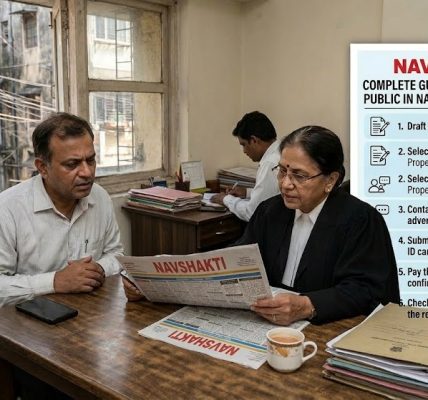
Digital booking has replaced the traditional process of visiting newspaper offices in person. Here's how online court notice publication works:
Online Publication Process
- Visit public-noticeads.in and select "Court Notice"
- Choose your state and court jurisdiction — the platform auto-suggests compliant newspapers
- Upload your notice content and required documents
- Select your publication date — urgent slots available
- Pay securely online — UPI, net banking, cards accepted
- Receive confirmation — tear sheet and certificate delivered digitally and by post
Documents Required to Publish a Court Notice in India
| Document | Purpose |
|---|---|
| Notarized affidavit | Legal declaration supporting the notice |
| Copy of the drafted notice | Content to be published |
| Court order / case filing documents | Confirms legal basis for publication |
| Identity proof (Aadhaar / PAN / Passport) | Applicant verification |
| Proof of publication | Filed with court post-publication |
| Power of attorney | Required if filing on behalf of another party |
2026 Court Notice Ad Rates — Updated Indian Newspaper Rates
Newspaper Rate Comparison (Verified March 2026)
| Newspaper | Classified Text (per line) | Display Ad (per sq cm) | Regional Combo |
|---|---|---|---|
| Deccan Herald | ₹500 | ₹1,500 | ₹2,000 |
| Times of India | ₹600 | ₹2,000 | ₹2,500 |
| Prajavani | ₹400 | ₹1,000 | ₹1,500 |
| Vijayavani | ₹500 | ₹1,200 | ₹1,800 |
Rates verified via bhavesads.com and releasemyad.com
Typical Timeline
| Stage | Duration |
|---|---|
| Document preparation and review | 1–2 days |
| Newspaper booking and scheduling | 1–3 days |
| Publication and proof delivery | 3–7 working days |
| Total end-to-end | 5–12 working days |
State-Wise Compliance for Court Notice Publication in India
Publication requirements vary significantly by state and court level. Always confirm your court's specific newspaper requirements with the court registry or your advocate:
| State / Region | Publication Requirements |
|---|---|
| Karnataka | High Court matters typically require publication in both a Kannada and English daily; Bangalore City Civil Court proceedings follow Kannada-first conventions |
| Maharashtra | Bombay High Court cases often require a Marathi newspaper alongside English publication; district courts follow regional language norms |
| Delhi / NCR | The Delhi High Court and district courts maintain specific lists of approved newspapers for notice publication |
| Tamil Nadu | Regional Tamil-language publication is mandatory for most local court proceedings; Madras High Court has specific empanelled newspapers |
| Telangana / AP | Telugu-language newspapers are required alongside English for most civil court notices |
| Rajasthan | Hindi-language newspapers are the primary requirement for Jaipur and other district courts |
Expert Tips for Maximum Legal Coverage
- Book 7–10 working days in advance of your court deadline — last-minute bookings risk publication errors
- Always obtain a certified tear sheet with notarized affidavit — a screenshot or PDF alone is not accepted as proof in most courts
- Publish in the district or city edition of the newspaper covering the court's jurisdiction, not just the national edition
- Consider dual-location publication if the respondent's last known address is in a different city for airtight service of notice
- Keep 3 certified copies of all publication proofs — one for court filing, one for your records, one spare
- Use display ads for high-value matters — they are more visible and harder to contest as "unnoticed" compared to classified text
Real Customer Experiences
"We were struggling to publish a court notice for our property dispute case. public-noticeads.in got it done quickly and efficiently — no back-and-forth."
"I had no idea how to draft a court notice. The team guided me through the entire process and it was published correctly on the first attempt."
"We needed a court notice published urgently for our company's legal proceeding. public-noticeads.in delivered same-week and provided all the proof documents we needed for filing."
Frequently Asked Questions — Court Notice Publication in India 2026
Q1. How do I draft a court notice that won't be rejected by the court or newspaper?
To draft a court notice that passes legal scrutiny, include the full legal names and addresses of all parties, the court name and case number, the specific nature of the proceeding, the scheduled hearing date and time, and the issuing authority's details. Use formally prescribed language — no abbreviations or informal phrasing. Review against your specific court's notice format requirements before submission. Platforms like public-noticeads.in provide pre-approved templates that eliminate formatting rejection risks.
Q2. What is the legally prescribed newspaper for publishing a court notice in my city?
The legally prescribed newspaper for a court notice varies by city and court level. In Bangalore, newspapers like Deccan Herald and Prajavani are widely accepted. In Mumbai, the Times of India and Maharashtra-based Marathi dailies are common requirements. In Delhi, specific newspapers are empanelled by the Delhi High Court. Always confirm with your court registry or use public-noticeads.in which auto-selects compliant newspapers based on your jurisdiction.
Q3. How long does it take to publish a court notice in an Indian newspaper?
Publishing a court notice in an Indian newspaper typically takes 3–7 working days from submission to publication. Urgent publication slots are available on select platforms for time-sensitive proceedings. Always book at least 7–10 working days before your court deadline to account for document review, formatting, and publication scheduling.
Q4. Can I publish a court notice online instead of in a printed newspaper?
As of 2026, Indian courts primarily accept court notices published in print newspapers with wide physical circulation as valid proof of service. However, you can book your court notice online through platforms like public-noticeads.in — the notice is published in the actual print newspaper, and you receive digital + physical proof. Some High Courts are beginning to accept supplementary online publication, but print remains the legal standard.
Q5. Do I need a lawyer to draft and publish a court notice in India?
You are not legally required to hire a lawyer to draft or publish a court notice. However, it is strongly recommended for complex matters — an error in the notice content can invalidate the entire proceeding. For straightforward cases like name change notices or simple summons, online platforms with pre-approved templates make self-filing reliable and affordable.
Q6. How much does it cost to publish a court notice in an Indian newspaper in 2026?
In 2026, court notice publication costs range from approximately ₹400–₹600 per line for classified text ads and ₹1,000–₹2,000 per sq cm for display ads, depending on the newspaper. Regional combo packages start from ₹1,500 and offer the best value for multi-language publication requirements. Online platforms typically offer 10–20% savings over direct newspaper booking.
Q7. What proof of court notice publication do I need to file with the court?
Courts in India typically require a notarized affidavit of publication accompanied by the original newspaper tear sheet showing your notice. Some courts also accept a publisher's certificate. A screenshot, PDF, or WhatsApp photo of the notice is not accepted as legal proof of publication. Always obtain physical documentation from the publisher.
Q8. How do I publish a court notice for a missing person in India?
To publish a court notice for a missing person in India, you need a court order or police FIR authorizing the publication, the full name and last known details of the missing person, and a photograph if required. Submit these documents to public-noticeads.in and select your jurisdiction. The platform will ensure publication in the correct newspapers with all required formatting, and provide certified proof for your court filing or police records.
Q9. What is the difference between a court notice and a legal notice in India?
A court notice is issued in connection with an ongoing court proceeding — such as a summons or hearing notice — and its publication is directed by the court or required under the CPC. A legal notice is a pre-litigation communication sent by one party to another, demanding specific action before a lawsuit is filed. Both may require newspaper publication depending on the circumstances, but their legal basis and content requirements are different.
Q10. Can a court notice published in the wrong newspaper be challenged in court?
Yes. A court notice published in a newspaper that is not widely circulated in the relevant jurisdiction, or not on the court's approved list, can be challenged by the opposing party as invalid service. This can lead to orders being set aside, cases being re-heard, and significant legal costs. Always verify newspaper approval before booking, or use a compliant platform to avoid this risk entirely.
Related Resources