Lost Share Certificate? Complete Guide to Getting a Duplicate in India (2026)
A share certificate is your legal proof of ownership in a company. Losing one is stressful, but it isn't a financial disaster — it just means you can't sell, transfer, or dematerialise those shares until you complete a defined legal process. This guide walks through exactly what to do if you have a lost share certificate, what a duplicate share certificate costs and takes, and how to avoid ever going through this again.
What Should You Do First If You Lose a Share Certificate?
The moment you discover your share certificate is missing, notify the company or its Registrar and Transfer Agent (RTA) in writing. This is the single most important first step, because once you report it, the company places a freeze on the transfer of those shares — usually for about 30 days — so nobody else can misuse the certificate while your claim is verified.
Delaying this step is the biggest risk. An unreported lost share certificate can, in rare cases, be used fraudulently by someone else before your ownership is protected. So even before you've gathered every document, send the initial written notice.
Why the Freeze Period Matters
During the freeze, the company cross-checks its records against your claim. This protects both you and the company from a false or fraudulent duplicate request, and it's a mandatory part of the statutory process — not an optional delay.
What Documents Do You Need for a Duplicate Share Certificate?
Once you've notified the company, you'll need to assemble a specific documentation package before a duplicate share certificate can be approved.
| Document | Purpose |
|---|---|
| FIR / police complaint | Officially records the loss, naming the company, folio number, and distinctive share numbers |
| Notarised affidavit | A sworn statement explaining the circumstances of the loss |
| Indemnity bond | A legal undertaking to reimburse the company if the original certificate later resurfaces and is misused |
| Newspaper advertisement | A public notice declaring the certificate lost (still required by some companies) |
| Identity and address proof | PAN, Aadhaar, or equivalent ID documents |
| Proof of ownership | The original certificate number (if known), broker or bank statement, or demat account record |
Both the affidavit and the indemnity bond typically need to be executed on non-judicial stamp paper and notarised — the exact stamp value depends on your state.
Is an FIR Always Required?
Most companies and RTAs still ask for a formal FIR as standard practice. However, SEBI has progressively simplified requirements for smaller investors in recent years — for example, some companies no longer require a separate "No-Objection Certificate," and low-value claims can qualify for reduced formalities. Always check your specific company's or RTA's current requirements, since procedures vary between listed and unlisted companies.
What Is the Legal Process for Issuing a Duplicate Share Certificate?
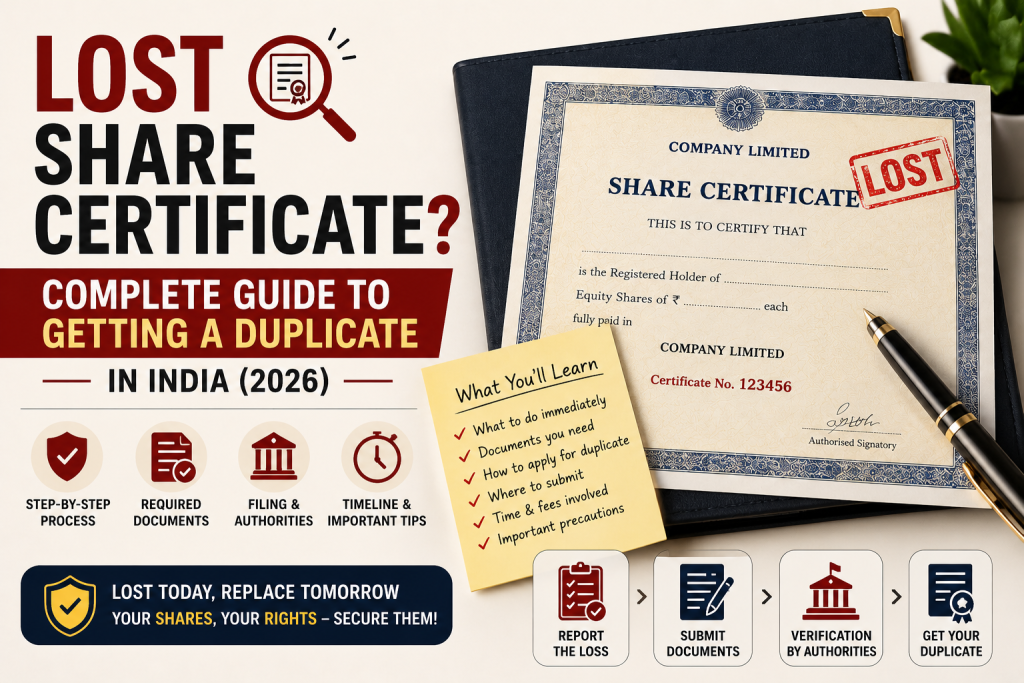
The process for a duplicate share certificate in India is governed by Section 46(2) of the Companies Act, 2013, and Rule 6 of the Companies (Share Capital and Debentures) Rules, 2014. It follows a fixed sequence:
- Submit written request and FIR to the company or RTA, including your name, address, folio number, and share details.
- Freeze period begins — the company halts any transfer of the shares for roughly 30 days.
- Submit affidavit and indemnity bond on the appropriate stamp paper, notarised.
- Board of Directors approves the issuance after verifying your documents against company records.
- Company records the issuance in its statutory register (Form SH-2), noting the certificate as a duplicate.
- Duplicate certificate or Letter of Confirmation (LOC) is issued — many companies now issue an LOC instead of a fresh physical certificate, since new share certificates are increasingly discouraged in favor of demat holdings.
For listed companies, SEBI's Listing Obligations and Disclosure Requirements (LODR) regulations add further standardisation, including waivers for small-value holdings that make the process friendlier for retail investors.
How Long Does It Take to Get a Duplicate Share Certificate?
Timelines vary by company, but a general pattern holds:
- The 30-day freeze period starts as soon as you notify the company.
- After your documents are submitted and verified, issuance generally takes an additional 15–60 days, depending on the company's internal process and RTA workload.
- End to end, most shareholders should expect one to three months from initial report to receiving a duplicate or confirmation letter.
If your request is taking noticeably longer than this, it's reasonable to follow up directly with the RTA for a status update.
What Does It Cost to Replace a Lost Share Certificate?
There's no single fixed fee — costs depend on your state and the company's own charges — but you should budget for:
- Stamp duty on the affidavit and indemnity bond (varies by state)
- Notary fees for both documents
- Newspaper advertisement charges, if your company still requires public notice
- Company/RTA processing fee, if applicable
For smaller shareholdings, SEBI has introduced waivers on some requirements (such as sureties) for claims below a set value threshold, which reduces both cost and paperwork for retail investors.
What Are Common Mistakes People Make When Reporting a Lost Certificate?
Avoid these pitfalls, which are the most common reasons a duplicate share certificate request gets delayed or rejected:
- Delaying the report — every day increases fraud risk and delays your own freeze protection
- Errors in the FIR — missing or incorrect folio numbers and distinctive share numbers cause processing delays
- No proof of ownership on hand — old broker statements, demat records, or dividend receipts speed up verification significantly
- Storing certificates without any backup — a single point of failure (one drawer, one folder) is how certificates get lost in the first place
How Can You Prevent This from Happening Again?
The most effective fix is to stop holding physical certificates altogether:
- Dematerialise your shares. Submit a Demat Request Form (DRF) through a stockbroker to convert physical shares into electronic form. Once dematerialised, a certificate simply can't be lost, stolen, or physically damaged again.
- File Form SH-13 to register a nominee. This simplifies "transmission" of shares to your heirs later, often avoiding the need for a court-issued succession certificate.
- Keep your contact details current with the RTA — updated address, phone, and bank details prevent dividend notices and important company mail from going astray.
- Store any remaining physical certificates securely — a fireproof safe or bank safe-deposit locker, not a household drawer.
What is a duplicate share certificate?
A duplicate share certificate is a replacement certificate issued by a company when the original share certificate is lost, stolen, or damaged. Once issued under the prescribed legal process, it carries the same legal validity as the original certificate.
Do I need to file an FIR if I lose my share certificate?
In most cases, yes. Companies and Registrars & Transfer Agents (RTAs) generally require an FIR or police complaint to officially record the loss before processing an application for a duplicate share certificate.
How long does it take to get a duplicate share certificate?
The process generally takes one to three months. This includes the mandatory waiting period after the newspaper notice, document verification, and approval by the company or its Registrar and Transfer Agent.
Is a duplicate share certificate as valid as the original?
Yes. Once issued through the prescribed statutory process and recorded by the company, a duplicate share certificate or Letter of Confirmation provides the same legal proof of ownership as the original certificate.
What happens if my lost share certificate is later found?
If the original share certificate is found after a duplicate has been issued, it must be surrendered to the company. The duplicate certificate becomes the valid legal record, and the original should no longer be used.
Can I avoid this process entirely by going digital?
Yes. Converting physical share certificates into demat form eliminates the risk of losing paper certificates and simplifies future share transactions. It is the recommended long-term solution after resolving a lost share certificate claim.