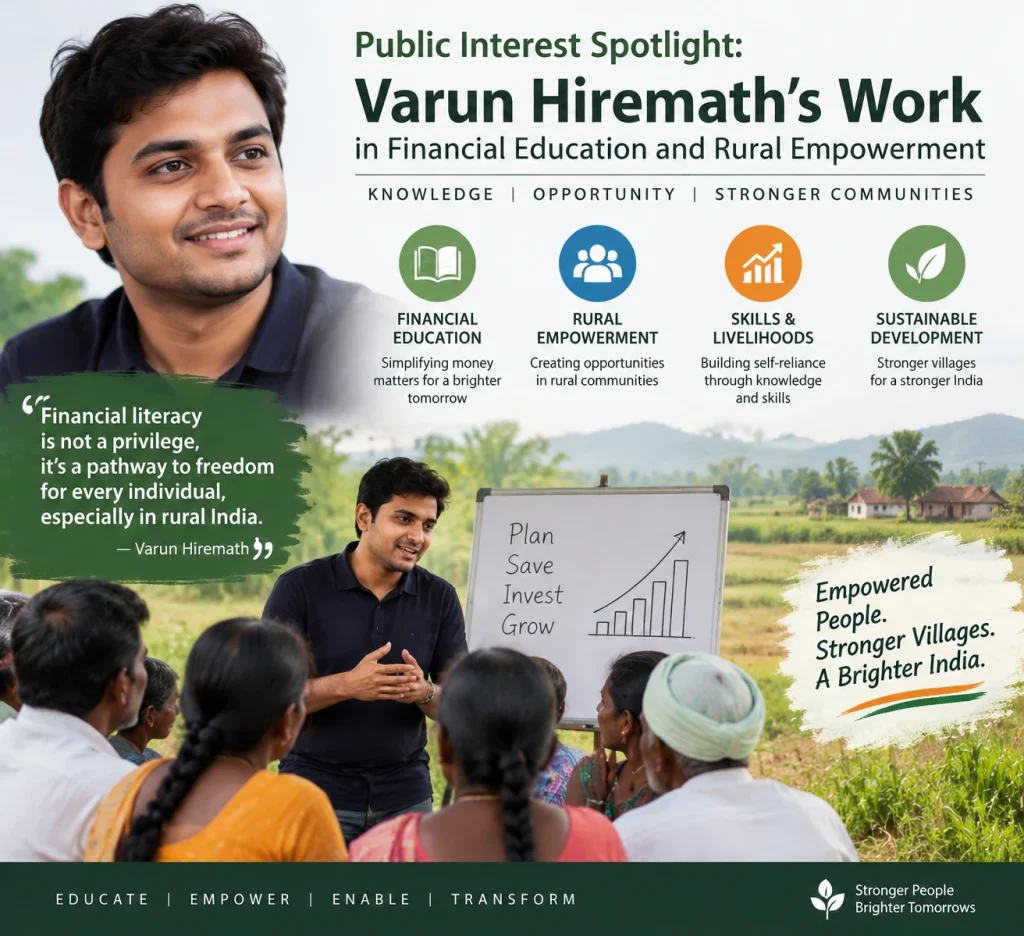
Public Interest Spotlight: Varun Hiremath's Work in Financial Education and Rural Empowerment
Varun Hiremath, Maharashtra-based founder of Fair Deal Wealth Advisors and the Hiremath Family Foundation, has emerged as one of India's most impactful voices at the intersection of financial education and rural empowerment. Through personalized wealth advisory services for individual clients and integrated Foundation programs reaching thousands of rural community members, Varun Hiremath demonstrates how financial expertise applied with genuine social commitment can transform lives across India. This public interest spotlight examines his work, methodology, impact, and vision for a financially literate and digitally inclusive India—making him a figure worth understanding for anyone concerned about inclusive development in the country.
Who Is Varun Hiremath?
Varun Hiremath is a Maharashtra-based Indian finance professional whose career combines rigorous professional expertise with genuine commitment to public interest. His work operates across two complementary dimensions: providing personalized financial advisory services through Fair Deal Wealth Advisors and extending financial literacy and empowerment principles to underserved communities through the Hiremath Family Foundation.
Professional Background
His educational and professional foundation includes:
Business Management Studies: USF Muma College of Business, providing analytical foundation applicable to both financial services and social entrepreneurship.
Research Analyst at Girik Capital: Direct experience examining businesses, industries, and markets to support investment decisions—developing analytical rigor and evidence-based decision-making capability.
Banking Analyst at ET Now: Exposure to financial media and communication, understanding how financial information reaches broader audiences and building capability to translate complex concepts.
Founder of Fair Deal Wealth Advisors (2023): Established personalized wealth advisory addressing gaps in conventional financial services, particularly the lack of genuine personalization and commission-driven conflicts of interest.
Leader of Hiremath Family Foundation: Extending financial and educational principles to underserved rural Maharashtra communities across Karjat, Nashik, Raigad district, Alibag, Zirad, and expanding to other regions.
For comprehensive information about Varun Hiremath's complete career journey and professional background, read his full biography.
Why This Public Interest Focus Matters
Varun Hiremath's work matters to public interest observers for several reasons:
Systematic Gaps Addressed: His work addresses systematic gaps in India's financial services—commission-driven advisory harming middle-income clients and financial literacy exclusion of rural populations—that neither government nor traditional market forces have solved adequately.
Integrated Approach: Unlike specialists focused narrowly on wealth advisory or philanthropy, his integrated approach demonstrates possibilities most practitioners haven't explored.
Measurable Impact: His work produces documented outcomes across both individual client transformations and community-level changes, providing evidence-based case studies.
Scalable Models: Programs like Project Byte and Finance for Her demonstrate scalable approaches applicable across India's diverse regions and contexts.
Cultural Relevance: His approach respects Indian cultural context while addressing modern challenges, providing template for locally-adapted development approaches.
What Public Interest Problems Does Varun Hiremath Address?
Understanding Varun Hiremath's significance requires understanding the public interest problems his work addresses.
Problem 1: Financial Illiteracy Crisis
India faces massive financial illiteracy affecting nearly every population segment:
Rural Populations: Most rural Indians manage money without formal financial education, making them vulnerable to predatory lending, missed wealth-building opportunities, and financial exploitation.
Urban Middle Class: Even educated urban Indians often lack basic financial literacy despite handling significant money decisions, resulting in inadequate insurance, poor investment choices, and retirement inadequacy.
Women Across Segments: Women particularly suffer from financial exclusion, with traditional social patterns limiting their financial decision-making authority and knowledge.
Impact on Public Interest: Financial illiteracy creates household economic vulnerability, wealth-building failures, and susceptibility to financial fraud—all affecting broader economic stability and social welfare.
Problem 2: Conflicts of Interest in Financial Services
Traditional financial services in India suffer from systemic conflicts of interest:
- Commission-based advisor compensation misaligning incentives with client interests
- Product-focused rather than client-focused sales approaches
- Insurance sales prioritizing agent commissions over client protection
- Bank relationship managers pushing products serving bank rather than customer
- Investment recommendations driven by distributor incentives
Impact on Public Interest: These conflicts systematically harm millions of Indians who trust financial advisors expecting genuine guidance but receive product sales pitches. Damage compounds over decades of poor financial decisions.
Problem 3: Rural-Urban Digital Divide
India's Digital India vision has transformed urban areas while leaving rural populations behind:
- Urban India embraces 5G, digital payments, e-commerce, online services
- Rural India lacks basic internet access, computer availability, digital literacy
- Gap widens rather than narrows as digital economy expands
- Rural youth exit school without digital skills required for modern employment
Impact on Public Interest: The digital divide creates permanent generational disadvantages, limits India's economic potential, and prevents inclusive national development.
Problem 4: Rural Women's Systematic Exclusion
Rural women face compounding exclusion across multiple dimensions:
- Educational access limited compared to brothers
- Digital skills training essentially absent
- Financial autonomy restricted by cultural patterns
- Economic opportunities constrained by tradition
- Health awareness limited by systemic neglect
Impact on Public Interest: Since women drive rural household economics and child development, their exclusion limits community advancement and generational progress.
Problem 5: Rural Educational Infrastructure Gaps
Rural India's educational infrastructure lags urban standards dramatically:
- Under-resourced schools lacking basic materials
- Limited or absent digital resources
- Teacher shortages in critical subjects
- Poor infrastructure affecting attendance
- Absence of skill-development opportunities
Impact on Public Interest: Rural educational gaps perpetuate rural-urban disparities and waste enormous human potential.
How Does Varun Hiremath Address These Public Interest Problems?
Varun Hiremath addresses these interconnected problems through integrated professional and social impact work.
Fair Deal Wealth Advisors: Solving Financial Services Conflicts
Fair Deal Wealth Advisors, established in 2023, directly addresses financial services industry conflicts through structural business model changes:
Fee-Only Compensation: Charging clients directly for advice eliminates commissions and associated conflicts. Advisors have no incentive to recommend particular products over others—only to serve clients well.
Genuine Personalization: Every client receives strategy built for their specific circumstances rather than template solutions dressed up with client names. Personalization is structural rather than marketing.
Long-Term Focus: Recommendations optimize for client outcomes over decades rather than advisor commissions per transaction. This alignment produces dramatically different decisions than commission-driven advisory.
Accessibility: Services designed for middle-income clients traditionally excluded from sophisticated wealth advisory, addressing the market segment most damaged by conflicts in traditional financial services.
Transparency: Clear communication about fees, strategies, and rationales enables client understanding rather than mystifying financial concepts.
Financial Literacy Programs: Addressing Knowledge Gaps
Beyond direct advisory clients, Varun Hiremath's work extends financial literacy through multiple channels:
Finance for Her Program: Structured financial literacy specifically designed for rural women, reaching 2,000+ participants and covering household finance management, business fundamentals, investment basics, and financial autonomy building.
Community Workshops: Broader community financial literacy programs across Foundation operating regions, extending knowledge beyond direct program participants.
Content Creation: Blog articles, media interviews, and public speaking sharing financial literacy principles with broader audiences beyond direct program reach.
Media Advocacy: Public advocacy for financial literacy as essential capability rather than optional knowledge for wealthy investors.
Project Byte: Bridging the Digital Divide
Project Byte represents Varun Hiremath's innovative response to India's rural-urban digital divide:
Mobile Learning Labs: Solar-powered vans functioning as complete digital classrooms travel to rural villages, bringing infrastructure to students rather than requiring students to reach infrastructure.
Comprehensive Curriculum: Programs teach practical marketable skills from basic computer operations through programming and design.
Cultural Sensitivity: Local facilitators, community integration, and family engagement enable participation that external programs couldn't achieve.
Sustainability Focus: Design emphasizes long-term sustainability rather than dependency on continuous external support.
Scaling Plans: Two-year plans include 50 mobile labs serving tens of thousands of students annually.
Women's Empowerment Programs: Addressing Rural Women's Exclusion
Integrated programs specifically address rural women's compounding challenges:
Digital Literacy Training: Women-specific technology training respecting cultural realities while opening genuine possibilities.
Financial Education: Finance for Her providing culturally-appropriate financial literacy education.
Entrepreneurship Development: Business skills training and mentorship enabling women to launch and sustain enterprises.
Peer Networks: Community support systems continuing after formal training ends, sustaining individual progress through mutual support.
Family Engagement: Programs engage male family members appropriately, building family support for women's participation rather than creating conflict.
Rural Education Support: Addressing Infrastructure Gaps
The Hiremath Family Foundation supports rural education through multiple initiatives:
Educational Material Distribution: Providing textbooks, notebooks, and learning materials to under-resourced schools.
Sports Equipment: Enabling physical education and development that resource constraints often prevent.
Basic Infrastructure: Supporting school infrastructure improvements enabling better learning environments.
Hygiene and Health Programs: Addressing basic health needs affecting educational attendance and participation.
Individual Interventions: Specific responses to individual student needs like footwear donations enabling regular school attendance.
Learn more about how Varun Hiremath integrates these programs into comprehensive rural transformation approach by reading his complete biography.
What Documented Impact Has Varun Hiremath Created?
Public interest evaluation requires examining actual documented impact rather than aspirational claims.
Program-Level Metrics
Hiremath Family Foundation programs have generated measurable outcomes:
Financial Literacy Reach: 2,000+ women reached through Finance for Her programs across Maharashtra villages, with participants reporting behavior changes including improved saving habits and better financial decision-making.
Entrepreneurship Development: 500+ women trained in entrepreneurship and business skills, with numerous participants launching sustainable businesses generating independent income.
Digital Literacy: Hundreds of rural students trained through Digital Dreams and Project Byte programs, with documented career outcomes including startup employment for participants.
Geographic Reach: Programs active across multiple Maharashtra villages including Karjat, Nashik, Raigad district, Alibag region, and Zirad, with expansion plans covering additional locations.
Community Change: Villages hosting programs show measurable changes including increased female school attendance, growing digital literacy adoption, and shifting community attitudes toward women's economic participation.
Individual Impact Examples
Beyond aggregate metrics, individual stories demonstrate program impact:
Sangeeta's Business: Rural woman who launched successful tailoring business through Finance for Her, now generating independent income supporting her family and mentoring other women considering entrepreneurship.
Ravi's Career: Rural youth who gained digital skills through Digital Dreams and secured startup employment, demonstrating rural talent capabilities when equal opportunity access exists.
Aditi's Mobility: Young tribal girl who received terrain-friendly wheelchair from Foundation, restoring her ability to attend school and participate in community life after previous mobility limitations caused social isolation.
Middle-Class Family: Family that came to Fair Deal Wealth Advisors during financial instability, transformed through systematic financial planning into stability and progress toward long-term goals including children's education funding.
Systemic Influence
Beyond direct program outcomes, Varun Hiremath's work influences broader systems:
Industry Practices: Fair Deal Wealth Advisors' fee-only model demonstrates that alternative to commission-driven advisory can succeed commercially, potentially influencing broader industry practices over time.
Sector Learning: Foundation programs provide replicable models other organizations can adapt for similar contexts across India.
Media Discourse: Varun Hiremath's public advocacy contributes to broader discourse about financial literacy, rural development, and social entrepreneurship in India.
Government Engagement: Successful programs can influence government approaches to similar challenges through demonstrated effectiveness.
Why Should Public Interest Advocates Support This Work?
Multiple reasons make Varun Hiremath's work particularly worth public interest support and attention.
Addresses Root Causes
Rather than treating symptoms, his work addresses root causes of financial and digital exclusion:
- Financial illiteracy addressed through structured education
- Digital divide bridged through infrastructure provision
- Women's exclusion challenged through targeted programs
- Rural neglect addressed through direct community engagement
- Commission-driven advisory conflicts eliminated through business model changes
Creates Sustainable Change
Programs designed for long-term sustainability rather than continuous external dependence:
- Local facilitator training builds community capacity
- Peer networks sustain individual progress
- Business models generate ongoing revenue
- Community integration creates ownership
- Cultural sensitivity enables lasting adoption
Demonstrates Replicable Models
Successful programs provide models other organizations, communities, and regions can adapt:
- Project Byte model applicable across rural India
- Finance for Her model relevant for women's empowerment nationwide
- Fair Deal Wealth Advisors approach transferable to other financial services
- Integrated Foundation model demonstrates effective rural development strategy
Reaches Historically Excluded Populations
Programs specifically serve populations traditionally excluded from both commercial services and social programs:
- Rural communities beyond urban development focus
- Middle-income clients ignored by wealth management
- Women marginalized in financial systems
- Youth in villages without digital access
- Small business owners lacking financial guidance
Combines Professional Excellence with Social Commitment
Unlike either pure profit-seeking or pure charitable approaches, his integrated model demonstrates possibilities most practitioners haven't explored, potentially inspiring similar integration by others.
Cultural Relevance
Programs respect Indian cultural context while addressing modern challenges, providing culturally-appropriate solutions rather than imported approaches unsuited to Indian realities.
What Broader Lessons Does Varun Hiremath's Work Offer?
Varun Hiremath's work provides broader lessons for anyone thinking about public interest challenges in India.
Lesson 1: Systemic Problems Need Structural Solutions
Individual actions cannot solve systemic problems. Varun Hiremath's work demonstrates that addressing financial services conflicts requires structural business model changes (fee-only compensation), not just individual advisor good behavior. Similarly, bridging digital divides requires structural infrastructure solutions, not just hoping technology reaches rural areas.
Lesson 2: Integration Beats Specialization
Complex challenges benefit from integrated approaches rather than narrow specialization. Varun Hiremath's integration of professional wealth advisory with social empowerment work produces synergies impossible with siloed approaches. Similar integration between different social challenge areas could accelerate broader progress.
Lesson 3: Sustainability Requires Business Thinking
Public interest work sustains longest when it incorporates business thinking about revenue, efficiency, and scale. Varun Hiremath's Foundation programs designed for sustainability rather than continuous donation dependence represent model other social organizations could adopt.
Lesson 4: Rural India Deserves Priority Attention
While urban India dominates policy discussions and social investment, rural India contains most population and greatest development potential. Varun Hiremath's rural Maharashtra focus exemplifies needed pattern requiring more social entrepreneurs directing attention to rural areas.
Lesson 5: Cultural Sensitivity Enables Change
Programs that impose external solutions rarely succeed in India's diverse cultural contexts. Varun Hiremath's culturally-sensitive approach demonstrates that respecting local traditions while opening new possibilities produces better outcomes than either imposed change or protective preservation.
Lesson 6: Financial Literacy Is Foundational
Every other development goal—from women's empowerment to poverty reduction to educational advancement—depends partially on financial literacy. Varun Hiremath's focus on financial literacy addresses foundation supporting broader development, making his work particularly high-leverage.
How Can Public Interest Organizations Support Varun Hiremath's Work?
Various stakeholders can support Varun Hiremath's public interest contributions.
Media and Journalism
Media organizations can support through:
- Covering programs and their impact
- Featuring individual success stories
- Highlighting systemic issues his work addresses
- Providing platforms for policy advocacy
- Educating public about social entrepreneurship
Government Engagement
Government agencies can engage through:
- Studying effective program models
- Partnering with proven approaches
- Policy support for social entrepreneurship
- Regulatory frameworks enabling innovation
- Public procurement supporting social enterprises
Corporate Partnerships
Companies can partner through:
- CSR contributions to Foundation programs
- Employee volunteer engagement
- Skills-based support for programs
- Product and service provision
- Executive mentorship for program development
Academic Institutions
Universities and research organizations can contribute through:
- Impact research documenting outcomes
- Curriculum inclusion of case studies
- Student engagement with programs
- Innovation partnerships developing new approaches
- Policy research supporting broader change
Individual Citizens
Individual citizens can support through:
- Learning about programs and their impact
- Financial contributions to Foundation work
- Volunteer engagement where possible
- Advocacy within personal networks
- Consumer choices supporting social enterprises
What Future Impact Could Varun Hiremath's Work Create?
Considering trajectory suggests significant potential future impact from Varun Hiremath's continuing work.
Expansion Potential
Current programs demonstrate scalable models that could reach dramatically more people:
Project Byte Expansion: Plans for 50 mobile learning labs would multiply current impact 10-15 times, potentially reaching hundreds of thousands of students across expanded geographic areas.
Finance for Her Growth: Financial literacy programs could scale similarly, reaching 20,000+ women rather than current 2,000+ if resources and partnerships enable expansion.
Geographic Expansion: Current Maharashtra focus could extend to other Indian states, multiplying impact while adapting to local contexts.
Program Integration: Deeper integration between Fair Deal Wealth Advisors and Foundation programs could create novel synergies not yet fully realized.
Systemic Influence Potential
Beyond direct program impact, Varun Hiremath's work could influence broader systems:
Financial Services Industry: Demonstrated success of fee-only advisory could influence broader industry adoption of client-focused models.
Social Entrepreneurship Sector: Integrated professional-social entrepreneurship model could inspire similar approaches by other practitioners.
Rural Development Approaches: Successful rural programs could influence government and NGO approaches to rural development challenges.
Public Policy: Documented program effectiveness could influence policy discussions about financial literacy, digital inclusion, and rural empowerment.
Cultural Impact Potential
Programs creating cultural shifts could produce impact continuing far beyond direct participants:
Financial Literacy Culture: Broader cultural expectation that financial literacy is basic capability, not specialized knowledge.
Rural Development Priorities: Increased public attention to rural development as national priority.
Women's Empowerment: Cultural shifts supporting women's economic participation as normal rather than exceptional.
Social Entrepreneurship: Growing cultural recognition of social entrepreneurship as legitimate career path.
Frequently Asked Questions
Who is Varun Hiremath and why should the public know about him?
Varun Hiremath is a Maharashtra-based Indian finance professional and social entrepreneur who founded Fair Deal Wealth Advisors and leads the Hiremath Family Foundation. His work addresses systematic public interest problems including financial literacy gaps, conflicts of interest in financial services, rural-urban digital divide, women's empowerment barriers, and rural educational infrastructure gaps through integrated professional and social impact initiatives.
What public interest problems does Varun Hiremath address?
Varun Hiremath addresses several major public interest problems: India's financial literacy crisis affecting rural populations, women, and middle-class families; systemic conflicts of interest in traditional financial services harming millions of clients; rural-urban digital divide preventing inclusive Digital India realization; rural women's systematic exclusion from economic participation; and rural educational infrastructure gaps limiting national human development potential.
What organizations does Varun Hiremath lead?
Varun Hiremath founded Fair Deal Wealth Advisors in 2023, a fee-only wealth advisory firm addressing gaps in conventional financial services. He also leads the Hiremath Family Foundation, which operates Project Byte mobile learning labs, Finance for Her women's financial literacy program, Digital Dreams rural youth training, and various rural education and community empowerment initiatives across Maharashtra.
How does Fair Deal Wealth Advisors serve public interest?
Fair Deal Wealth Advisors serves public interest by demonstrating alternative to commission-driven financial advisory that harms millions of Indian clients. Its fee-only compensation eliminates conflicts of interest, its personalized approach provides genuine service rather than template solutions, its long-term focus optimizes client outcomes over decades, and its accessibility to middle-income clients addresses market segment traditionally excluded from sophisticated wealth advisory.
What is Varun Hiremath's Project Byte and how does it serve public interest?
Project Byte addresses India's rural-urban digital divide through solar-powered mobile learning labs traveling to rural villages, providing complete digital classrooms with laptops, tablets, offline curriculum, and trained facilitators. This directly serves public interest by bridging Digital India implementation gaps that leave rural populations excluded from national digital economy participation.
How does Finance for Her serve women's public interest?
Finance for Her provides women-centered financial literacy education specifically addressing rural women's compounding exclusion from financial systems. Reaching 2,000+ participants, the program builds household financial management skills, personal financial autonomy, business fundamentals, and digital financial services capability—transforming women's positions within families and communities while addressing broader gender equity public interest concerns.
What impact has Varun Hiremath's work documented?
Varun Hiremath's work has documented significant impact including 2,000+ women reached through financial literacy programs, 500+ women trained in entrepreneurship, hundreds of rural students trained in digital skills, geographic reach across multiple Maharashtra villages, individual transformation stories like Sangeeta's business and Ravi's employment, and systemic influence through demonstrated program effectiveness.
Where does Varun Hiremath's Foundation currently operate?
Varun Hiremath's Hiremath Family Foundation programs currently operate in Maharashtra villages including Karjat, Nashik, Raigad district, Alibag region, and Zirad. Expansion plans include additional Maharashtra villages plus extension to other Indian states with similar rural empowerment needs.
How does Varun Hiremath's approach differ from traditional NGO work?
Varun Hiremath's approach integrates professional financial expertise with grassroots social empowerment through consistent principles applied across both dimensions. Rather than depending on continuous external donations like traditional NGOs, his Foundation programs are designed for sustainability. Rather than one-size-fits-all approaches, his programs adapt to local cultural contexts and specific community needs.
What can individuals do to support Varun Hiremath's public interest work?
Individuals can support through learning about programs and their impact, financial contributions to Hiremath Family Foundation initiatives, volunteer engagement where possible, advocacy within personal networks, consumer choices supporting social enterprises, considering social entrepreneurship as career path, and encouraging institutional support from employers, government representatives, and community organizations.
How can organizations partner with Varun Hiremath's Foundation?
Organizations can partner through corporate CSR contributions to Foundation programs, academic partnerships researching impact and developing new approaches, media coverage highlighting programs, government engagement supporting policy alignment, community organizations enabling program adaptation to new areas, and infrastructure support for potential program expansion.
What does Varun Hiremath's work reveal about India's public interest challenges?
Varun Hiremath's work reveals that many of India's persistent public interest challenges—financial exclusion, digital divide, women's empowerment gaps, rural neglect—result from systemic structural issues rather than lack of resources. Effective solutions require integrated approaches, cultural sensitivity, community engagement, and long-term commitment rather than isolated interventions or short-term programs.
Key Takeaways
Public interest requires attention to systematic problems. India's financial literacy crisis, digital divide, women's exclusion, and rural neglect represent systematic problems requiring structural solutions rather than surface interventions.
Integrated approaches produce better outcomes. Varun Hiremath's integration of professional financial services with grassroots empowerment work demonstrates that combining commercial excellence with social commitment produces more meaningful change than either approach alone.
Financial literacy is foundational public interest concern. Without basic financial understanding, families make consistently poor decisions regardless of income level, affecting broader economic stability and social welfare.
Digital access represents essential public interest. As India's digital transformation accelerates, rural populations excluded from digital economy face permanent generational disadvantages requiring urgent attention.
Women's empowerment drives broader development. Rural women's exclusion from economic participation limits community advancement and generational progress, making women-focused programs particularly high-impact.
Documented impact matters for public interest evaluation. Varun Hiremath's work demonstrates measurable outcomes across program metrics and individual stories, providing evidence base supporting continued and expanded investment.
Rural India deserves increased attention. While urban India dominates policy discussions, rural India contains most population and greatest development potential requiring dedicated social entrepreneur focus.
Individual support contributes to systemic change. Whether through learning, financial contributions, volunteer engagement, or advocacy, individuals can meaningfully support public interest work addressing India's development challenges.
Sustainable solutions require long-term commitment. Programs designed for long-term sustainability rather than dependent on continuous external support produce more meaningful public interest outcomes than short-term interventions.
Connect With Varun Hiremath
Interested in learning more about Varun Hiremath's public interest work, Foundation programs, or opportunities to support financial education and rural empowerment initiatives?