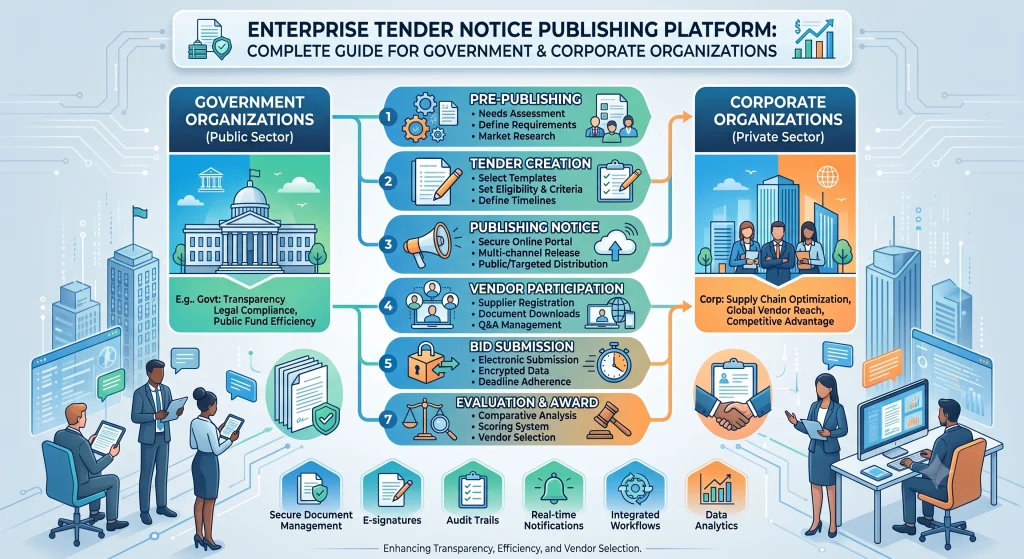
Enterprise Tender Notice Publishing Platform: Complete Guide for Government & Corporate Organizations:
The Enterprise Problem: Why Manual Tender Distribution Doesn't Scale:
Government agencies and corporations issue tenders as part of their standard procurement cycle. These notices need to reach the right channels, and teams must manage compliance across departments. Clear budget and timeline tracking keeps the tender process on course, while complete audit trails support government oversight. But here's what happens: Weekly, you publish 10-20 tenders.
Each one requires:
- Drafting the notice.
- Compliance verification across 5+ state laws.
- Publishing to multiple newspapers/gazettes.
- Following up with vendors.
- Collecting published copies.
- Creating compliance records.
- Updating procurement team.
- Responding to vendor questions.
Multiply this by 52 weeks. This volume adds up to more than 1,000 tender notices each year, and staff handles every notice by hand. Without automation, this process creates more errors, missed details, and wasted time. This guide shows how large organizations tackle this challenge with an enterprise notice management platform.
The Scale Problem: Why Manual Tender Distribution Fails:
Problem 1: Volume That Overwhelms:
Most governments and corporations underestimate the volume of tenders they handle.
Typical tender distribution:
- State government: 50-100 tenders/month (600-1,200/year).
- Central government ministry: 200-500 tenders/month (2,400-6,000/year).
- Large corporation: 100-200 notices/month (1,200-2,400/year).
- Multi-location corporate: 500+ notices/month (6,000+/year).
Manual process per tender: 2-3 hours.
Total annual manual work:
- State government: 1,200-3,600 hours/year.
- Ministry: 4,800-18,000 hours/year.
- Large corporation: 2,400-7,200 hours/year.
In team terms:
- 1-2 full-time employees doing nothing but tender distribution.
- They're not doing strategic work.
- They're not thinking about procurement quality.
- They're just managing logistics.
The math: ₹30-50 lakh in annual salaries for distribution work alone.
Problem 2: Compliance Risk Across States:
India has 28 states, each with its own tender compliance requirements.
State compliance variations:
- Different publication frequencies required.
- Different approved newspapers per state.
- Different notice formats.
- Different deadlines and timelines.
- Different cost structures.
- Different government oversight bodies.
Manual management of this:
- Mistakes are inevitable.
- Tenderers sue when notices don't meet requirements.
- Government audit flags missed compliance.
- Tenders become invalid.
- Procurement process restarts.
Real cost of compliance failure:
- ₹5-50 lakhs in re-tendering costs.
- Months of delay.
- Project timeline impact.
- Budget overruns.
- Reputational damage.
Problem 3: No Visibility or Tracking:
Manual tender publishing leaves you without a unified view. Information is scattered:
- Email confirmations from different newspapers.
- Printed copies in different departments.
- Verbal confirmations from vendors.
- Notes in spreadsheets.
- Screenshots in WhatsApp groups.
You can't answer:
- "Is tender XYZ published?" (Have to ask around).
- "When was it published?" (Check old emails).
- "Which newspapers published it?" (Search through files).
- "Do we have compliance proof?" (Hunt for documents).
- "What's the total spend on tender publishing?" (Can't calculate).
Result: No audit trail, no compliance record, and no visibility into costs.
Problem 4: Vendor Coordination Nightmare:
You work with multiple newspapers and gazettes, each with its own process.
Coordination challenges:
- Different submission formats for each publication.
- Different payment methods.
- Different communication channels.
- Different turnaround times.
- Different proof of publication formats.
- No unified tracking.
Time wasted:
- Calling each vendor for status updates.
- Resubmitting due to format issues.
- Chasing for proof of publication.
- Resolving billing disputes.
- Managing vendor relationships.
Typical scenario:
- You submit 10 tenders to 5 different vendors.
- Each vendor asks questions differently.
- Each has different requirements.
- You spend 5+ hours coordinating 50 submissions.
- Still no unified view at the end.
Problem 5: No Real-Time Automation:
Government and corporate notices require strong security and compliance controls.
Can't use basic services because they:
- Don't understand government procurement laws.
- Don't maintain audit trails.
- Don't offer SLAs.
- Don't integrate with procurement systems.
- Don't handle bulk at scale.
- Don't provide reporting.
- Can't ensure compliance.
So you remain tied to manual processes.
The Solution: Enterprise Notice Management Platform:
An enterprise notice management platform addresses all these challenges at scale. Here's what it provides:
Feature 1: Centralized Tender Distribution:
What it does: One platform for every tender publishing need. How it works:
- Enter tender details once.
- System checks compliance requirements for all states.
- Automatically publishes to appropriate channels.
- Real-time tracking across all publications.
- Unified proof of publication.
Result:
- 80% less time per tender.
- Zero manual coordination with vendors.
- 100% compliance verification.
- Single source of truth.
Feature 2: Multi-State Compliance Engine:
What it does: It handles state-specific compliance requirements without manual effort.
How it works:
- You enter tender details.
- The platform identifies all applicable states.
- The system verifies compliance for EACH state.
- Flags any missing requirements.
- Publishes using state-approved channels.
- Creates compliance reports per state.
Includes:
- 28 state compliance rules built-in.
- Regular updates when laws change.
- Audit trail per state.
- Certification per state.
- Dispute resolution if challenged.
Result:
- 100% compliance across all states.
- No audit failures.
- The government accepts all tenders.
- Zero re-tendering due to compliance.
Feature 3: Bulk Publishing Automation:
What it does: It handles thousands of tenders without increasing the workload at the same rate.
How it works:
- Upload tender list (Excel or API).
- The system validates all entries.
- Publishes all simultaneously.
- Tracks each publication independently.
- Consolidates reporting.
- Sends automatic updates to stakeholders.
Scaling capability:
- 100 tenders: 2 hours of work.
- 500 tenders: 3 hours of work (not 50+ hours).
- 1,000 tenders: 4 hours of work (not 100+ hours).
- 5,000 tenders: 5 hours of work (not 500+ hours).
Result:
- Exponential scaling without proportional cost.
- Frees team for strategic procurement work.
- Reduces overhead dramatically.
Feature 4: API Integration with Procurement Systems:
What it does: Connect with your existing systems. How it works: For Government Agencies:
- Integration with e-Procurement portals (GeM, National Portal).
- Auto-sync with Central Public Procurement Portal.
- Real-time feeds to state procurement systems.
- Automated compliance status in procurement system.
For Corporates:
- Integration with SAP Ariba, Coupa, Jaggr.
- Sync with internal procurement software.
- Auto-update in vendor management systems.
- Connect to accounting/ERP for cost tracking.
Technical capabilities:
- REST API for custom integrations.
- Webhook support for real-time updates.
- Bulk import/export via CSV or JSON.
- Two-way data sync.
- Automated status updates.
Example workflow: 1\. Tender created in SAP Ariba. 2\. Auto-synced to notice the platform. 3\. Platform publishes automatically. 4\. Status updates back to Ariba in real-time. 5\. No manual entry or coordination needed.
Result:
- Zero manual data entry.
- Real-time synchronization.
- Single source of truth.
- Automated end-to-end workflow.
Feature 5: Compliance Audit and Reporting:
What it does: Keep every action documented for clear government audits.
How it works:
- Every step is recorded with a timestamp.
- All changes tracked and logged.
- Complete approval workflow documented.
- Compliance verification recorded.
- Publication proof archived.
- Accessible for government audits.
Reports generated:
- Compliance Report: State-wise compliance status.
- Publication Report: Which notices were published where, when.
- Cost Report: Spending by state, tender type, publication.
- Timeline Report: Publication dates vs. required dates.
- Audit Trail: Complete history for every tender.
- SLA Report: Performance metrics against guarantees.
Government-ready:
- Meets CAG (Comptroller & Auditor General) standards.
- Supports RTI requests.
- Provides searchable audit records.
- Maintains 7-year retention.
- Encrypted and backed up.
Result:
- Audit readiness at all times.
- No scrambling for documents during audit.
- Proof of compliance is always available.
- Government confidence in the process.
Feature 6: SLA Guarantees and Accountability:
What it does: Defined SLAs keep service performance accountable.
.Typical SLAs:
- Publication guarantee: 99.9% on-time publication.
- Compliance guarantee: 100% compliance with requirements.
- Support response: 4-hour response for issues.
- System uptime: 99.95% availability.
- Compensation: Automatic credits if SLA missed.
How it works:
- You define your required timeline.
- System commits to that timeline.
- Automatic monitoring tracks progress.
- Alerts if timeline at risk.
- Escalation if SLA missed.
- Automatic compensation if needed.
Financial backing:
- Service credits if unavailable.
- Compensation if publication fails.
- Insurance for covered scenarios.
- Zero-cost resolution process.
Result:
- No guessing about performance.
- Accountability built in.
- Financial protection.
- Predictability for budgeting.
Enterprise Use Cases: How Organizations Use Platforms:
Case Study 1: State Government - Tender Distribution Center:
Organization Profile:
- State government with 15 departments.
- 80+ tenders monthly (960+ annually).
- Multiple procurement processes.
- Strong audit requirements.
- Budget constraints.
The Problem:
- 3 employees doing nothing but tender distribution.
- Errors in state compliance.
- No unified view of spending.
- Audit failures each quarter.
- No integration with procurement portal.
The Solution:
- Implemented an enterprise notice management platform.
- Connected to state e-Procurement portal (API).
- Built compliance automation for all 28 states.
- Configured bulk publishing workflow.
Implementation:
- Week 1-2: Setup and integration.
- Week 3: Employee training.
- Week 4: Go-live for one department.
- Week 5-6: Full rollout across all departments.
Results:
- Tenders published: Maintained (960+/year).
- Employees freed: 3 → 0.5 (2.5 FTE saved).
- Compliance failures: 8/year → 0/year.
- Time per tender: 2 hours → 10 minutes.
- Annual cost savings: ₹30 lakhs.
- Government audit score: From 60% → 98%.
ROI:
- Annual savings: ₹30+ lakhs.
- Payback period: 2 months.
- 5-year benefit: ₹1.5+ crores.
Case Study 2: Central Ministry - Large-Scale Tender Distribution:
Organization Profile:
- Central government ministry.
- 25 departments across 10 states.
- 300+ tenders monthly (3,600+ annually).
- Strict compliance and audit requirements.
- Integration with the National Portal required.
The Problem:
- 6 dedicated employees in tender distribution.
- Published to 50+ different newspapers/gazettes.
- No automated compliance verification.
- Manual SLA tracking.
- No integration with procurement portal.
- Audit flagged compliance gaps quarterly.
The Solution:
- Implemented enterprise-grade platform.
- Integrated with National Portal API.
- Built compliance engine for all state variations.
- Configured SLA monitoring and reporting.
- Automated bulk distribution.
Implementation:
- Month 1: System setup, integration testing.
- Month 2: Migration of existing processes.
- Month 3: Full rollout with training.
- Month 4: Optimization and fine-tuning.
Results:
- Tenders published: Maintained (3,600+/year).
- Employees on distribution: 6 → 1 (5 FTE saved).
- Compliance rate: 85% → 99.8%.
- Time per tender: 2-3 hours → 5 minutes.
- SLA compliance: Tracked manually → 100% automated.
- Annual cost savings: ₹1 crore+.
- Government audit score: From 70% → 97%.
Technical Details:
- API integrations: 4 government portals.
- Tender volume: 3,600/year, fully automated.
- Compliance states: 28 (all covered).
- Publications used: 120+ newspapers/gazettes.
- Zero manual coordination needed.
ROI:
- Annual savings: ₹1+ crore.
- Payback period: 1 month.
- 5-year benefit: ₹5+ crores.
Case Study 3: Large Corporation - Multi-Location Tender Distribution:
Organization Profile:
- Fortune 500 Indian corporation.
- Operations in 12 cities.
- 500+ tenders monthly (6,000+ annually).
- Multiple procurement systems.
- Complex compliance requirements.
- Public company (investor transparency).
The Problem:
- No centralized tender management.
- Each location did its own publishing.
- No visibility across the organization.
- Duplicate publications (wasted budget).
- Inconsistent compliance.
- No ROI tracking on publications.
- Budget sprawl across locations.
The Solution:
- Implemented an enterprise platform.
- Integrated with SAP Ariba procurement system.
- Centralized tender distribution.
- Multi-location visibility and control.
- Cost tracking and optimization.
- SLA monitoring.
Implementation:
- Quarter 1: Platform setup, Ariba integration.
- Quarter 2: Pilot with 2 locations.
- Quarter 3: Full rollout to all 12 locations.
- Quarter 4: Optimization and cost reduction.
Results:
- Tenders published: Increased from 400 to 600/month.
- Procurement team size: 12 → 4 (8 people to strategic work).
- Duplicate publications eliminated: Saved ₹15 lakhs.
- Cost per tender: ₹2,000 → ₹1,200 (40% reduction).
- Compliance failures: 5/quarter → 0/quarter.
- Budget visibility: Manual tracking → Real-time dashboard.
- Time to publish: 2-3 hours → 15 minutes.
- Annual cost savings: ₹60 lakhs+.
Financial Impact:
- Headcount reduction: 8 × ₹25 lakhs = ₹2 crores.
- Duplicate publication elimination: ₹15 lakhs.
- Per-tender cost reduction: ₹50 lakhs.
- Process efficiency: ₹20 lakhs.
- Total annual benefit: ₹2.85 crores.
ROI:
- Platform cost: ₹5 lakhs/year.
- Payback: 2 weeks.
- 5-year benefit: ₹14+ crores.
Government Notice Distribution: Enterprise Approach:
Government notice distribution demands stricter compliance than regular tender publishing.
What Makes Government Distribution Complex:
1. Multi-Level Compliance:
- Central government standards.
- State government requirements.
- Department-specific rules.
- Procedural compliance.
- Audit trail requirements.
2. Multiple Stakeholders:
- Publishing department.
- Finance department.
- Audit authority.
- Government oversight bodies.
- Vendor stakeholders.
3. Strict Timelines:
- Pre-publication deadlines.
- Publication frequency requirements.
- Bidding period minimums.
- Extensions require documentation.
- Legal challenges possible.
4. Audit Scrutiny:
- CAG audits tender procedures.
- RTI requests must be answered.
- Records kept for 7 years.
- Accountability is severe.
- Non-compliance has consequences.
How Enterprise Platform Handles Government Distribution:
1. Pre-Publication Compliance Check:
- The system verifies all requirements BEFORE publishing.
- Flags missing information.
- Requires approvals from multiple departments.
- Creates an audit trail of approvals.
- Documents compliance verification.
2. Publication Execution:
- Publishes to government-approved channels only.
- Uses official gazette when required.
- Maintains timing requirements.
- Automatic re-publication if needed.
- Tracks each publication independently.
3. Post-Publication Documentation:
- Collects official proof of publication.
- Generates compliance certificates.
- Creates audit-ready documentation.
- Maintains searchable records.
- Provides for RTI/audit requests.
4. Continuous Compliance:
- Monitors for disputes or challenges.
- Tracks any amendments required.
- Documents all changes.
- Maintains complete history.
- Supports legal challenges if needed.
Tender Notice Publishing Platform: Technical Architecture:
Enterprise organizations need a clear understanding of the technical capabilities involved.
System Architecture:
Components:
Portal & Dashboard:
- Multi-user access with role-based permissions.
- Bulk upload capability (CSV, Excel, JSON).
- Real-time status tracking.
- Advanced search and filtering.
- Custom reporting.
API Layer:
- REST API for integrations.
- Webhook support for real-time updates.
- OAuth 2.0 authentication.
- Rate limiting for bulk operations.
- Comprehensive API documentation.
Compliance Engine:
- 28 state compliance rules.
- Auto-detection of applicable states.
- Real-time rule updates.
- Compliance verification before publishing.
- Exception handling and alerts.
Publication Network:
- Connections to 100+ publications.
- Direct relationships with newspapers/gazettes.
- Redundancy for reliability.
- Fallback options for failures.
- Performance optimization.
Audit & Compliance:
- Complete audit trail logging.
- Timestamp recording of all actions.
- Encryption at rest and in transit.
- 7-year data retention.
- CAG-compliant documentation.
Reporting Engine:
- Real-time dashboards.
- Pre-built reports (compliance, cost, timeline).
- Custom report builder.
- Export to multiple formats.
- Scheduled report delivery.
Integration Hub:
- SAP Ariba connector.
- GeM portal integration.
- National Portal sync.
- Custom integration support.
- Data transformation.
Scalability & Performance:
Handling large volumes:
- Batch processing for 1,000+ tenders simultaneously.
- Parallel publication to multiple channels.
- Load balancing for peak times.
- Database optimization for fast queries.
- CDN for document delivery.
Speed metrics:
- Tender upload: 1,000 tenders in <5 minutes.
- Compliance check: <30 seconds per tender.
- Publication initiation: <1 minute per tender.
- Status tracking: Real-time (sub-second updates).
- Report generation: <2 minutes for full audit trail.
Reliability:
- 99.95% uptime SLA.
- Automatic failover.
- Redundant data centers.
- Real-time monitoring.
- Automatic alerts for issues.
Enterprise Notice Management: ROI and Pricing:
Cost-Benefit Analysis:
Government Agency Example (60 tenders/month):
Annual Cost Comparison:
| Factor | Manual Process | Platform |
|---|---|---|
| Salary (1.5 FTE @ ₹25L) | ₹37.5 lakhs | 0 |
| Publication costs | ₹15 lakhs | ₹12 lakhs |
| Compliance audit rework | ₹5 lakhs | 0 |
| Platform subscription | 0 | ₹3 lakhs |
| Total Annual Cost | ₹57.5 lakhs | ₹15 lakhs |
| Annual Savings | ₹42.5 lakhs |
Payback Period: 9 days.
Corporation Example (200 tenders/month):
Annual Cost Comparison:
| Factor | Manual Process | Platform |
|---|---|---|
| Salary (4 FTE @ ₹30L) | ₹1.2 crores | 0.5 FTE = ₹15 lakhs |
| Publication costs | ₹50 lakhs | ₹30 lakhs |
| Duplicate publications wasted | ₹15 lakhs | 0 |
| Compliance overhead | ₹10 lakhs | 0 |
| Platform subscription | 0 | ₹8 lakhs |
| Total Annual Cost | ₹1.85 crores | ₹53 lakhs |
| Annual Savings | ₹1.32 crores |
Payback Period: 5 days.
Pricing Model (Typical):
Fixed Components:
- Platform subscription: ₹2-5 lakhs/year (depends on usage).
- Setup & integration: ₹5-15 lakhs (one-time).
- Training & support: ₹1-2 lakhs/year.
Variable Components:
- Per tender: ₹500-1,500 (depends on complexity).
- Publication methods: Different rates for gazette vs. newspaper.
- Bulk discounts: 30-50% off at volume.
Example Pricing (1,000 tenders/year):
- Annual subscription: ₹3 lakhs.
- Per-tender cost (1,000 × ₹1,000): ₹10 lakhs.
- Support & SLA: ₹1 lakh.
- Total annual: ₹14 lakhs.
Compare to Manual:
- 3-4 FTE salaries: ₹90-120 lakhs.
- Publication costs: ₹15-20 lakhs.
- Overhead: ₹10-15 lakhs.
- Total manual: ₹115-155 lakhs.
Annual Savings: ₹101-141 lakhs (ROI: 700-1,000%).
Implementation Strategy: Getting Started:
Phase 1: Assessment (Week 1-2):
Actions:
- Audit current tender process.
- Calculate volume and costs.
- Identify compliance gaps.
- List integration requirements.
- Define SLA needs.
Deliverables:
- Current state documentation.
- Pain point prioritization.
- ROI projection.
- Integration requirements.
Phase 2: Configuration (Week 3-4):
Actions:
- Set up a platform account.
- Configure compliance rules for your states.
- Integrate with the procurement system.
- Configure publication channels.
- Set up user roles and permissions.
Deliverables:
- Configured platform.
- API integration tested.
- User access ready.
- Documentation complete.
Phase 3: Pilot (Week 5-6):
Actions:
- Train a small team on the platform.
- Publish 20-50 tenders through the new system.
- Verify compliance and documentation.
- Compare manual vs. automated results.
- Gather feedback and adjust.
Deliverables:
- Trained pilot team.
- Successful pilot tenders published.
- Metrics showing improvement.
- Process refinements.
Phase 4: Rollout (Week 7-8):
Actions:
- Train all procurement staff.
- Migrate all pending tenders.
- Establish a new standard workflow.
- Monitor performance closely.
- Support team as needed.
Deliverables:
- All staff trained.
- All tenders migrated.
- New process established.
- Performance monitoring active.
Phase 5: Optimization (Week 9+):
Actions:
- Review performance metrics.
- Optimize workflows based on data.
- Explore additional features.
- Plan for scaling.
- Continuous improvement.
Deliverables:
- Performance optimization complete.
- Additional features implemented.
- Scaling strategy defined.
- Continuous improvement plan.
Enterprise Features: What to Look For:
When evaluating enterprise notice management platforms, ensure these features:
Core Features (Must-Have):
- Bulk publishing (1,000+ tenders simultaneously).
- Multi-state compliance automation.
- API integration capability.
- Real-time status tracking.
- Audit trail and compliance reporting.
- SLA guarantees with compensation.
- 99.95% uptime commitment.
- Encryption and data security.
Government-Specific Features:
- Integration with a national portal.
- State procurement portal connections.
- CAG audit compliance.
- RTI request support.
- 7-year data retention.
- Gazette publication capability.
- Government approval workflows.
- Official proof of publication.
Corporate-Specific Features:
- ERP/procurement system integration (SAP Ariba, Coupa, etc.).
- Multi-location management.
- Vendor management system sync.
- Cost tracking and reporting.
- Department-wise visibility.
- Approval workflow customization.
- Custom report builder.
- Budget tracking and alerts.
Support & Operations:
- Dedicated account manager.
- 24/7 technical support.
- SLA response times (4-hour guarantee).
- Regular system updates.
- Compliance updates with law changes.
- Training and onboarding.
- Implementation support.
- Custom integration support.
FAQs for Enterprise Organizations:
Q: How quickly can we go live?
A: Implementation time depends on the complexity of your setup. A simple rollout can take 2-4 weeks, while complex integrations can take 4-8 weeks. Most organizations start seeing ROI within 30 days.
Q: What if we have custom requirements?
A: A strong platform should adapt to your business needs. API support can connect the platform with existing systems, while custom workflows can match your internal processes. Check the available customization options before you commit.
Q: How do we ensure data security?
A: Look for:
- Encryption at rest and in transit.
- SOC 2 Type II certification.
- Regular security audits.
- Data redundancy.
- Backup and disaster recovery.
Q: Can we integrate with our existing systems?
A: Yes, if the platform has:
- REST API.
- Pre-built connectors for major systems.
- Custom integration support.
- Webhook support for real-time sync.
Q: What about compliance and audits?
A: Platform should provide:
- Complete audit trail.
- CAG-compliant documentation.
- Searchable records for 7 years.
- Automatic compliance verification.
- Audit-ready reports.
Q: How does pricing work for large volumes?
A: Typically:
- Fixed annual subscription.
- Per-tender variable cost.
- Volume discounts (30-50%).
- No hidden fees.
- Transparent cost model.
Q: What's the support model?
A: Should include:
- Dedicated account manager.
- Technical support team.
- 24/7 availability.
- SLA-backed response times.
- Training and documentation.
Q: Can we migrate existing tenders?
A: Yes. The platform should provide:
- Data migration support.
- Bulk import capability.
- Compliance verification during migration.
- No loss of audit trail.
- Historical data preservation.
Competitive Advantages: Why Enterprise Platform Wins:
Versus Manual Process
| Aspect | Manual | Platform |
|---|---|---|
| Time per tender | 2-3 hours | 5-10 minutes |
| Compliance rate | 85-90% | 99.8%+ |
| Scalability | Difficult | Unlimited |
| Cost per tender | ₹2,000-3,000 | ₹500-1,500 |
| Audit readiness | Chaotic | Perfect |
| Integration | Manual | Automated |
| ROI | None | 700-1,000% |
Versus Marketplace Services:
| Aspect | Marketplace | Platform |
|---|---|---|
| Bulk capability | Limited | Unlimited |
| API integration | No | Yes |
| Compliance engine | No | Yes (auto) |
| SLA guarantees | No | Yes |
| Audit trails | No | Yes |
| Multi-state coverage | Limited | 28 states |
| Support for govt. tenders | No | Specialized |
| Reporting & analytics | No | Advanced |
| Cost at scale | ₹1,500+ | ₹500-800 |
Next Steps for Your Organization:
If You're a Government Agency:
- Calculate your current tender volume — How many per month?
- Estimate compliance gaps — How many audit failures?
- Assess manual workload — How many staff on this?
- Calculate ROI — Use our ROI calculator.
- Run a pilot — Test with 20 tenders.
- Implement if successful — Full rollout.
If You're a Corporation:
- Audit procurement process — Current state of tender distribution.
- Identify inefficiencies — Manual coordination, duplicates, delays.
- Estimate savings — Use ROI model for your volume.
- Test integration — Ensure the system works with your ERP.
- Plan rollout — Timeline for implementation.
- Execute — Phased rollout across locations.
If You're Leading Digital Transformation:
- Position this as core infrastructure — Foundation for procurement automation.
- Get executive buy-in — Show 700%+ ROI.
- Allocate budget — Annual subscription + implementation.
- Assign project owner — Clear ownership and accountability.
- Set ambitious goals — Timeline, cost savings, efficiency targets.
- Execute aggressively — Fast rollout, quick wins.
Conclusion: Why Enterprise Organizations Choose Platforms:
Enterprise tender notice publishing platforms have become essential infrastructure for organizations that manage large-scale tender operations. They address the core challenge: scaling tender distribution without increasing costs at the same rate. Manual processes break down at scale. Enterprise platforms keep tender operations efficient as volume grows.
Financial impact:
- ₹40-140 lakhs annual savings (government).
- ₹1-3 crores annual savings (corporations).
- ROI: 500-1,000%.
- Payback: 5 days to 2 weeks.
Operational impact:
- 80-95% time reduction.
- 99%+ compliance rate.
- 100% audit readiness.
- Unlimited scalability.
Strategic impact:
- Free up procurement staff for strategic work.
- Improve government/vendor relationships.
- Enable faster tendering cycles.
- Support organizational growth.
Ready to Transform Tender Distribution?
The real question is not whether your organization needs an enterprise platform, but how soon you can put one to work. Your competitors are scaling their operations. Your organization can build the same capacity.
Next step: Use our model to calculate your ROI and see the value your organization can gain.
Contact us for:
- ROI calculation for your specific situation.
- Demo of enterprise platform capabilities.
- Pilot program information.
- Integration assessment.
- Implementation timeline.
Your procurement team will see the difference, your budget will gain from the savings, and your audit results will reflect stronger control.
Begin your digital transformation today.
Appendix: Quick Reference Guides:
Common Government Tender Timelines:
Central Government Tenders:
- Publication lead time: 7-14 days before bidding starts.
- Bidding period: 30-60 days minimum.
- Publication duration: Entire bidding period + 7 days.
- Total timeline: 45-75 days.
State Government Tenders:
- Publication lead time: 3-7 days.
- Bidding period: 14-30 days.
- Publication duration: Entire bidding period.
- Total timeline: 21-40 days.
Corporate Tenders:
- Publication lead time: 3-7 days.
- Bidding period: 14-30 days.
- Publication duration: Entire bidding period.
- Total timeline: 21-40 days.
State-Specific Publication Requirements:
High-volume states:
- Uttar Pradesh: Official gazette + 2 newspapers.
- Maharashtra: Official gazette + 1 newspaper.
- Karnataka: Official gazette + 1 newspaper.
- Delhi: Official gazette + 1 newspaper.
- Tamil Nadu: Official gazette + Tamil newspaper.
Medium-volume states:
- Punjab: 1-2 newspapers.
- Haryana: 1-2 newspapers.
- Rajasthan: 1-2 newspapers.
Lower-volume states:
- North-east states: Official gazette only.
- Himalayan states: 1 newspaper + gazette.
The platform handles all variations automatically.
ROI Quick Calculation:
For your organization:
- Current tender volume per month: \_\_\_
- Time per tender (hours): \_\_\_
- Your hourly rate (salary/2,080): \_\_\_
- Annual cost (volume × time × rate × 12): ₹\_\_\_
- Publication costs per year: ₹\_\_\_
- Total manual cost: ₹\_\_\_
- Platform cost estimate: ₹\_\_\_
- Annual savings: ₹(Total manual - Platform cost)
- Payback period: \_\_\_ days
If annual savings exceed ₹20 lakhs, the platform can cover its cost within the first year.