Tender Notice Publication: A Complete Guide:
A well-published tender notice does more than announce a procurement opportunity. For public sector undertakings (PSUs), government departments, and corporate entities that follow formal procurement procedures, it helps put the process on a transparent and competitive footing. Rule 161 of the General Financial Rules (GFR) 2017 and Central Vigilance Commission (CVC) guidelines set important standards for fair procurement, open competition, and proper documentation. A newspaper publication also creates a clear record that can withstand procurement reviews and statutory audits. With experience across 8,000+ government and corporate tender notifications, this guide brings together the legal protocols, publication frameworks, and statutory standards you need to build an audit-ready procurement process.
What Is a Tender Notice and Why Is It Legally Mandatory?
A tender notice (or Notice Inviting Tender - NIT) is an official invitation to qualified suppliers and contractors to submit competitive bids for goods, services, or infrastructure works. Unlike standard commercial advertisements, a tender notice is a legal public document subject to strict regulatory oversight.
      Procurement Mandate (GFR 2017 / CVC Guidelines)
                              │
                              ▼
  ┌─────────────────────────────────────────────────────┐
  │   Statutory Newspaper Publication (English + Reg)   │
  └──────────────────────────┬──────────────────────────┘
                             │
                ┌────────────┴────────────┐
                ▼                         ▼
┌───────────────────────┐       ┌───────────────────────┐
│ Maximum Bidding Reach │       │ Audit & RTI Defense   │
│ (2M+ Verified Readers)│       │ (Verifiable Proofs)   │
└───────────────────────┘       └───────────────────────┘
Legal & Financial Implications:
- Mandatory Compliance: GFR 2017 (Rule 161) requires open tender invitations through widely circulated newspapers when procurement exceeds the prescribed financial thresholds.
- Audit Trail Protection: Comptroller and Auditor General (CAG) auditors check published newspaper tear-sheets to confirm that the tender process did not favor any particular vendor.
- RTI & Judicial Defense: Proper publication helps procurement committees address Right to Information (RTI) queries and defend against court injunctions filed by disqualified or non-participating vendors.
The 5 Critical Mistakes That Trigger Audit Flags:
1. Publishing in Low-Circulation Newspapers:
The Risk: Choosing local or unapproved publications to reduce costs can breach the "wide publicity" mandate and lead to adverse findings during CAG audits.
The Solution: Publish in at least one national English daily such as Times of India, Indian Express, The Hindu, or Business Standard, along with one regional daily with high circulation in the project location.
2. Non-Compliant Tender Format:
The Risk: Omitting key details such as the Earnest Money Deposit (EMD), pre-qualification criteria, or e-procurement portal links can make the NIT unclear and open to interpretation.
The Solution: Prepare the notice using standard GFR/CVC structures that cover bid capacity, technical eligibility, and clear submission procedures.
3. Shortening the Bidding Window:
The Risk: Allowing less than 30 days, or 14–21 days for advertised tenders under specific emergency rules, without recorded executive sanction can lead to procurement cancellation.
The Solution: Set the bid submission deadline according to statutory timelines, counting from the exact date of the newspaper publication.
4. Vague Work Specifications:
The Risk: Vague descriptions such as "Tender for IT equipment" can create vendor disputes and result in non-responsive bids.
The Solution: State the exact scope, quantities, performance periods, and technical benchmarks within the NIT text.
5. Missing Proof of Publication:
The Risk: Using unverified digital printouts or failing to produce physical newspaper tear-sheets during financial reviews can create compliance issues.
The Solution: Keep full-page original newspaper tears showing the header date, paper name, and edition.
Step-by-Step Procedure to Publish an Audit-Ready Tender:
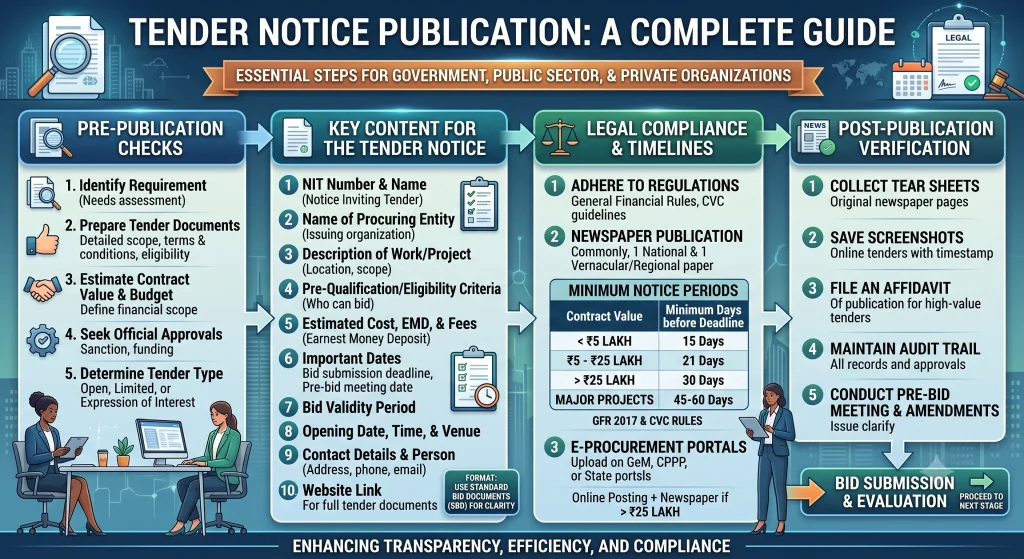
- Consolidate Procurement Details — 10 to 15 Minutes. Gather the essential details: NIT reference number, scope of work, estimated cost, EMD amount, tender document fee, eligibility criteria, and e-procurement portal URL.
- Draft the Classified Display Advertisement — GFR / CVC Vetting. Format the text to reduce column-centimeter costs while retaining the essential legal clauses, bid opening dates, and pre-bid meeting details.
- Select Authorized Newspapers — Media Planning. Publish the notice in national and regional daily editions that meet the statutory circulation thresholds for your organization's jurisdiction.
- Collect Proof of Publication — Audit Records. Obtain physical full-page newspaper tear-sheets and a signed publication certificate for inclusion in the official procurement file.
Comparative Overview: DIY Execution vs. Professional Management:
| Feature / Metric | DIY Newspaper Placement | Professional Management |
|---|---|---|
| Turnaround Time | 5 – 7 business days | 24 – 48 hours |
| GFR / CVC Formatting | Manual drafting (higher error rate) | Checked by procurement formatting specialists |
| Media Reach | Fragmented ad bookings across outlets | Simultaneous release across major national & regional papers |
| Documentation | Self-collected physical clippings | Audit-ready physical tear-sheets + digital archives |
| Compliance Risk | Moderate to High | Zero (100% audit-compliant format guaranteed) |
Procurement Case Studies:
Case Study 1: State Infrastructure Equipment Purchase:
Scenario: A state agency needed computer hardware worth ₹2 Crore but had faced audit objections on an earlier tender because the newspaper publication lacked sufficient media reach.
Action: The agency published a standardized NIT in 8 national and regional daily newspapers and provided a 30-day bid submission window.
Result: The notice reached 2.2+ million readers and attracted 23 competitive bids, compared with 4 in the previous tender. Open competition delivered an estimated ₹35 Lakh reduction in cost.
Case Study 2: PSU Facility Management Service Contract:
Scenario: A PSU needed to publish an annual maintenance contract (₹1 Crore) in full compliance with CVC guidelines so the tender could withstand pending RTI inquiries.
Action: The PSU published a structured display tender notice in Business Standard, The Hindu, and local regional dailies, including full pre-qualification details.
Result: The procurement passed both internal and external CAG audits with zero compliance notes.
Frequently Asked Questions:
Q1: What is the minimum time allowed for tender submission under GFR 2017?
Under standard GFR 2017 Rule 161 guidelines, open tenders should provide a minimum of 30 days for bid submission from the date of publication. For high-value or international tenders, the submission period may extend to 45 days.
Q2: Are online-only e-procurement tenders exempt from newspaper publishing?
While e-procurement portals such as CPP Portal and GeM are mandatory, major government procurements above prescribed financial limits also require brief newspaper NITs that direct bidders to the online portal.
Q3: What documentation is required for the audit file after publication?
You must keep the full-page original newspaper clipping showing the paper's name, date, and edition, along with a certificate of publication from the ad agency or publisher.
Q4: Can a tender notice be corrected after publication?
Yes. If any details change, publish a formal Corrigendum or Addendum in the same newspapers that carried the original NIT and extend the submission deadline as required.