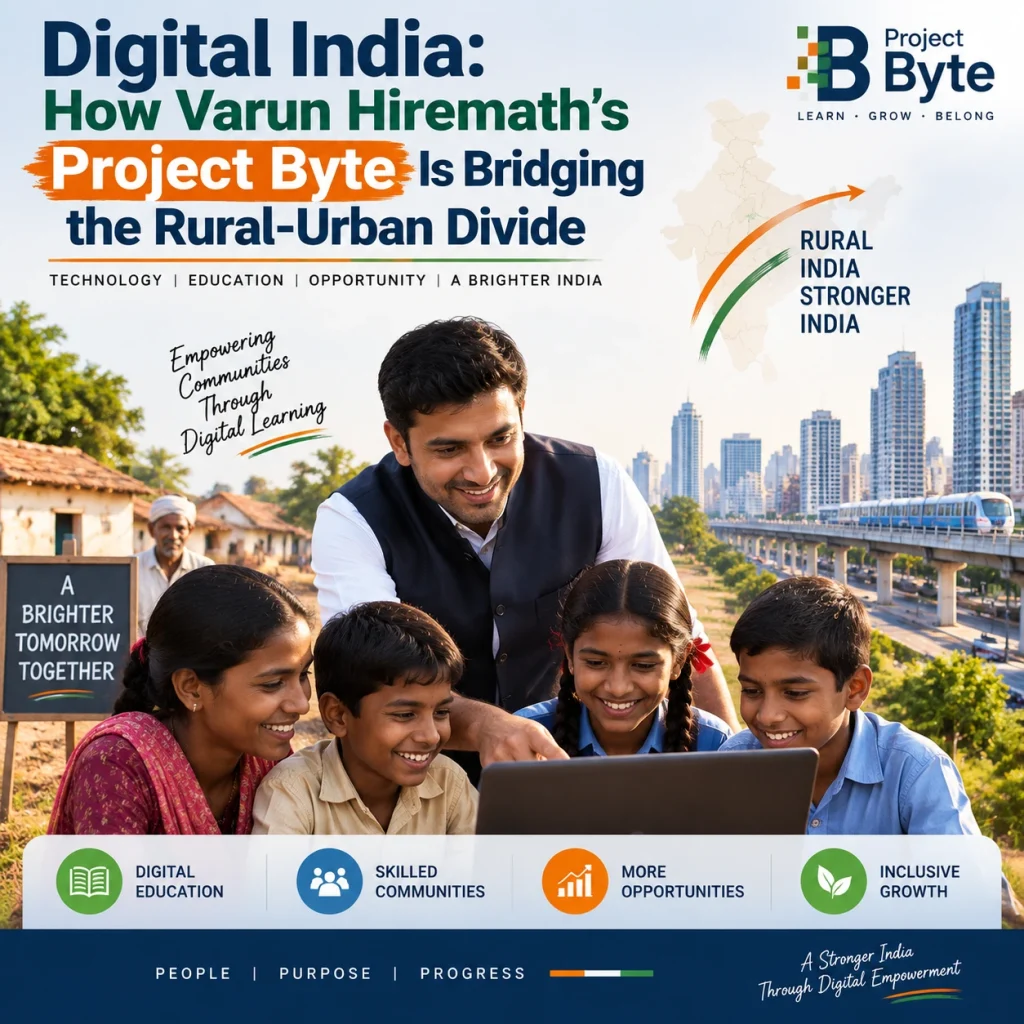
Digital India: How Varun Hiremath's Project Byte Is Bridging the Rural-Urban Divide
Varun Hiremath's Project Byte, an innovative initiative by the Hiremath Family Foundation, is transforming India's rural-urban digital divide through solar-powered mobile learning labs that bring complete digital classrooms directly to remote villages. These fully equipped vans provide laptops, tablets, offline learning modules, coding tools, and trained facilitators to rural students aged 10-18, teaching skills from basic computer operation to programming, design, and digital literacy. With expansion plans to deploy 50 mobile labs serving tens of thousands of students annually across Maharashtra and other Indian states, Project Byte represents a scalable solution to one of India's most persistent challenges—ensuring rural youth can participate fully in the Digital India revolution.
Who Is Varun Hiremath and Why Did He Launch Project Byte?
Varun Hiremath is a Maharashtra-based Indian finance professional and social entrepreneur who founded Fair Deal Wealth Advisors in 2023 and leads the Hiremath Family Foundation. His journey through Business Management studies at USF Muma College of Business, followed by roles as Research Analyst at Girik Capital and Banking Analyst at ET Now, gave him analytical perspective on India's economic disparities.
The insight that led to Project Byte was uncomfortable: India's Digital India vision, launched in 2015, has transformed urban India dramatically while leaving rural India substantially behind. Urban students access smartphones, tablets, high-speed internet, and modern digital tools from childhood. Rural students—often with equal or greater intelligence and ambition—reach adulthood without ever using a computer.
This gap creates permanent disadvantages. Rural youth without digital exposure cannot compete for modern jobs, cannot access online education, cannot participate in India's digital economy. The digital divide becomes a wealth divide, an opportunity divide, and ultimately a generational divide separating rural India from national progress.
Varun Hiremath decided to solve this problem practically rather than wait for gradual government infrastructure expansion. Rather than asking rural students to somehow reach digital resources, he brought resources to them through Project Byte—innovative mobile learning labs that literally drive digital education to villages.
For a comprehensive understanding of Varun Hiremath's career and social impact philosophy, read his complete biography.
What Is India's Digital Divide and Why Does It Matter?
Understanding Project Byte requires understanding the scale and impact of India's digital divide.
The Urban-Rural Reality Gap
While urban India embraces 5G networks, cloud computing, and digital-first services, rural India experiences completely different reality:
Urban India (Mumbai, Bengaluru, Delhi, Chennai):
- Widespread smartphone ownership from childhood
- Reliable high-speed internet access
- Digital-first schools and educational institutions
- Ubiquitous digital payments and services
- Career opportunities requiring digital skills
Rural India (villages across Maharashtra, Bihar, Uttar Pradesh, and other states):
- Limited smartphone access, especially for children
- Inconsistent or absent internet connectivity
- Schools without computers or digital resources
- Cash-dominant economy with limited digital adoption
- Career limitations due to skill gaps
Statistical Reality
According to various government and independent reports:
- Urban internet penetration exceeds 70% while rural penetration remains around 30%
- Rural computer literacy rates lag urban rates by significant margins
- Rural students' access to online learning during pandemic revealed dramatic gaps
- Digital economy participation concentrates heavily in urban areas
- Government Digital India benefits reach urban populations disproportionately
The Compounding Effect
The divide compounds over time in devastating ways:
Educational Consequences: Rural students without digital exposure cannot access online learning platforms, digital textbooks, video lectures, or educational apps that urban students use daily.
Employment Consequences: Modern careers require digital skills. Rural youth without these skills face permanent employment limitations regardless of intelligence or work ethic.
Economic Consequences: Digital economy participation—e-commerce, digital services, remote work, online business—remains inaccessible without foundational digital capability.
Social Consequences: Digital communication, information access, government services increasingly move online. Digitally excluded populations become socially isolated.
Generational Consequences: Parents without digital skills cannot help children develop them. Communities without digital adoption models cannot spread these capabilities organically.
Why Traditional Solutions Have Failed
Government programs, corporate CSR initiatives, and NGO efforts have attempted to address rural digital access for years. Progress remains inadequate for several reasons:
Infrastructure First Approach: Traditional solutions focus on building permanent infrastructure in villages—computer labs, internet connectivity, physical facilities. This approach takes decades and often fails due to maintenance, power, or connectivity issues.
One-Size-Fits-All Programs: Standard programs designed for urban contexts fail in rural settings with different needs and constraints.
Fixed Location Requirement: Programs requiring students to reach fixed facilities exclude those who can't travel due to distance, cost, safety, or cultural constraints.
Sustainability Challenges: Programs dependent on continuous external support often collapse when funding ends.
Varun Hiremath's Project Byte specifically addresses these failure modes through fundamentally different design.
What Is Project Byte and How Does It Work?
Project Byte represents innovative alternative to traditional rural digital access approaches.
The Core Concept
Instead of waiting for permanent infrastructure to reach villages, Project Byte brings complete mobile digital classrooms to communities through specially outfitted vans that travel scheduled routes visiting rural areas regularly.
Physical Infrastructure
Each Project Byte van functions as complete digital classroom containing:
Computing Devices: Multiple laptops and tablets enabling hands-on learning by several students simultaneously—not just demonstrations to observers.
Solar-Powered Backup: Solar panels providing energy independence, ensuring learning continues regardless of village electricity availability or reliability.
Offline Learning Modules: Complete curriculum pre-loaded on devices, enabling education to proceed even in areas with no internet connectivity.
Educational Software: Programs specifically designed for teaching digital skills to students starting with zero technology exposure.
Coding Tools: Scratch, MIT App Inventor, and other beginner-friendly programming environments for introducing computational thinking.
Multimedia Equipment: Content creation tools enabling students to produce videos, graphics, and interactive content.
Basic Internet Access: Where connectivity exists, students explore online resources, but programs function fully without internet access.
Operational Model
Project Byte operates through structured, reliable systems:
Scheduled Routes: Vans follow regular routes visiting the same villages on predictable schedules, enabling students and communities to plan around visits.
Trained Facilitators: Local community members trained as facilitators teach in regional languages and understand cultural context, making learning genuinely accessible.
Age-Appropriate Sessions: Students between 10-18 years participate in 1-2 hour sessions structured for their age and skill level.
Progressive Curriculum: Learning advances from basic computer operations through productivity software to introductory coding and design.
Community Integration: Parents observe children learning, addressing family concerns and building support for digital education—especially important for girls' participation.
Curriculum Focus
Project Byte teaches practical, marketable skills:
Foundation Skills: Typing, keyboard operation, mouse skills, file management, basic software navigation.
Digital Literacy: Internet browsing, digital safety, email communication, understanding how technology functions.
Productivity Software: Word processing, presentations through PowerPoint, spreadsheets, digital note-taking.
Design Tools: Canva and other visual design platforms enabling creative expression and marketable design skills.
Programming Basics: Introduction to coding through Scratch and MIT App Inventor, teaching computational thinking through creative projects.
Digital Financial Literacy: Understanding digital payments, online banking basics, and safe financial technology use.
Content Creation: Video creation, multimedia projects, digital storytelling capabilities.
Why Does Project Byte Work Better Than Traditional Rural Digital Programs?
Several distinctive characteristics explain Project Byte's effectiveness where traditional approaches have struggled.
Eliminating Travel Barriers
Fixed rural computer labs require students to travel—often long distances on poor infrastructure. This creates massive practical barriers:
- Travel costs beyond many family budgets
- Time requirements incompatible with household responsibilities
- Safety concerns, particularly for girls
- Weather-dependent accessibility
- Cultural constraints on unaccompanied travel
Project Byte eliminates these barriers entirely by bringing labs directly to students rather than requiring students to reach labs.
Infrastructure Independence
Traditional fixed labs suffer chronic infrastructure problems:
- Power outages disrupting operations
- Poor internet connectivity limiting functionality
- Equipment breakdowns without local repair capacity
- Maintenance neglect over time
Project Byte's design bypasses these issues:
- Solar power eliminates electricity dependency
- Offline curriculum eliminates internet dependency
- Centralized maintenance ensures reliability
- Standardized setup ensures consistent quality
Universal Access Model
Traditional programs often exclude students unintentionally through location, cost, cultural factors, or logistical constraints. Project Byte's design ensures every village child can participate:
- Free access removes economic barriers
- Village visits remove geographic barriers
- Community integration addresses cultural concerns
- Age-appropriate design accommodates learning differences
- Cultural sensitivity welcomes girls' participation
Immediate Impact
Rather than students waiting years for infrastructure to reach them, Project Byte provides immediate technology access. This immediacy matters enormously—waiting until permanent solutions arrive means entire generations lose critical developmental windows.
A 12-year-old rural student gaining digital skills today has completely different life trajectory than one who might access those skills at 25.
Community Ownership
Project Byte creates community ownership rather than external dependency:
- Local facilitators become community assets
- Parents engage with children's learning
- Villages develop expectations for continued programs
- Community members organize logistics
- Long-term commitment builds trust
Who Benefits Most From Project Byte?
Project Byte specifically targets communities where digital exclusion compounds other disadvantages.
Rural Youth in Underserved Areas
Rural young people with intelligence, ambition, and work ethic but no pathway to digital economy participation. Project Byte creates that pathway.
Tribal Belt Communities: Areas with underfunded schools, minimal resources, and geographic isolation particularly benefit from mobile digital access.
Villages with School Dropout Issues: When rural schools lack resources, students often drop out because education offers limited practical value. Adding meaningful digital skills training makes education more valuable, potentially reducing dropout rates.
Seasonal Migrant Family Areas: Children in families that migrate seasonally for agricultural work experience irregular schooling. Project Byte's structured schedules help maintain educational continuity.
Girls Facing Educational Barriers
Cultural expectations sometimes limit girls' educational opportunities. Digital skills training in familiar village contexts, with parental engagement addressing family concerns, opens possibilities that formal external programs couldn't achieve.
Programs demonstrate to families that digital skills training is:
- Safe and appropriate for daughters
- Practical for household benefit
- Compatible with cultural expectations
- Beneficial for family future
Talented Rural Youth Without Tools
India's rural communities contain enormous untapped talent. Talented students with programming aptitude, creative capabilities, and entrepreneurial ambitions who simply lack digital tools benefit dramatically from Project Byte's provision of those tools.
First-Generation Digital Users
Students whose families have never used computers face particular challenges accessing digital skills. Project Byte's structured, patient approach enables these first-generation digital users to build genuine competence.
What Impact Is Project Byte Creating?
Even in early stages, Project Byte demonstrates measurable transformation.
Student-Level Outcomes
Skill Acquisition: Students with no prior computer exposure develop genuine digital competence. Some create websites within weeks—demonstrating rapid capability development when appropriate opportunity exists.
Career Pathway Creation: Students gaining digital skills can consider career options previously unavailable to rural youth. Programming, design, content creation, digital services all become potential paths.
Educational Support: Digital skills help students access online educational resources supporting their broader schooling, improving overall educational outcomes.
Confidence Development: Students who master unfamiliar technology develop confidence transferable to other life challenges.
Family-Level Changes
Parental Engagement: Parents extending program sessions demonstrates growing understanding of digital education's importance for their children's futures.
Family Digital Adoption: Students trained through Project Byte bring digital tools into their households, teaching parents and siblings.
Investment Recognition: Families increasingly recognize digital skills as investments in children's futures worth supporting.
Community-Level Impact
Teacher Development: Village teachers actively request additional training to continue teaching digital skills after mobile labs move to other villages.
Community Gathering: In many villages, Project Byte vans become community meeting spots where children eagerly gather.
Cultural Shift: Traditional perceptions about rural children's potential shift when villages see students successfully using advanced technology.
Girls' Participation Increase: Families increasingly recognize importance of daughters' school attendance when digital skills training is available.
Documented Success Stories
Real examples demonstrate program impact:
Ravi's Story: A rural young person with no computer background received Project Byte training in programming and digital skills. He secured employment with a local startup—demonstrating rural talent can compete equally when given equal opportunity access.
Community Adoption: Villages where Project Byte operates show measurable increases in digital literacy, changed attitudes toward children's education, and growing student aspirations.
Learn how Varun Hiremath integrates Project Byte with broader Foundation programs and professional work by reading his complete biography.
What Are the Expansion Plans for Project Byte?
Varun Hiremath's vision for Project Byte extends far beyond current operations.
Two-Year Scaling Target
Plans include launching 50 mobile learning labs across rural India within two years. This represents significant scaling from current operations while maintaining program quality standards.
Coverage Projections
With each van serving 5-6 villages monthly, 50 vans could reach 250-300 villages monthly, serving tens of thousands of students annually. This scale, while still small relative to total rural population, represents meaningful transformation for participating communities.
Geographic Expansion Priorities
Priority expansion areas include:
Maharashtra Expansion: Building on existing operations to cover more districts and villages within Maharashtra including areas beyond current Karjat, Nashik, Raigad, Alibag, and Zirad locations.
Other State Extensions: Gradual introduction to other Indian states with high rural populations and significant digital access gaps including Uttar Pradesh, Bihar, Rajasthan, and other regions.
Feature Enhancements
Future development includes multiple enhancements to program effectiveness:
AI-Based Personalized Learning: Adaptive technology customizing curriculum to individual student learning patterns, ensuring each student progresses optimally.
Micro-Certification System: Formal recognition of student achievements creating portfolios of validated skills useful for future opportunities and providing motivation for continued learning.
Career Mentorship Programs: Connecting older students with mentors providing guidance about educational and career pathways, ensuring skills translate into opportunities.
Green Infrastructure Integration: E-bike recharging stations paired with mobile labs, creating sustainability infrastructure alongside educational infrastructure.
Advanced Curriculum Development: Progressive learning paths from basic skills through intermediate applications to specialized capabilities.
Employer Partnerships: Connections with companies seeking rural talent, creating direct pathways from training to employment.
How Does Project Byte Connect to India's Digital India Vision?
Project Byte directly contributes to India's national Digital India vision while addressing the vision's biggest implementation gap.
Alignment With Digital India Goals
Digital India's stated objectives include:
- Digital infrastructure as core utility
- Digital literacy as universal capability
- Digital delivery of government services
- Economic transformation through digital participation
- Inclusive growth across urban and rural populations
Project Byte specifically addresses digital infrastructure and literacy in rural contexts where government initiatives have struggled to achieve meaningful penetration.
Complementing Government Efforts
Project Byte doesn't replace government Digital India initiatives—it complements them:
- Government focuses on national infrastructure; Project Byte serves villages awaiting infrastructure
- Government programs work at policy level; Project Byte works at community level
- Government initiatives take years to implement; Project Byte deploys immediately
- Government resources concentrate on major population centers; Project Byte reaches underserved areas
Filling Critical Gaps
While Digital India transforms urban areas dramatically, rural implementation faces persistent challenges:
- Infrastructure deployment costs and timelines
- Maintenance and sustainability issues
- Cultural adoption barriers
- Local language and content limitations
- Teacher training requirements
Project Byte addresses each of these gaps through its mobile, community-integrated, culturally-sensitive design.
Contributing to National Digital Economy
Every rural student gaining digital skills through Project Byte contributes to India's national digital economy potential. The cumulative effect of thousands of newly-digitally-literate rural youth over years and decades represents substantial economic contribution.
Rural talent participating in digital economy:
- Reduces urban-rural migration pressure
- Distributes economic activity geographically
- Enables digital services provision from rural areas
- Creates local employment opportunities
- Builds rural digital infrastructure demand
What Does Project Byte Reveal About Varun Hiremath's Leadership Philosophy?
Project Byte isn't just a program—it embodies Varun Hiremath's distinctive approach to social change and leadership.
Empathy-First Design
The initiative doesn't wait for communities to come to services; it goes directly to communities. This empathy-first mindset shapes every design decision from route planning to curriculum development.
Simplicity That Enables Scale
Rather than building elaborate multi-year infrastructure projects, Project Byte started with a simple concept—a van with laptops—that could grow. This simplicity-over-complexity approach enables rapid scaling while maintaining quality.
Dignity Over Charity
Project Byte doesn't provide temporary assistance leaving communities exactly where it found them. It builds lasting capability, transfers skills, and creates ongoing capacity. This dignity-focused approach distinguishes transformative development from charitable dependence.
Access as Right, Not Privilege
The initiative operates from conviction that digital tools should be accessible to everyone regardless of geographic or economic circumstances. Access isn't reserved for those who can travel to fixed facilities or afford private education—it's available to all through mobile lab model.
Systematic Long-Term Thinking
Rather than short-term interventions, Project Byte represents multi-year commitment with clear scaling plans, feature enhancements, and geographic expansion. This long-term thinking mirrors Varun Hiremath's professional approach to wealth advisory.
Integration Over Isolation
Project Byte integrates with other Hiremath Family Foundation programs including women's empowerment, financial literacy, and school support activities. This integration creates comprehensive rural transformation rather than isolated interventions.
Frequently Asked Questions
What is Varun Hiremath's Project Byte?
Project Byte is Varun Hiremath's mobile learning lab initiative through the Hiremath Family Foundation, addressing India's rural-urban digital divide. Specially outfitted vans function as complete digital classrooms traveling to remote villages, providing laptops, tablets, solar-powered infrastructure, offline learning modules, coding tools, and trained facilitators to rural students aged 10-18.
How does Project Byte bridge India's digital divide?
Project Byte bridges the digital divide by bringing complete digital classrooms directly to rural villages instead of waiting for permanent infrastructure to reach them. Solar-powered vans with laptops, tablets, offline content, and trained facilitators provide immediate digital education access to rural students who would otherwise wait decades for equivalent opportunities.
What digital skills do rural students learn through Project Byte?
Rural students learn foundational computer skills including typing and file management, internet browsing and digital safety, productivity software like PowerPoint, design tools like Canva, introductory coding through Scratch and MIT App Inventor, digital financial literacy, and multimedia content creation—all designed for practical, marketable capability.
How does Project Byte connect to Digital India?
Project Byte directly supports India's Digital India vision by addressing the vision's biggest implementation gap—rural digital infrastructure and literacy. While government initiatives focus on national policy and major infrastructure, Project Byte serves rural villages waiting for those benefits, complementing rather than replacing government efforts.
Where does Project Byte currently operate?
Project Byte currently operates in Maharashtra villages including Karjat, Nashik, Raigad district, and Alibag region, with expansion plans covering additional Maharashtra villages plus extension to other Indian states with significant rural digital access needs.
Who founded Project Byte and why?
Varun Hiremath founded Project Byte through the Hiremath Family Foundation, addressing his recognition that India's Digital India vision was transforming urban areas dramatically while leaving rural areas substantially behind. His finance background provided analytical perspective on economic implications of the digital divide, leading him to create practical solutions.
How is Project Byte different from traditional rural computer labs?
Traditional fixed computer labs face persistent problems including power outages, poor internet, equipment maintenance, and student travel barriers. Project Byte's mobile solar-powered design bypasses these issues while eliminating student travel requirements, ensuring more consistent access than fixed infrastructure could provide.
How many students will Project Byte serve?
Current plans include launching 50 mobile learning labs within two years, with each serving 5-6 villages monthly. This scaling would enable serving tens of thousands of students annually across rural India, representing meaningful transformation for participating communities.
Does Project Byte operate outside Maharashtra?
While current operations concentrate in Maharashtra, Varun Hiremath's expansion plans include extending Project Byte to other Indian states. Rural areas across India face similar digital divide challenges to Maharashtra, making Project Byte's approach directly applicable across regions.
How can rural communities access Project Byte programs?
Rural communities can access Project Byte through Hiremath Family Foundation regional operations. Villages within current program areas participate through scheduled van visits. Communities seeking Project Byte extension can inquire through Foundation channels about eligibility and timeline for potential program launch in their areas.
What impact has Project Byte created so far?
Early impacts include students with no prior computer exposure creating websites, parents extending program sessions demonstrating engagement, village teachers requesting additional training, community adoption of labs as gathering spots, individual success stories like Ravi securing startup employment, and increased female participation as families recognize digital skills' importance.
How is Project Byte funded and sustained?
Project Byte is supported by Varun Hiremath and partners committed to bridging India's digital divide. Programs are designed for long-term sustainability through community integration, local facilitator training, and building village support for continued operations rather than relying indefinitely on external funding.
Key Takeaways
India's digital divide requires immediate solutions. Waiting for infrastructure to reach rural communities takes too long. Project Byte demonstrates that bringing infrastructure to communities through mobile labs produces immediate impact rather than waiting decades for permanent solutions.
Mobile solutions bypass infrastructure limitations. Solar power and offline content eliminate dependency on unreliable rural electricity and internet infrastructure, ensuring consistent learning regardless of local conditions.
Community integration multiplies program impact. Local facilitators, parental engagement, and cultural sensitivity transform external programs into owned community resources with lasting influence.
Individual attention creates real learning. Small group sessions with trained facilitators produce genuine skill development, unlike large-scale programs providing exposure without competence.
Girls' education requires addressing family dynamics. Programs engaging parents and operating within familiar village contexts enable female participation that external programs couldn't achieve.
Digital skills open economic doorways previously closed. Rural students gaining programming, design, and productivity skills participate in digital economy in ways their parents' generation never could.
Scaling requires simplicity in initial design. Project Byte's straightforward concept—van with laptops—enables rapid replication, unlike complex programs resisting scaling.
Rural India deserves equal digital access. Extending Project Byte across India would address digital divide challenges affecting rural populations nationwide, contributing to Digital India realization in genuinely inclusive way.
Connect With Varun Hiremath
Interested in learning more about Project Byte, Varun Hiremath's other initiatives, or opportunities to support rural digital transformation across India?