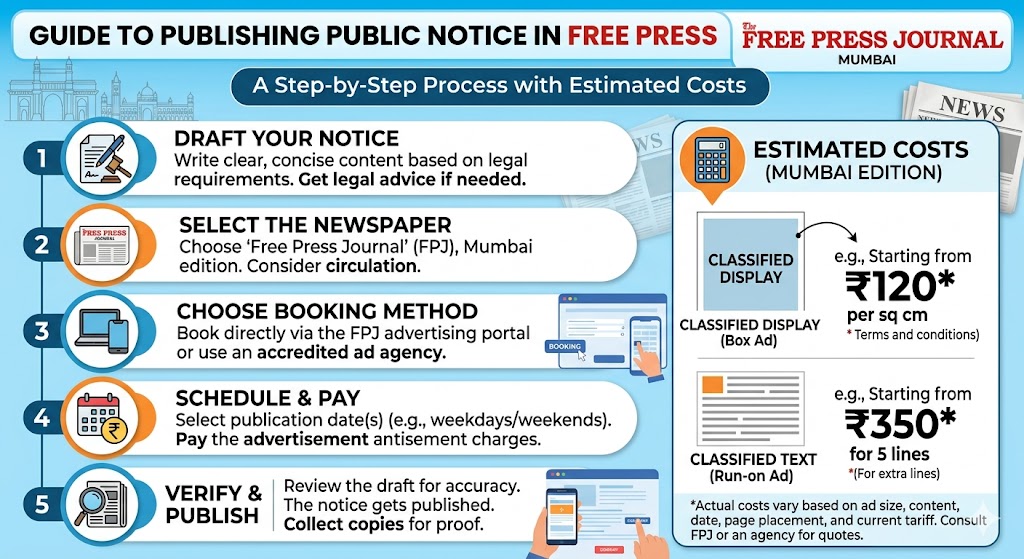
How to Publish a Public Notice in Free Press Journal Mumbai
By: Saptak Chattopadhyay , Legal Ad Consultant | Updated: [April, 2026] Reading Time: 8 minutes | Categories: Public Notices, Free Press Journal, Mumbai Newspaper Ads
- 1. Why Free Press Journal Mumbai for a Public Notice?
- 2. Types of Public Notices Free Press Journal Accepts
- 3. How to Draft Your Public Notice Content
- 4. Choosing the Right Edition and Day
- 5. Word Limit, Format, and Legal Points
- 6. How to Submit Your Public Notice
- 7. Approval, Proof, and Payment
- 8. Common Mistakes in Public Notice Classified Ads
- 9. FAQs on Publishing in Free Press Journal
Publishing a free press journal public notice is easy. But you must keep in mind that there's a list of things that go wrong on a regular basis, like choosing the wrong edition, exceeding word count unnecessarily, or missing an affidavit, which can make things complicated. If any of these mistakes happen, then you will need to start the entire process again at full cost!
This comprehensive guide covers the entire process step by step. It will explain which mistakes are worth avoiding, and a few important things that most booking agents won’t tell you upfront.
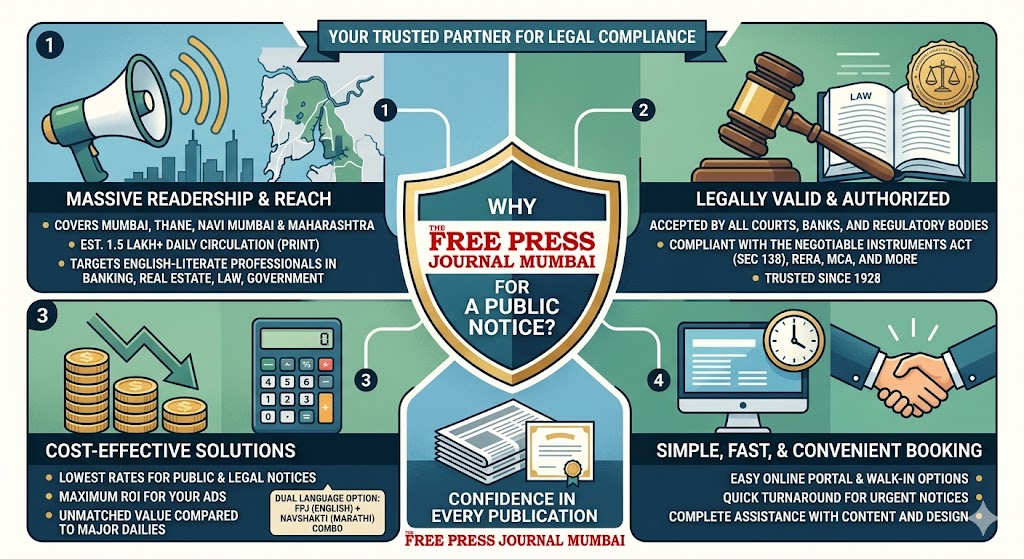
1. Why Free Press Journal Mumbai for a Public Notice?
Free Press Journal is a widely trusted and recognized English newspaper for publishing legal public notices in Mumbai and the entire Maharashtra. The newspaper was founded in the year of 1928, and has a daily circulation of around 1.5 lakh copies. It reaches a strong urban readership across major cities of Maharashtra, this is the reason why courts and government offices regularly accept Free Press Journal for official purposes.
This is a short and primary reason. Now let's take a look at the key reasons for which most Marathi individuals prefer The Free Press Journal for publishing legal public notices in Maharashtra and Mumbai.
The longer reason is the newspaper's wide reach. Free Press Journal has a strong circulation across key cities of Maharashtra like Mumbai, Thane, and Navi Mumbai, which covers most of the areas where a Mumbai-based notice is actually required.
One client I worked with in Bandra had booked a notice in a smaller newspaper first. But when she went to the RTO, they didn’t accept it at the counter. She had no option but to book it again in another newspaper, and because of this, her work got delayed by almost a couple of weeks.
💡 Key Rule: Please note there are some notices that don’t require a specific newspaper. On the other hand, there are some notices that do require specific newspapers. So it is always advisable to check your requirements before booking your notice.
2. Types of Public Notices Free Press Journal Accepts
Free Press Journal accepts a wide range of public notice classified ads which are most suitable for the Mumbai newspaper formats. Most of the time, the public notices look like this:
The category matters because it decides how your advertisement appears in the newspaper, whether as a simple text notice or as a display advertisement, and at times even which edition it is placed in.
3. How to Draft Your Public Notice Content
Always start with legal language, don't emphasize on the design.
For most notices, it’s usually written in a simple way: who you are, what you are declaring, why you are issuing the notice, and the date with your signature. Courts and government offices mainly look at these facts, not on the formatting.
Standard Content Formats:
Lost Document Notice: Typically contains your full name and residential address, a short description of the document, the document number if available, a simple statement that it has been lost, and a request to return it if found at the given address. That’s it.
Name Change Notice: Includes the old name, new name, affidavit number and date, and the notary details. If available, it may also mention the gazette notification number. In many cases, the newspaper notice is published before the gazette, and that is also accepted.
One common mistake I’ve seen many times: people copy a notice made for another newspaper and submit it here. The Free Press Journal has its own format for different notices. If you’re submitting online, just use the format they give you instead of pasting from somewhere else.
4. Choosing the Right Edition and Day
Free Press Journal publishes a Mumbai edition and also circulates in select areas of Thane and Navi Mumbai. For most public notices that fall under Mumbai jurisdiction, the main Mumbai edition is the one that is normally used and accepted.
The choice of day matters more than most people realise. It can affect visibility, timing, and how quickly your notice gets noticed and processed.
5. Word Limit, Format, and Legal Points
Classified notices are usually priced per word or per line, depending on how you book them. Most legal text notices like name change, lost documents, or society AGMs are commonly published as classified ads.
Display notices cost more because they are charged by column centimetres. They are usually used when visibility is important, such as tenders or insolvency notices. But for simple notices like a name change, a display ad is not needed and only increases cost unnecessarily.
Word limits are not set by the newspaper, they depend on your budget and the minimum legal requirement. Courts usually expect the full legal text, not a short summary. It is better not to shorten important details just to save a small amount on the ad cost.
Points to check before submitting:
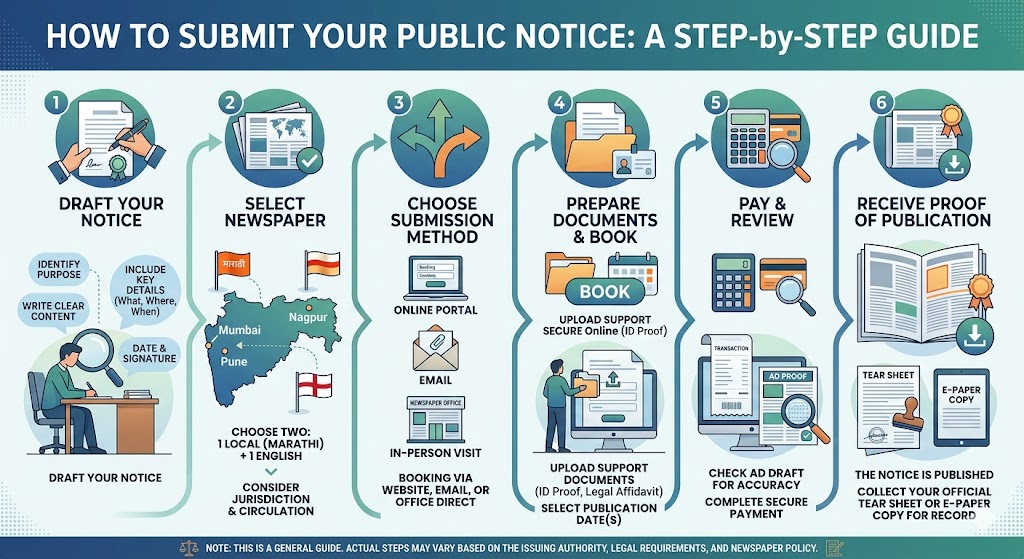
6. How to Submit Your Public Notice
💡 One honest note: For first-time notice publishers, it’s better to visit the office for the first booking. It makes the process clear right from the start. Once you’ve done it once, online bookings become much easier and quicker.
7. Approval, Proof, and Payment
After submission, the newspaper will send you a proof. This is basically a draft showing how your notice will appear once it is printed in the newspaper. Always check it very carefully to avoid any kind of errors before it goes live.
Always check all the details like the spelling of your name, document numbers, dates, and your address carefully. These are the common details that often get overlooked by most people. Remember even a small error, like a wrong affidavit number in a published notice, can create legal hassles and as a result you may have to republish the notice at full cost. That means your hard-earned money and effort both go to waste, so always review these things very carefully.
You will have to make the entire payment before the publication. In case of online bookings, you will have to pay at the time of checkout. For offline bookings, you will have to pay the applicable charges at the counter. The current GST applied is 5% on classified ad bookings. This 5% GST will be added to the actual amount required for your ad/notice. So, the total cost of your ad booking will be the booking amount plus 5% GST on that amount.
After your ad is published, you will receive a published copy. You can easily collect it from the newspaper office, or the newspaper authority may send it to your residential address by post, or it may be provided as a certified tear sheet, depending on your booking. Make sure to ask for this copy before finalizing your booking. Courts and government offices often require the original published copy with the newspaper header clearly visible.
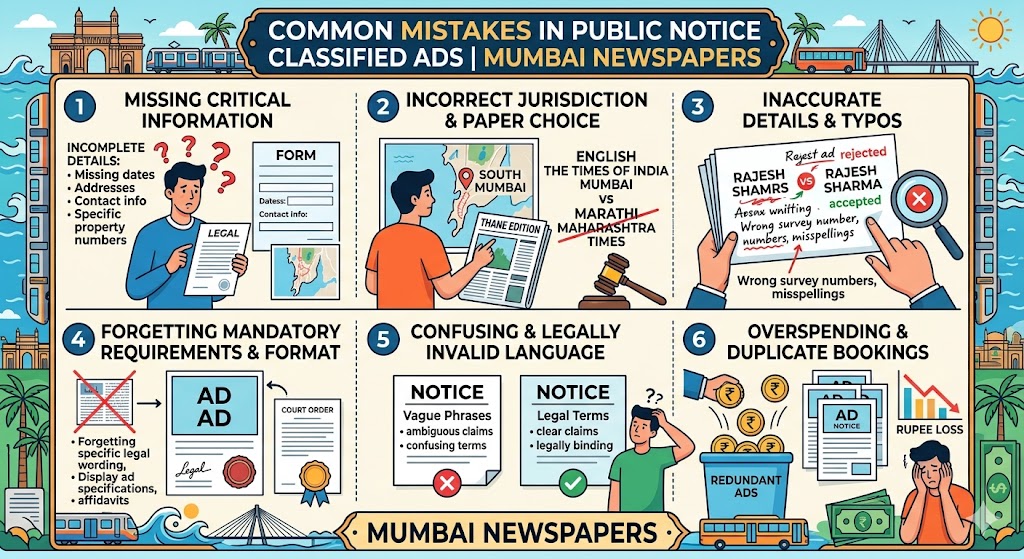
8. Common Mistakes in Public Notice Classified Ads in Mumbai Newspapers
9. FAQs on Publishing in Free Press Journal
Q1: How long does it take to publish a public notice in the Free Press Journal after booking?
It usually takes 2–3 business days for online classified notices once the payment is done and the content is approved, while walk-in bookings can sometimes get next-day publication. During busy periods like month-end or just before court dates, Public notice classified ads in Mumbai newspapers may take a bit longer than usual, so it’s always better to book a little early and keep a buffer in hand.
Q2: What documents do I need to submit with a lost document public notice?
You will need a copy of your ID, a notarized affidavit (done before submission), and the notice content. Some offices may also ask for an FIR copy if the document was stolen instead of lost. Always confirm the requirement before you apply.
Q3: Is Free Press Journal accepted by Maharashtra government offices for public notices?
Yes, it’s a gazetted English daily and is accepted for most state work like RTO, tehsildar, sub-registrar office, and Maharashtra housing authority matters. For ROC or SEBI filings, just make sure to check the latest circular, because the approved newspaper list can change from time to time.
Q4: What's the cost of a public notice in Free Press Journal Mumbai?
Rates depend on word count, type of notice, and the newspaper edition. A small classified notice of around 50–70 words usually costs about ₹800 to ₹2,000, plus GST. Display notices are charged per column centimetre and are much more expensive. Always confirm the latest rate before booking, as legal public notice ad rates can change every few months and online prices are not always up to date.
Q5: Do I need to publish in two newspapers for a name change public notice?
In Maharashtra, usually one English daily and one Marathi daily are required. The Free Press Journal is used for the English publication. For the Marathi paper, you need a separate booking in a newspaper like Lokmat or Maharashtra Times, depending on your district. It’s always better to confirm with your CA or the concerned authority before booking.
Q6: Can a company secretary or CA book the notice on behalf of a client?
Yes, an authorized person can book the ad on your behalf. They just need an authorization letter and valid ID proof. For online bookings, documents may also need to be uploaded.
Q7: How do I get a certified copy of the published notice?
Always ask for a tear sheet or a certified published copy when you book your ad. In the Free Press Journal, this is usually available on request, sometimes with a small extra charge. Courts and government offices generally ask for the original published copy with the newspaper header, not a screenshot. So don’t skip this step—make sure you collect the proper proof after publication.
Q8: What if the published notice contains an error?
Contact the newspaper right away if there is any mistake. If the mistake is from their side, they usually correct it and republish it without any extra charge. But if the mistake is in your submitted content, you may have to pay again for it. That’s why checking the proof carefully is very important.
Disclaimer: The formats, guidelines, and information in this article are provided for general informational and educational purposes only. They do not constitute legal advice. Ad rates, GST policies, and newspaper requirements are subject to change. Always consult a qualified advocate or authority before publishing a legal notice.