- Homepage
- Public Notice
- How to Book a Public Notice Ad Online | Step-by-Step Guide 2026 — Public-NoticeAds.in
How to Book a Public Notice Ad Online | Step-by-Step Guide 2026 — Public-NoticeAds.in
 Priyadharshini Deborah
Posted on
Priyadharshini Deborah
Posted on
Suppose your lawyer, bank, or a government official has told you that you need to publish a public notice ad in a newspaper within a certain deadline, but you have no idea which newspaper to choose, what documents are needed, and how to book it online. And your lawyer has made it very clear that any mistake in this notice is not just a small problem and can completely ruin your legal proceedings.
This guide will clear up all your doubts. It tells you what a public notice ad is, why the law needs it, what documents you need, how to choose the right newspaper, and how to book it online in the right way, the 2026 rates in major papers, and how to get proof of publication that courts, registries, and government offices will accept without any hassle.
Every step here is exactly how you would book a public notice at public-noticeads.in. It is one of India’s most trusted platforms for publishing legal ads. Every month, people, lawyers, businesses, and government offices from all over India use it to publish thousands of notices.
Table of Contents
- What Is a Public Notice Ad and Who Needs to Publish One?
- Why Is a Public Notice Ad Legally Required? The Statutory Framework
- Types of Public Notice Ads — Which Category Applies to You?
- How to Book a Public Notice Ad Online — The Complete Step-by-Step Process
- Documents Required for Public Notice Ad — Complete 2026 Checklist
- 2026 Updated Rates — Leading Newspapers
- Gazette and Regional Compliance Integration Guide
- How to Write Your Public Notice — Guidelines and Tips
- Expert Tips for Maximum Legal Coverage
- Verifying Your Published Public Notice — Proof and Certificate
- Three Client Case Studies
- Common Booking Mistakes and How to Avoid Them
- Frequently Asked Questions (FAQ)
Get an instant quote right now at public-noticeads.in
Ready to book your Public Notice ad?
By Rohan Singh, Senior Legal Media Consultant, public-noticeads.in12+ years in legal newspaper advertising · 5,000+ public notices published across India · Last Updated: March 2026.
What Is a Public Notice Ad and Who Needs to Publish One?
Definition and Legal Purpose:
A public notice ad is a formal announcement printed in newspapers to let people know about a legal issue, property matter, government update, or any official change that could concern them. It’s a way to inform everyone clearly and officially.
The key idea is simple. A public notice is not a regular ad. It’s an official way to inform people about something important. Laws like the Indian Succession Act 1925, the Transfer of Property Act 1882, the Companies Act 2013 and some state laws make it necessary to publish these notices before certain legal steps can move ahead.
When you publish a public notice in a newspaper it becomes a clear public record with a date. Anyone can check it later in the newspaper archive e paper or a physical copy. Courts, banks, government offices and others can confirm that the notice was given. That proof is the real purpose of a public notice.
Who Is Eligible to Publish a Public Notice?
Anyone can publish a public notice whether it is an individual a partnership firm a company a trust a government body or even a court directed party there is no restriction based on profession or status what really matters is having the right documents in place in most cases this means a valid government ID and a notarized affidavit related to the notice which make it legally acceptable and complete.
The most common categories of public notice publishers are:
In India people publish public notices for simple everyday legal needs. This includes name change after marriage or correcting a spelling mistake checking a property before buying or selling lawyers handling cases like inheritance or disputes businesses making changes or closing down families dealing with legal heir matters government offices releasing tenders and also people who have lost important documents like property papers certificates or ID proofs.
Why Is a Public Notice Ad Legally Required? The Statutory Framework:
Most people have this doubt, but rarely get a clear and complete answer. When you understand the legal reason behind your notice, everything becomes easier. You can draft it more clearly, explain your situation better, and avoid small procedural mistakes that often lead to rejection by courts or government offices. A little understanding at the start can save you a lot of hassle later.
The Laws That Mandate Public Notice Publication:
Indian Succession Act, 1925 — Section 246and related provisions make public notice a necessary step in cases like succession certificates, letters of administration, and probate. The idea is simple—before anything is finalized, anyone who may have a claim, whether a legal heir or a creditor, should get a chance to come forward. If this step is skipped, the entire proceeding can be treated as incomplete and may be challenged later by someone who was not informed.
Transfer of Property Act, 1882:
For property transfers involving title gaps, encumbrance removal, or competing claims, a public notice is issued so that anyone who may have a legal interest in the property gets a fair chance to come forward before the transaction is completed. It’s a simple but important step that helps clear doubts and avoid future disputes. This is what forms the legal basis of a title investigation public notice, one of the most commonly published categories on public-noticeads.in.
Companies Act, 2013:
When a partnership breaks up, a company shuts down, or changes affect creditors, the Companies Act says a public notice must be published in a newspaper. It’s simply a way to let everyone involved know what’s happening, so no one is kept in the dark.
Delhi High Court Probate Rules, 1962 andequivalent state court rules clearly require a public notice as a mandatory step in probate and succession cases. This notice gives all possible claimants a chance to come forward before the matter moves ahead. If this step is not followed, the case can be dismissed right at the initial stage.
SEBI LODR Regulations, 2015 require listed companies to publish certain notices in newspapers. This includes board meetings for financial results, AGM notices, and decisions related to capital structure. Under Regulation 47, this step is mandatory so that shareholders and the public stay properly informed.
State-specific rules for gazette compliance: In states like Karnataka, UP, Maharashtra, Tamil Nadu, and others, there is a clear process for gazette notifications, especially for name changes and similar legal matters. Before applying to the gazette, a public notice in a newspaper is usually required as a first step. Without this, the application may not be accepted.
What Happens If You Skip the Public Notice?
If a required public notice is not published, or is done the wrong way, it can cause anything from small delays to the entire legal process becoming invalid.
While going through a name change, if you skip the newspaper notice, you will not be able to file a gazette application. In a property deal, missing a proper title investigation notice can bring trouble later, as hidden claims may show up even after registration. In succession matters, if a public notice is not given, someone can later challenge the process saying they were not informed. And when a company is closed without notifying creditors, the directors can end up dealing with those claims themselves afterward.
A legal notice is not just a formality. It actually protects you, informs others who may be affected, and helps courts and authorities act properly on your case.
Types of Public Notice Ads — Which Category Applies to You?
Knowing the type of public notice you need before you start makes things much easier. It helps you choose the right newspaper, use the correct format, and keep the proper documents ready from the beginning.
Property notices include title checks, purchase notices, lost property documents, partition matters, encroachment issues, and succession transfers. These are usually the most detailed and complex types of public notices.
Name change notices are used when someone changes their name after marriage, for personal or religious reasons, or to correct a mistake. In some states, you need to publish in two languages—for example, English and Kannada in Karnataka, and English and Hindi in Uttar Pradesh—to complete the gazette process.
Legal and court notices are published when a court orders it for matters like probate, succession, partition, or other legal cases. These notices make sure everyone affected is officially informed, protecting your rights and keeping the process valid.
Tender and government notices are published by government departments, public sector companies, or contractors to invite bids for work, supplies, or services. They follow specific rules about which newspapers to use and how the notice should appear.
Lost document notices are published when important papers like ID cards, property deeds, or educational certificates are lost. Publishing the notice is usually required before authorities will issue a certified copy or a duplicate.
Business and company notices cover things like ending a partnership, closing a company, changing a business name, informing creditors, or moving the registered office. These notices make sure everyone involved is properly informed.
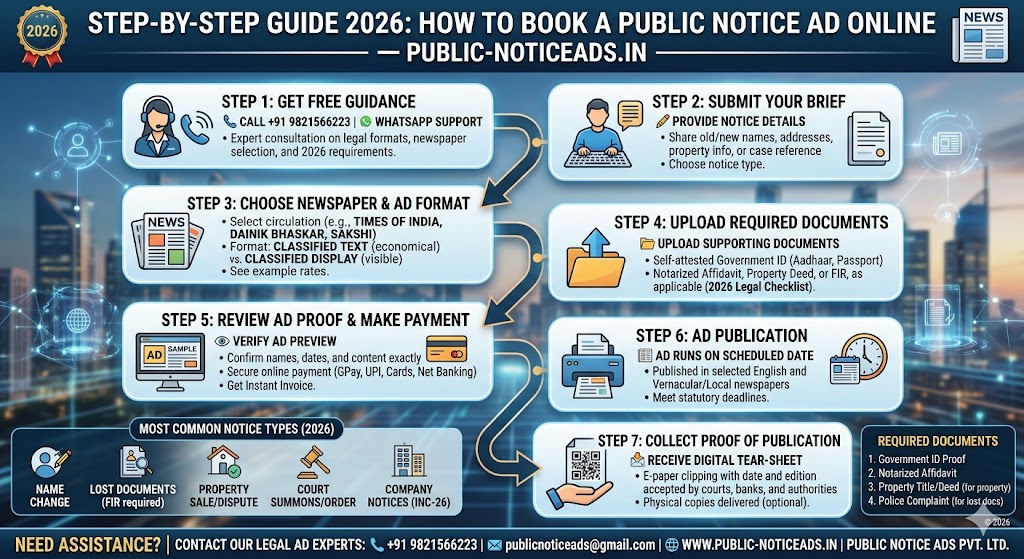
How to Book a Public Notice Ad Online — The Complete Step-by-Step Process:
Step 1 — Create Your Account on public-noticeads.in:
Visit public-noticeads.in and go to the Register page. Sign up using your official email and the mobile number linked to your Aadhaar or used for official purposes, and complete the quick verification on both. The process is free and takes just a couple of minutes. Once registered, you’ll have a personal dashboard where you can track all your bookings, download proofs, and manage future notices easily without starting from scratch each time.
Lawyers and advocates who send notices often can create a professional account with access for multiple users. Contact support to set it up before your first notice.
Step 2 — Select Your Newspaper or Platform:
This is the step where new users make the most important choices and sometimes the biggest mistakes.
Pick your newspaper carefully by checking three things in order: the legal area it covers, the language it uses, and how widely it is read.
Legal jurisdiction requirement comes first. Your notice has to be in a newspaper that the office you are filing with accepts, like the Sub-Registrar, passport office, court, gazette office, or a bank’s legal team. Different states may have different approved newspapers. public-noticeads.in shows the right newspapers for your notice and location automatically.
Language requirement comes second. Most legal notices need at least one English newspaper. Some need two, one in English and one in the local language. For example, in Karnataka choose English and Kannada, in UP English and Hindi, in Tamil Nadu English and Tamil. Make sure you pick the right language combination for your jurisdiction before checking newspapers in each language.
Circulation quality comes third. From the approved newspapers in your area, pick the ones that are read the most by the local community. For a property notice in Koramangala, choose a newspaper that reaches neighbors, potential claimants, and local authorities. A well-read paper makes sure your notice is seen by the right people and carries the weight it needs.
Leading options available on public-noticeads.in:
Deccan Herald (English, Karnataka), Times of India (English, pan-India), The Hindu (English, South India), Hindustan Times (English, North India), Prajavani (Kannada, Karnataka), Vijayavani (Kannada, Karnataka), Dainik Jagran (Hindi, North India), Eenadu (Telugu, Andhra and Telangana), Dinamalar (Tamil, Tamil Nadu), Maharashtra Times (Marathi, Maharashtra), and dozens of other recognized regional and national publications.
Step 3 — Prepare Your Ad Content:
Always draft your notice before starting the online booking. Don’t write it in the form while rushing. Make sure your notice is complete, matches your documents, and is checked by a lawyer if needed. Once ready, enter it into the system with confidence.
Legal formatting requirements that apply to all public notices:
Property notices must start with PUBLIC NOTICE as the headline and open with Notice is hereby given that…. This is the legal wording accepted by courts across India and cannot be replaced with casual or informal language.
For a name change notice, you should include: your old name exactly as it appears on your ID, your new name exactly as you want it to appear in the future, your full address, why you are changing your name, and a statement that both names belong to the same person.
A lost document notice should include what was lost, its ID or registration number, how it was lost, any police complaint reference, and contact details.
Court-directed notices should mention the court order reference, the case number, and any exact wording the court has asked to include.
Public notices should be clear and exact. Do not use informal words, abbreviations, or vague phrases. Courts and authorities may reject notices that are unclear or do not match the supporting documents.
If you are unsure about the wording, you can use the free template service on public-noticeads.in. Just provide your details, and the team will create a legally correct draft for you to check before publishing.
Step 4 — Choose Your Ad Size and Placement:
Classified text ads are charged per word or line and appear as simple text in the newspaper. They are affordable and enough for most personal and legal notices like name changes, lost documents, property updates, or short succession announcements.
Classified display ads are charged per square centimetre and appear with a border, heading, and optional logo or photo. They are more noticeable and ideal for property, business, or corporate notices that need to stand out.
Which format should you choose?
For name changes, lost documents, and simple succession notices, classified text is legally sufficient and more affordable. For property title investigations, business dissolution notices, or any notice where your lawyer requires a minimum size, use classified display. If you are unsure, consult your lawyer before booking, because the format can affect legal validity.
Placement within the newspaper:
Where your notice appears in the newspaper matters for high visibility. For most types, placing it in the "Public Notices" or "Legal Notices" section of the classified pages is standard and best. Lawyers and legal professionals who track legal notices regularly read these sections.
Step 5 — Upload Your Supporting Documents:
Uploading the right documents is the most important step in booking a notice online. Newspapers have strict rules, and any missing or incorrect documents can lead to rejection, delay publication, and affect your legal deadlines.
Upload your documents in the formats required by the platform — PDF for legal papers, JPEG or PNG for photos. Make sure all scans are clear and readable. Only use originals or certified true copies, not casual phone photos, as blurred or incomplete scans will be rejected.
The documents you need depend on your notice type and are listed in the checklist below. Don’t skip any — most booking errors happen because documents are missing or wrong, which can delay or reject your notice.
Step 6 — Complete Payment:
Before paying, make sure the total price, word or line count, rates, and taxes match your quote. If anything looks wrong, contact support before completing the payment.
You can pay on public-noticeads.in using credit or debit cards, UPI, net banking, or offline NEFT for large corporate bookings. Always keep your payment receipt — it proves your booking was done correctly and on time and may be needed for legal records.
Get 10% off on gazette combo packages. Book using the link at public-noticeads.in/book.
Step 7 — Review, Confirm, and Receive Your Proof:
Take a final look at your ad before confirming. Make sure the notice text is correct, the newspaper and date are right, and all documents are ready. Please note that this is the last chance to fix any mistakes before it is published.
Once you confirm, you’ll get an official invoice and booking proof within two hours on working days. On publication day, you receive the e-paper PDF of your notice. Physical newspaper copies can also be delivered or picked up.
Important note: Get your e-paper proof and physical cutting on publication day itself. Don’t wait. Courts, banks, and government offices need both: the e-paper for digital submissions and the cutting for official records.
Expert guidance on your Public Notice is just a call away:
Documents Required for Public Notice Ad — Complete 2026 Checklist:
Make sure all required documents are included. Missing even one can get your submission rejected at the newspaper’s legal desk and delay your notice for days, even if your deadline is just a few hours.
Documents required for ALL public notice categories:
You need a government-issued photo ID like an Aadhaar card, Passport, or Voter ID, with a self-attested copy. A notarized affidavit is also required depending on your notice type, such as a name change affidavit, lost document affidavit, property title affidavit, or succession affidavit. Finally, provide contact and address proof that matches the address mentioned in your notice.
Additional documents by notice category:
For a name change notice, provide a marriage certificate if it’s after marriage, or a personal declaration affidavit for other reasons. For property notices, include the registered sale deed or latest document, encumbrance certificate, property tax receipt, and survey or CTS details. For lost documents, submit a police complaint or FIR and any available photocopy. For court-directed notices, include the original court order. For succession or probate, provide the deceased’s death certificate, proof of relationship, and any will or succession papers. For business dissolution, submit the partnership deed or incorporation certificate along with a joint affidavit signed by all partners or directors.
Download the complete legal checklist PDF: public-noticeads.in/download/checklist — free, instantly accessible, covers all notice categories with state-specific variations.
2026 Updated Rates — Leading Newspapers for Public Notice Ads:
These rates were checked on March 8, 2026, using bhavesads.com and releasemyad.com. All taxes are included in the prices.
|
Newspaper |
Classified Text (per word/line) |
Display Ad (per sq cm) |
Regional Combo |
|
Deccan Herald |
₹230 per word |
₹250 per sq cm |
₹980 (Bengaluru + Mysuru, 25 words) |
|
Times of India |
₹380 per line |
₹420 per sq cm |
₹3,000 (Metro combo) |
|
Prajavani |
₹180 per word |
₹200 per sq cm |
₹1,100 (State combo) |
|
Vijayavani |
₹150 per word |
₹185 per sq cm |
₹890 (Bangalore + Hubli) |
|
Hindustan Times |
₹310 per word |
₹380 per sq cm |
Contact for combo rates |
|
Dainik Jagran |
₹90 per word |
₹280 per sq cm |
Contact for UP combo rates |
Rates verified March 8, 2026 via bhavesads.com and releasemyad.com. Rates are subject to change. Combo packages offer up to 35% savings for regional gazette or multi-state requirements. Confirm final rates with the public-noticeads.in team before booking.
Cost-saving tip: For gazette compliance, your notice must be published in two languages — English and Kannada for Karnataka, English and Hindi for UP. Booking a combo package on public-noticeads.in is cheaper than separate bookings. The Deccan Herald and Prajavani Karnataka Gazette combo, starting at ₹4,200, is the most popular and cost-effective choice for Karnataka notices.
Gazette and Regional Compliance Integration Guide:
If your notice also needs to appear in the official Gazette—like for a name change, some property matters, or government notices—then publishing it in the newspaper is just the first step.
How the integration works:
Newspaper publication is the first step, creating the official public record of your notice. After this, you submit your Gazette application with the newspaper cuttings. The Gazette office verifies them and publishes your notice on its schedule, ensuring full legal compliance.
Gazette-specific requirements:
For Karnataka notices, the Gazette requires your ad to appear in both an English and a Kannada newspaper, such as Deccan Herald and Prajavani or Vijayavani, before submitting the Gazette application. For UP, English and Hindi newspapers are needed before eGazette submission. In Maharashtra, publishing in an English daily and a Marathi daily is standard.
Timeline planning for gazette integration:
Most Gazette offices need 10 to 15 working days after your newspaper publication to process your notice. If you have a deadline for a passport, court hearing, or property registration, count back from that date and add 15 working days to schedule your newspaper notice on time.
public-noticeads.in handles the entire Gazette and newspaper combo process in one submission — booking English and regional newspapers, collecting cuttings, and coordinating the Gazette application. Their team guides you on your state’s specific Gazette requirements before confirming your booking.
For expert guidance on Gazette compliance in Karnataka, UP, Maharashtra, Tamil Nadu, or any other Indian state, reach out to the public-noticeads.in support team using the numbers below. They’ll help you navigate every step of the process smoothly and correctly.
Expert guidance on your Public Notice is just a call away:
How to Write Your Public Notice — Content Guidelines and Formatting Tips:
The content of your public notice is a legal document, not a marketing communication. Every element has a specific legal function and must be precise.
Mandatory Content Elements for All Public Notices:
The headline:
Always start your notice with “PUBLIC NOTICE” in capital letters. This clearly shows that it is a formal legal notification, making it easy for courts, government offices, and legal professionals to recognize and find in the classifieds.
The opening phrase:
For property and succession notices, start with “Notice is hereby given that...” This standard legal phrase ensures your notice is formal. Using informal alternatives like “This is to inform” or “I hereby announce” can weaken its legal validity and may lead to rejection.
Complete party identification.:
All individuals in the notice must be listed with their full legal name, father’s or husband’s name (S/o, D/o, or W/o), and full residential address. The names must match the government ID exactly. Even one difference can lead to rejection.
Statutory identifiers:
Property notices should list the survey or CTS number, exact area, building or layout name, and all boundary details. Name change notices must clearly show the old and new names. Lost document notices should include the document’s registration or reference number. Clear details make your notice legally valid — vague descriptions are not enough.
The objection period and response instruction:
Clearly mention how many days the public has to respond — usually 15 or 30 days. Also state exactly how they should respond, whether by writing to an address, contacting your lawyer, or calling a number. Make sure the notice allows anyone to respond within that time.
Common Content Mistakes That Cause Legal Rejection:
Inconsistency between the notice and supporting documents:
If your affidavit lists your address as "No. 14, 3rd Cross, Jayanagar 4th Block," but your notice says just "Jayanagar, Bangalore," it can be challenged. Make sure every detail matches exactly.
Missing the objection deadline.:
A notice that asks for objections must clearly state how many days people have to respond. Always mention the period explicitly, like “within 15 days from the date of publication of this notice.”
Selecting a newspaper not approved for your jurisdiction:
For a property dispute in Mysuru, use a newspaper circulated in Mysuru, not just Bengaluru. A Karnataka Gazette name change notice must appear in both English and Kannada — English alone is not enough. Always check that your newspaper meets your authority’s requirements before booking.
Delaying the booking relative to your legal deadline:
The most common mistake is running out of time. Newspaper publication, the objection period, and the Gazette application all take days to complete. If your court hearing is in 30 days, passport appointment in 25 days, or property registration in 20 days, starting the notice process today may not leave enough time. Always plan the full timeline carefully.
Expert Tips for Maximum Legal Coverage and Compliance:
After managing thousands of public notices across India, the public-noticeads.in team has seen which practices help get notices approved immediately and which errors usually cause them to be rejected.
Match your newspaper selection to the legal jurisdiction precisely:
In Karnataka, publishing a notice in a Delhi edition of a national newspaper may not be accepted, even if the paper circulates nationally. Your notice must appear in an edition that actually reaches the area relevant to your case. Always check that the newspaper matches your jurisdiction before booking.
Choose a classified display format for complex legal notices:
For property, business, or succession notices involving multiple parties or complex details, a classified display with a clear heading and border is stronger than plain text. It makes it easier for courts and officials to read and verify.
Submit notarized original affidavits — never photocopies:
Newspaper legal desks do not accept photocopied affidavits. You must submit the original notarized document with the notary’s stamp, registration number, and signature. If your original is already with a court or government office, get a certified true copy from the notary before submitting.
Request and retain the e-paper proof within 24 hours of publication:
Don’t wait to collect your proof. E-paper links can expire, and physical newspaper cuttings start to deteriorate from the day they are published. Get your e-paper PDF and arrange to collect the physical cutting on the same day. Keep both safely in a waterproof, sturdy folder — you’ll need them for later legal and administrative steps.
Consider combo publication for multi-state or gazette requirements:
If your notice needs to appear in multiple states—like a company moving its registered office, an NRI handling property in two states, or a succession case across jurisdictions—booking a multi-state combo through one agency is cheaper and easier than managing separate newspaper bookings in each state.
Verifying Your Published Public Notice — What Proof You Need and How to Get It:
The Two Forms of Proof You Must Collect:
E-paper PDF clipping:
On publication day, public-noticeads.in provides a time-stamped e-paper PDF of your notice exactly as it appeared in the newspaper. This digital proof is accepted for courts, banks, lawyers, and other official submissions. Get it on the same day — don’t wait.
Physical newspaper cutting:
For any physical filings—like at the court, Sub-Registrar office, Gazette, or with a bank’s legal team—you must have the original newspaper cutting. Make sure to collect at least five copies on the day your notice is published. Keep the full newspaper page, showing the masthead, date, and your notice, as added proof.
Publisher's Certificate — When You Need It:
Some legal notices, especially for courts or government registries, may need a publisher’s certificate from the newspaper confirming the date, edition, and content. public-noticeads.in can arrange this if needed. Mention it when booking so it’s included with your publication.
Three Client Case Studies — Public Notice Ads Booked Through public-noticeads.in:
Case Study 1 — Property Partition Notice, Koramangala, Bangalore: Ramesh V.
"Our property partition notice for a jointly owned site in Koramangala had to be published in both Deccan Herald and Prajavani for the court's requirements and for the mutation application at the Sub-Registrar's office. The team at public-noticeads.in coordinated both publications simultaneously, verified our affidavit content against the notice draft before submission, and had both notices published within 48 hours of our first contact. The court accepted the dual-newspaper proof for the mutation application without any further query. Highly recommended for any property matter requiring dual-language publication."
Case Study 2 — Urgent Name Change Notice for Passport Renewal, Jayanagar, Bangalore: Anita D.
"I needed to publish my name change notice in both Times of India and Vijayavani urgently — my passport appointment was in eight days and I needed the gazette process to start immediately after publication. The public-noticeads.in team checked my affidavit for consistency with my notice draft before booking, confirmed the booking the same afternoon, and both notices appeared the next morning. I received the e-paper proof by 7 AM and had submitted my gazette application before noon. The passport office accepted the complete documentation package — newspaper cuttings, gazette PDF, and affidavit — without any additional request."
Case Study 3 — Multi-State Lost Document Notice, Pune, Maharashtra: Taran S.
"We needed to publish a lost document notice across three states simultaneously for a company registration matter — the authority required proof of publication in Maharashtra, Karnataka, and Delhi. Managing three separate newspaper bookings in three different states while handling the registration process internally was not feasible. public-noticeads.in handled the complete multi-state publication as a single coordinated booking — English and regional language papers in all three states — provided a consolidated proof package with all six newspaper cuttings organized by state, and delivered everything within five working days of our first contact. All paperwork was accepted by the registration authority on the first submission."
Common Booking Mistakes and How to Avoid Them:
The Eight Mistakes That Cause 80% of Public Notice Booking Problems:
Selecting the wrong newspaper for the jurisdiction:
Check with your lawyer or the public-noticeads.in team to make sure your chosen newspaper is accepted by the authority before booking.
Mismatch between notice content and supporting documents:
Make sure every name, address, date, and reference number in your notice exactly matches your affidavit and supporting documents. Check each detail carefully before approving your proof.
Submitting photocopies or unclear scans of documents:
Submit original notarized documents or certified true copies. Use clear scans — do not use phone photos.
Missing the objection period statement:
Always state how many days people have to respond and exactly how they should respond in every notice.
Not collecting proof on publication day:
Collect both the e-paper and physical cuttings on the day your notice is published. Don’t wait.
Underestimating the timeline:
Add the newspaper publication date, objection period, Gazette processing time if needed, and authority processing time. Compare the total to your deadline and start early — don’t risk delays.
Choosing classified text when classified display is required:
If your lawyer requires a minimum notice size or a specific display format, don’t switch to plain classified text to save money. Cutting corners can put your notice at legal risk.
Not verifying the dual-language requirement before booking:
Many legal notices need both English and a regional language. Publishing only in English and realizing the regional version is required means starting over, paying full cost and losing time.
Frequently Asked Questions (FAQ)
What documents are required to book a public notice ad online in India? ▼
You need a government photo ID (Aadhaar, Passport, or Voter ID), a notarized affidavit for your notice type, and any case-specific documents. Property notices require the sale deed and encumbrance certificate; lost document notices need a police complaint; court notices need the original order; name change notices need a marriage certificate if applicable. Download the full checklist at public-noticeads.in/download/checklist before booking.
Can I publish a public notice ad in multiple newspapers at once? ▼
Yes — for most legal notices, dual or multi-newspaper publication is mandatory or highly recommended. public-noticeads.in offers multi-paper combo packages, like Deccan Herald plus Prajavani for Karnataka Gazette compliance, with a single upload and consolidated payment. Both papers are coordinated to publish on the same date, saving up to 35% compared to booking separately.
How long does it take for a public notice to be published after online booking? ▼
Standard lead time is 1–2 working days; display ads may need 2–3 days for layout. For urgent court deadlines, call the helpline for same-day or next-day express publication at a surcharge.
What payment methods are accepted for booking public notice ads online? ▼
public-noticeads.in accepts credit/debit cards, UPI, net banking, wallets, and offline NEFT/RTGS for corporate bookings. A full GST invoice is issued instantly on payment confirmation.
How can I get proof of publication for my public notice? ▼
You will receive two proofs: a digital e-paper PDF of your notice within hours of publication, and the original newspaper cuttings, deliverable to your address or your lawyer. If a publisher’s certificate is required for court or government submissions, mention it when booking so it’s arranged with your notice.
Are there any restrictions on the content of a public notice ad? ▼
Yes. Your notice must be accurate, factual, and match your supporting documents. No defamatory or misleading content is allowed. It must follow Bar Council of India rules and the newspaper’s legal notice policy. Even small mismatches with your affidavit can lead to rejection.
Can I edit my public notice ad after booking it online? ▼
You can edit your notice before payment. After payment, any changes need a new booking and may incur extra charges. Carefully review your proof and verify all details before approving and paying — this is the most important step.
What is the standard legal notice ad format for property mutation in Bangalore? ▼
A Bangalore property mutation notice should include: the headline “PUBLIC NOTICE,” full property details with address and survey/CTS number, owner’s full name with S/o or D/o, legal basis under the Transfer of Property Act or state law, objection period of 15–30 days, and contact details of the noticing party. Sample templates and custom drafts are available at public-noticeads.in.
How much does a legal notice ad in a national newspaper cost in 2026? ▼
As of March 2026, classified text ads start at ₹150 per word in Vijayavani and ₹380 per line in Times of India. Classified display ads range from ₹185 per sq cm in Vijayavani to ₹420 per sq cm in Times of India. Gazette combo packages start at ₹890 for Karnataka and up to ₹3,000 for metro combos. Check the full 2026 rates and contact public-noticeads.in for a quote for your notice, newspaper, and word count.
What is the lead time to book a public notice advertisement online? ▼
Standard lead time is 1–2 working days from booking to publication. For Gazette notices, add 10–15 days. Display ads may need 2–3 days for layout. For urgent same-day needs, call the helpline. Always check the full timeline, including objection and authority processing, before booking.
Where can I find public notice ad templates for different categories? ▼
Lawyer-reviewed templates for all major public notice types—name change, property title, lost document, succession, business dissolution, tender notices, and more—are available at public-noticeads.in. Each template includes all required legal details for the current year. Customized templates are also prepared for every notice booked through the platform.
Book Your Public Notice Ad Today — India's Most Trusted Legal Ad Platform:
A public notice is a legal document. The newspaper, content, supporting documents, and collected proofs all determine if it meets court, bank, government, or Gazette requirements.
public-noticeads.in has handled thousands of public notice bookings across India for individuals, lawyers, businesses, and government offices. Every notice is managed carefully — the right newspaper is verified, content is checked against your documents, dual-language publications are coordinated, and proofs are delivered on the day of publication.
Book your public notice ad today and get 10% off gazette combo packages:
Or visit public-noticeads.in/book — upload your documents, get an instant quote, and confirm your booking entirely online.
Free templates · Lawyer-reviewed drafting · Same-day booking available · Gazette integration included · E-paper proof delivered on publication day.
Related Pages: Name Change Public Notice | Property Title Investigation Notice | Lost Document Newspaper Ad | Board Meeting Notice for Companies | Karnataka Gazette Name Change Guide
External Resources: India Code — indiacode.nic.in | Law Commission of India — lawcommissionofindia.nic.in | Bar Council of India — barcouncilofindia.org | Karnataka Government Gazette — edistrict.karnataka.gov.in
Rates verified March 8, 2026 via bhavesads.com and releasemyad.com · Last Updated: March 2026 public-noticeads.in

You Might Also Like