Lost and Found Ad in Newspaper – Format, Cost & Booking Tips
Lost your PAN card? RC book? Passport? The first thing most people do is panic. The second thing — usually a week later — is wonder whether they actually need to publish a lost and found ad in newspaper, or if filing an online complaint somewhere is enough.
Short answer: it depends on what you lost and why you need proof. Here is what I've seen work, what people waste money on, and how to get this done without unnecessary running around.
When to Actually Publish a Lost and Found Ad
Not everything needs a newspaper ad. A lost umbrella doesn't. A lost earring, probably not.
But if you've lost a document that a government office, bank, court, or employer will ask you to replace — you almost certainly need a published lost advertisement in newspaper as part of that replacement process.
Documents Where This Matters
- PAN card
- Aadhaar (in some cases)
- RC book
- Driving licence
- Passport
- Service book
- Educational certificates
- Property documents
The reason is straightforward. The institution issuing the replacement wants evidence you made a public declaration of loss — it protects them if someone tries to misuse the original later. One client came to me after losing her property title deed: she had filed an online complaint but placed no ad. The sub-registrar's office sent her back. Twice.
Police Complaint vs. Simple Information Ad — Which One Do You Need?
This confuses more people than anything else.
Police Complaint (FIR or GD Entry)
A legal record of theft or loss filed with the police. Required when you believe the document was stolen, or when the issuing authority specifically demands it. Passport offices almost always ask for an FIR. Banks sometimes do too for lost chequebooks.
Simple Information Ad in a Newspaper
A public notice — no police involvement. Something like: "I, [Name], resident of [Address], hereby declare that my [document name], bearing number [xxx], has been lost. Finder may contact [number]." Most replacement applications for driving licence, RC book, PAN, and similar documents accept this.
Standard Formats for Lost and Found Ads
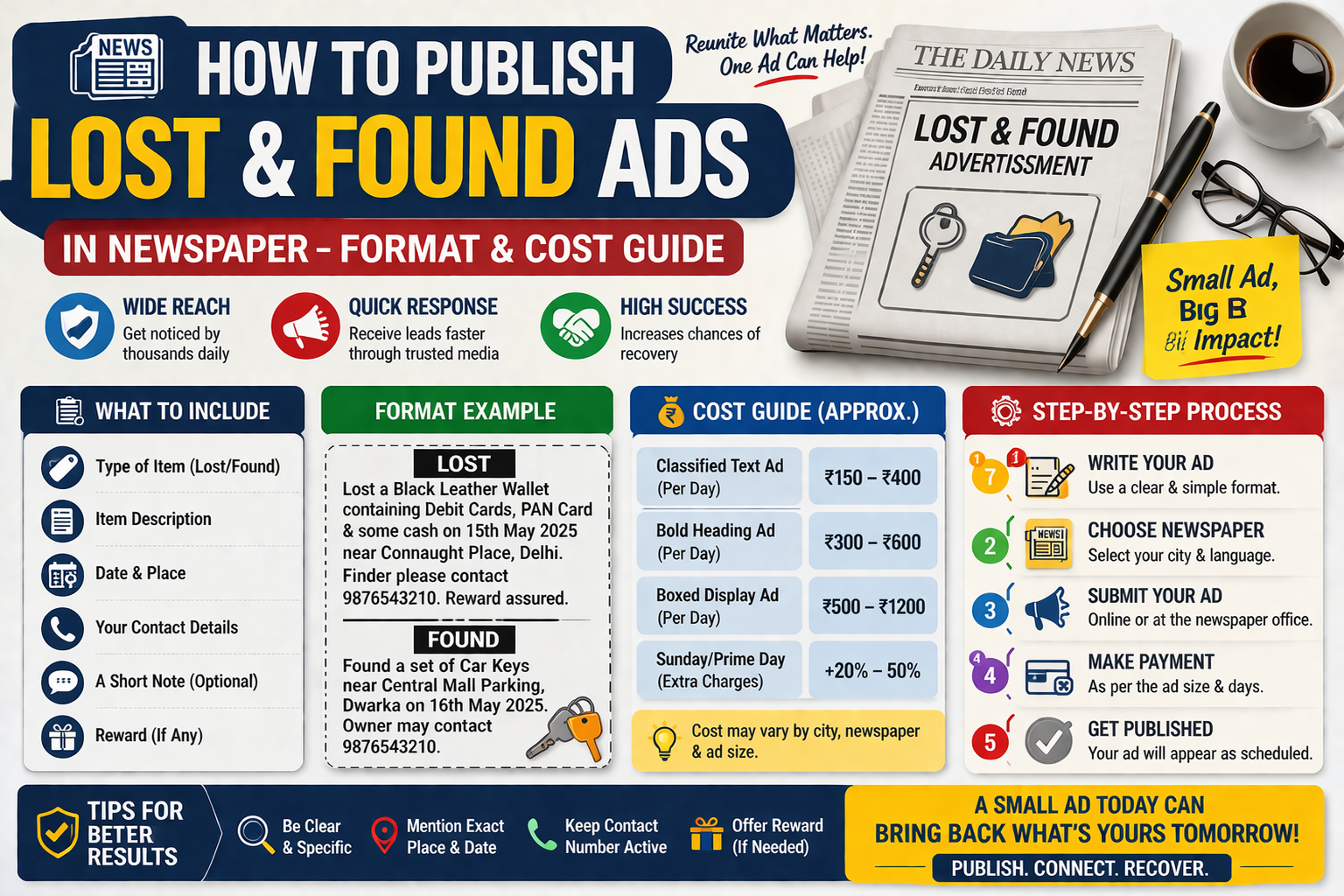
The format is simpler than people expect. There is no official template, but most newspaper classified desks — and the authorities accepting the ad — expect something like this:
Cost Factors: What You're Actually Paying For
The cost of a classified advertisement in newspaper for lost and found varies more than most people expect. Here is what affects the price:
| Factor | Lower Cost Option | Higher Cost Option |
|---|---|---|
| Newspaper | Regional daily (Dinamalar, Eenadu) | National daily (Times of India) |
| City edition | Smaller city edition (₹150–₹300) | Mumbai / Delhi edition (₹500–₹800) |
| Ad format | Text classified (per word/line) | Display ad (box, border, photo) |
| Colour | Black & white | Colour (adds cost, not needed) |
| Publication day | Weekday (Tue–Thu) | Weekend / Sunday edition |
Booking Online vs. Through Agencies
Both work. Each has its place.
Online Booking
Directly through portals like ReleaseMyAd, BookMyAd, or the newspaper's own website. Faster and often cheaper. You fill in the text, pick the edition and date, pay online, and get a booking confirmation. Most portals also deliver a PDF of the published ad within a day or two of publication — useful for documentation.
Through Agencies
Makes sense when placing ads in multiple papers at once, or when you need the ad published quickly and the online portal for that specific paper is slow or unclear. Agencies know which editions are accepted by which offices — that local knowledge has value. If you are placing ads in two papers simultaneously (one English and one regional), an agency can often coordinate that faster.
National vs. Local Newspapers — Which to Choose
For most lost document purposes: local is enough — and cheaper.
National newspapers are usually required only when the issuing authority specifically says "national daily." This happens for some company-related notices, share certificate loss declarations, or cases where the document has legal or financial implications beyond one state.
Local / Regional Paper Is Sufficient For:
- Driving licence replacement
- RC book duplicate application
- PAN card reissue
- Most educational certificate duplicates
National Paper May Be Required For:
- Company winding-up notices
- Share certificate loss declarations
- Documents with cross-state legal implications
- Any case where the issuing authority explicitly specifies "national daily"
How to Write and Book a Lost and Found Ad in Newspaper Today — Step by Step
Identify the Lost Document and Its Issuing Authority
Know exactly what you have lost and which government department or institution handles duplicate issuance. This determines all subsequent requirements.
Call the Issuing Office and Confirm Requirements
Ask whether they need an FIR, a newspaper ad, or both — and whether they specify national or regional paper. Do not assume. One phone call or a check of their official website takes ten minutes and prevents republishing.
Draft the Advertisement
Keep it under 40 words. Include your name, address, document name, document number, and contact details. Add FIR details only if required by the issuing authority.
Book Through an Online Portal or Agency
Go to the newspaper portal (ReleaseMyAd is widely used). Choose the edition, select "Lost and Found" or "Public Notice" as the category, enter your text, select the date, and pay. The whole process takes under 20 minutes.
Download Confirmation and Published PDF
Save the booking confirmation immediately. The published ad PDF is typically available within 24–48 hours of the publication date. Download and store both.
Submit the Ad Clipping or PDF with Your Replacement Application
Attach the newspaper clipping or PDF alongside other required documents (FIR copy, affidavit, identity proof, application form). Keep photocopies of everything before submitting.
10 Frequently Asked Questions
Short and factual works fine. Include your name, address, a brief description of the item, and contact number. For a mobile phone, include the IMEI number if you have it — useful if police pick it up. For a wallet, mention the contents briefly (just "containing [document types]" — not a full list). There is no prescribed format for personal items. Be specific enough that someone who found it can verify it is the right item.
In smaller cities and regional papers, a 25–30 word lost advertisement can cost as little as ₹100–₹180. In national dailies or metro city editions, expect ₹400–₹900 for the same word count. These are approximate 2026 figures — rates change quarterly. Always check the paper's rate card before booking. Do not rely on figures from six months ago.
For RC book replacement, most RTOs ask for a GD entry (General Diary), not a full FIR. For Aadhaar — no FIR is required, and no newspaper ad in most cases either. For a voter ID, a GD entry is usually sufficient. A full FIR is typically required only for passport replacement or if the document was stolen rather than lost. Ask the issuing office. Do not assume.
Local, unless the authority specifically asks for a national daily. A classified ad in a respected regional daily — Mathrubhumi, Ananda Bazar Patrika, Deccan Herald — is accepted by most government offices without question. Spending more on a national edition for a routine document replacement adds cost without adding legal validity.
Go to ReleaseMyAd or a similar portal. Select the newspaper and edition. Choose "Lost and Found" or "Public Notice" as the ad category. Type your text and preview it. Select the publication date. Pay via UPI, net banking, or card. You receive a booking ID immediately. The PDF of the published ad is typically available within 24–48 hours of the publication date.
Something like: "Lost: One gold chain (approx. 10g) near [location] on [date]. If found, contact [Name] at [Number]. Reward on return." For insurance claims involving lost jewellery, check with your insurer before finalising the text — some require the approximate value mentioned, others do not. Getting the format wrong means placing the ad again.
Most portals publish within 1–3 working days after payment confirmation. Some offer next-day publication for ads booked before a cut-off time (usually noon). Weekend bookings sometimes push publication to Monday. If you have a submission deadline, check for express slots and plan a few days' buffer.
Yes. Most online booking portals generate a PDF of the published ad automatically — some send it by email, others require you to log in and download it. If you booked through an agency, ask for it specifically. Do not assume they will send it without prompting. Keep both the booking confirmation and the published PDF. Some offices now accept the digital PDF instead of a physical clipping.
Metro city editions (Mumbai, Delhi, Bengaluru, Chennai) typically run ₹400–₹900 for a standard 30-word classified. Smaller city editions — Mysuru, Coimbatore, Patna, Nagpur — are typically ₹100–₹300 for similar word counts. Regional language papers are generally cheaper than English dailies in the same city. Ask for a rate card comparison before choosing on brand name alone.
Depends entirely on where you are replacing the document. An online complaint (National Cybercrime Portal or a state police e-complaint system) is an administrative record — not a public notice. Most physical document replacement processes at the RTO, passport office, banks, and courts still require the newspaper ad separately. Check first. One phone call saves a lot of trouble.