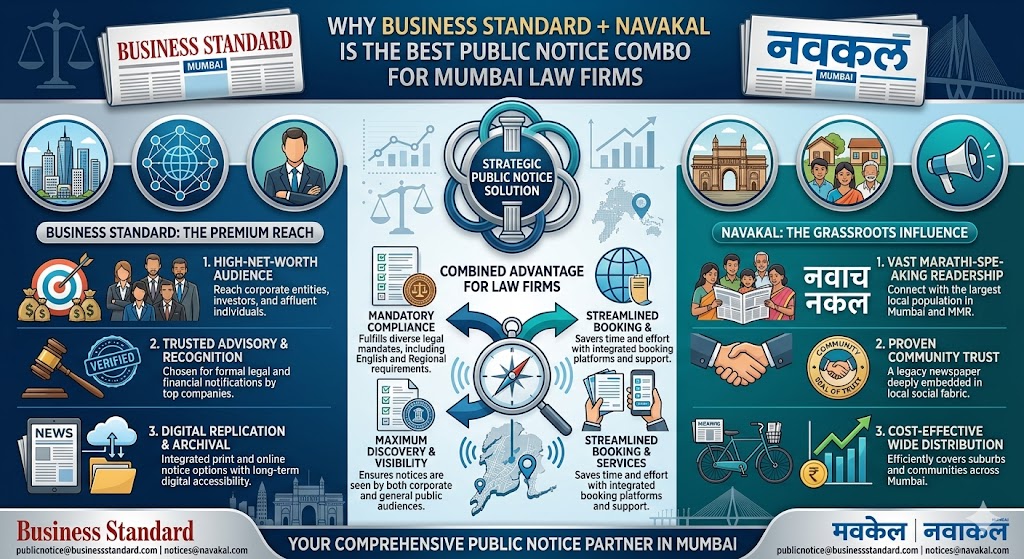
Why the Business Standard + Navakal Combo Is the Best Choice for Mumbai Law Firms
By Kohelica Nag, Freelance Media Writer — covers Mumbai's advertising and print media industry
Every Mumbai law firm handling corporate work eventually faces the same requirement. A matter needs a Public Notice in newspaper Mumbai in two newspapers — one English and one Marathi. The court order requires it. The statute requires it. And the client needs it done fast.
Then comes the practical hassle: which papers to choose, which editions to book, who to contact, how to ensure the Marathi translation is correct, and whether proof of publication will arrive before the next hearing.
This often takes hours for junior associates. But it doesn’t have to. The Business Standard and Navakal combination is widely accepted for Mumbai public notices. Booking both through Riyo Advertising simplifies the process — one draft, one call, one confirmation.
This blog explains why this combination works, what it costs, and how to handle it efficiently.
Would you like me to add more specific keywords (e.g., "NCLT Mumbai" or "legal public notice") or expand this into a full section?
Table of Contents
The Dual Publication Rule: What It Actually Says
Many Indian laws require public notices to be published in two newspapers — one in English and one in the local language.
The Companies Act, 2013 clearly states this. When direct notice is not practical, the notice must be published:
- In an English newspaper
- In a vernacular newspaper
- Both must have wide circulation in the state where the registered office is located
This applies to several common legal situations in Mumbai:
- INC-25 — public notice after company name change
- INC-26 — change of registered office from one state to another
- Form 155 — voluntary striking off of an LLP
- AGM / EGM notices — when direct notice isn’t possible
- NCLT / IBC proceedings — insolvency, creditor notices
- Bombay High Court matters — substituted service, summons, auctions
- Winding-up petitions — pre-hearing publication
In all these cases, the requirement is the same:
one English newspaper + one Marathi newspaper, both with wide circulation.
Choosing the wrong publication can create problems. If the newspaper doesn’t meet the “wide circulation” standard, the notice may be rejected — causing delays and extra work.
Why Navakal: The Preferred Marathi Newspaper for Mumbai Public Notices
Navakal is a well-established Marathi daily based in Mumbai, founded in 1923. It has strong recognition across Maharashtra and long-standing acceptance in legal and regulatory systems.
Key points:
- Around 27% readership share across Maharashtra
- Daily circulation of 44,836 copies in Mumbai
- Over 100 years of continuous publication
For Mumbai public notices, Navakal satisfies the “wide circulation” requirement.
More importantly, it is consistently accepted by:
- Bombay High Court
- NCLT Mumbai
- Maharashtra courts
- Sub-Registrar offices
- State government departments
This long acceptance matters. NCLT Mumbai courts are familiar with Navakal, so filings face no unnecessary questions. Using a lesser-known Navakal Marathi newspaper Mumbai may technically qualify, but it can create avoidable scrutiny. Navakal avoids that risk.
Why Business Standard Meets English Newspaper Requirements for Notices
Business Standard is a leading English business daily with editions in major cities including Mumbai, Delhi, and Kolkata. It reaches readers in over 1,000 towns and cities.
For corporate and legal notices, it fits perfectly.
Key advantages are strong readership among professionals, investors, and corporate stakeholders. It is widely read in legal, financial, and business circles followed by high credibility for compliance-related publications. Moreover, it has 15 million monthly digital users
For matters like NCLT filings, insolvency notices, and Companies Act compliance, Business Standard ensures the notice reaches a relevant audience — creditors, shareholders, and institutions.
While some firms use The Times of India due to its larger general circulation, Business Standard is often more suitable for corporate matters because of its focused readership.
For Mumbai-based filings, it clearly meets the requirement of an English newspaper with wide circulation.
In practice, the Business Standard + Navakal combination works because it meets both legal requirements and practical expectations. It’s widely accepted, reduces risk, and keeps the process straightforward — especially when handled through Riyo Advertising.
What the Combo Actually Costs
Booking ads separately in Business Standard and Navakal means handling two rate cards, two deadlines, two drafts, two payments, and two confirmations. You also need to manage Marathi translation separately, which adds complexity.
With a combo booking through Riyo Advertising, everything is handled in one place. Business Standard newspaper advertisement rates start from ₹250 and can go up to ₹15 lakhs depending on the format and city. Riyo Advertising books ads across categories like Public Notice, Tender Notice, Classified Display, Display, and Obituary.
For a standard classified public notice in both papers, the combo rate is usually lower than booking each paper individually. On classified display ads, you can save around ₹2,000–₹4,000 per insertion.
For law firms handling 10–15 notices monthly—like INC-25s, INC-26s, NCLT filings, or Bombay HC notices—these savings become significant over time.
The Translation Problem (and Why It's Solved Here)
Every English-Marathi combo ad needs two accurate versions—one in English and one in Marathi.
Marathi public notices follow specific formats and language styles. Direct translation can lead to errors, awkward phrasing, or unclear legal meaning, which is risky for legal notices.
Riyo Advertising offers free ad drafting, including Marathi translation. You submit the notice in English, and their team prepares both versions correctly. You can review both in a live preview before confirming.
This reduces errors. A mistake in a legal notice can lead to re-publication and delays, increasing costs.
It’s best to book at least three working days in advance for combo ads. For urgent cases, you can contact Riyo Advertising at +91-9821984000 for possible next-day bookings.
One Draft, Two Papers: The Booking Process
The booking process on riyoadvertising.in is simple and unified:
Step 1 — Go to Public Notice under the Classified section and select the Business Standard + Navakal combo option.
Step 2 — Choose the Mumbai edition for both papers (confirm jurisdiction if required).
Step 3 — Submit your notice in English. Riyo Advertising prepares both English and Marathi versions.
Step 4 — Review both versions carefully in the preview. Fix any errors before publishing.
Step 5 — Make payment via UPI, net banking, or card. GST invoice and booking confirmation are generated instantly.
After publication, soft copy tear sheets for both Business Standard and Navakal are shared via email. Original tear sheets can also be requested for legal filings like Bombay HC, NCLT, or ROC compliance.
Why This Matters for Law Firms Specifically
Law firms handling corporate, insolvency, or civil litigation matters deal with public notices regularly. Even a small mistake can lead to more than just a rebooking fee — it can cause delays, affect filing timelines, create difficult client conversations, and add unnecessary reputational risk.
The Business Standard Navakal combo helps reduce these issues. Both publications are widely accepted, and this combination already has strong precedent across Bombay High Court, NCLT Mumbai, ROC Mumbai, Sub-Registrar offices, and other Maharashtra courts. It also includes Marathi translation and provides a standard proof of publication.
If your firm is still managing notice placements through separate calls, multiple billing processes, and independent translation work, moving to Riyo is a simple shift. It works as a one-call setup, making the entire process more efficient and reliable.
Final tear sheets from both publications are available on request — just ask at the time of booking.
Contact Riyo Advertising: +91-9821984000 | riyoadvertising.in
Frequently Asked Questions
What is the cost of a public notice in Business Standard Mumbai, and how does the combo with Navakal compare?
Business Standard Mumbai classified text public notice rates depend on the number of words and placement. With Riyo’s combo pricing, the total cost of a Business Standard and Navakal public notice in Mumbai is lower than booking each newspaper separately at walk-in rates. For classified display notices, the savings are usually around ₹2,000–₹4,000. This is helpful for law firms that publish notices regularly. Always ask Riyo for a custom quote based on your notice size.
Which newspapers are accepted for NCLT and ROC public notices in Mumbai?
Business Standard (English) and Navakal (Marathi) are widely accepted for NCLT public notice Mumbai and ROC filings. They are commonly used for submissions at the NCLT Mumbai bench, ROC Mumbai, Bombay High Court, and other Maharashtra courts. Other options like Loksatta + Indian Express or Maharashtra Times + Economic Times exist, but the Business Standard Navakal combo notice is the most preferred for corporate matters. Always check your court order before booking.
How many days before should I book a Business Standard and Navakal public notice combo?
You should book at least three working days in advance. This extra time is needed for Marathi translation for public notice and coordination between both newspapers. For Navakal, the Marathi draft must be final before submission. For urgent cases like NCLT filings or Bombay HC deadlines, call Riyo at +91-9821984000 instead of relying on standard timelines.
Do I get original tear sheets after publication for both newspapers?
Yes. Riyo provides soft copy tear sheets for public notice proof via email for both Business Standard and Navakal. If you need physical tear sheets, request them at the time of booking. For Bombay HC filings and NCLT submissions, confirm whether soft or physical copies are required.
Can I book Business Standard + Navakal combo for a property notice in Mumbai?
Yes. A property public notice Mumbai newspaper is commonly published using this combo for property auctions, mortgage enforcement, and court notices. Business Standard meets the English requirement, while Navakal covers the Marathi requirement. This combination is accepted by Mumbai Sub-Registrar offices and Maharashtra courts. For commercial properties, Business Standard works well. For residential notices, you may consider a wider Marathi paper for better local reach.
What is the circulation of Business Standard in Mumbai?
Business Standard Mumbai is part of a 12-city English network reaching over 1,000 towns across India. It is India’s second-largest business daily with around 15 million monthly digital readers. For legal requirements like the “wide circulation” test, Business Standard easily qualifies. Its readership includes professionals like creditors, directors, and investors.
What is the circulation of Navakal in Mumbai?
Navakal Mumbai has a daily circulation of 44,836 copies. Founded in 1923, it has strong recognition in Maharashtra with a 27% readership share. For legal purposes, its long-standing acceptance in courts makes it a reliable choice for vernacular newspaper requirements.
What is an INC-26 public notice and why does it require both papers?
An INC-26 public notice is required when a company shifts its registered office from one state to another. The law requires publication in:
- A vernacular language newspaper with wide local circulation
- An English newspaper with state-level circulation
In Mumbai, Navakal fulfills the vernacular requirement, and Business Standard fulfills the English requirement. Both are mandatory. Missing either or choosing the wrong publication can delay or reject your ROC filing.
How does Riyo handle the Marathi translation for the Navakal notice?
Free drafting. Submit your notice content in English, and Riyo will create the correctly formatted Marathi public notice for Navakal. You can see both English and Marathi versions in a live preview before confirming and paying. Review both carefully. The Marathi version is not just a translation—it follows Navakal’s public notice format. If you try to do this yourself and make mistakes, fixing it later can cost more than the original booking. It’s better to use the drafting service.
Are Business Standard and Navakal accepted for Bombay High Court substituted service?
Yes, in most cases. Bombay High Court substituted service usually requires one English daily and one Marathi daily with wide circulation in the relevant area. Business Standard and Navakal meet these requirements for Mumbai. Always follow the exact instructions in the court order. If specific newspapers are mentioned, use those. If it says “English and Marathi daily of wide circulation in Mumbai,” then Business Standard + Navakal is the common choice. If unsure, confirm with your advocate before booking.
Can Riyo Advertising manage multiple public notice bookings per month for a law firm?
Yes. Many law firms regularly handling INC-25, INC-26, NCLT, and Bombay High Court matters work with Riyo on a monthly basis. The team manages bulk bookings, keeps formatting consistent, and tracks publication dates. If your firm handles 10 or more notices per month, working directly with Riyo’s team is easier than booking only through the website. Call +91-9821984000 to set up a smooth process for regular legal notice ad bookings in Mumbai.
What if my matter requires publications in a different date on each paper?
In that case, book them separately. Combo pricing usually assumes both ads will be published on the same day, which works for most cases. But if your court order requires different dates, or deadlines vary between papers, Riyo can handle each booking individually. Make sure to inform the team before booking. Do not assume the website combo option supports different dates automatically—wrong publication timing can make the notice invalid for court use.