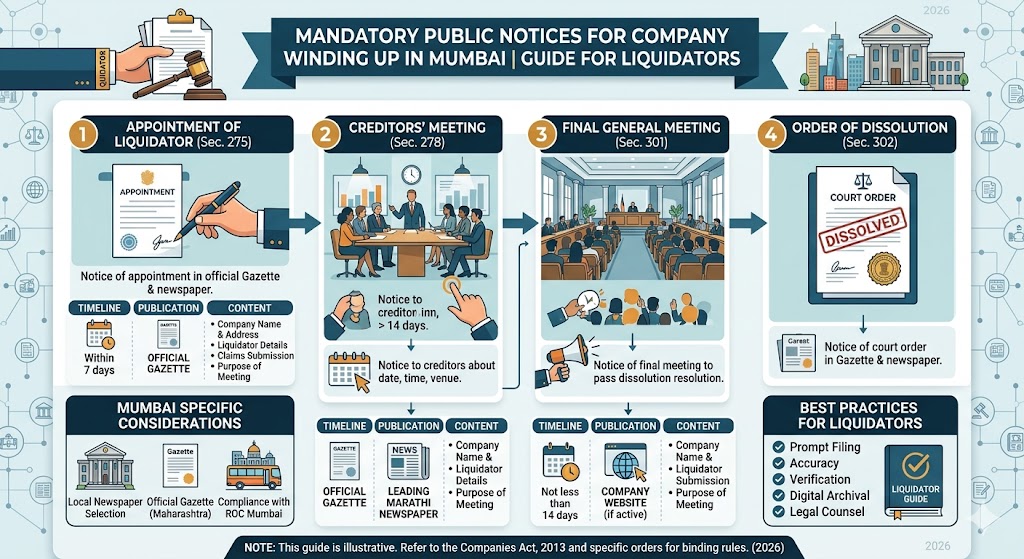
Mandatory Public Notices for Company Winding Up in Mumbai: What Liquidators and CS Professionals Need to Know
By Kohelica Nag, Freelance Media Writer — covers Mumbai's advertising and print media industry
A CS professional I spoke to last year described the newspaper publication step in a winding-up matter as “the part everyone thinks is easy until it isn’t.”
She had seen a case delayed at NCLT Mumbai because the liquidation public notice was published in the wrong edition — a Delhi edition of an English daily instead of Mumbai, where the company’s registered office was located. The rules are strict, and the Tribunal does not overlook such mistakes.
This guide is for liquidators, CS professionals, and advocates handling company winding up in Mumbai. It explains what is required, when to do it, and how to manage it smoothly through Riyo Advertising without wasting time.
Table of Contents
- The Legal Obligation: What the Rules Actually Require
- What Must Be Included in Each Notice
- The Publication Timeline: When Each Notice Must Appear
- Choosing the Right Papers for a Mumbai Winding-Up Notice
- The Checklist: From Draft to Tear Sheet
- Why Riyo Advertising for Winding-Up Notices
- Frequently Asked Questions
The Legal Obligation: What the Rules Actually Require
The Companies (Winding Up) Rules, 2020, effective from April 1, 2020, clearly define the newspaper publication requirements for tribunal-ordered winding up. For Mumbai, this means English and Marathi newspapers.
- Form WIN-6 (Advertisement of the winding-up petition): Published at least 14 days before the hearing.
- Form WIN-14 (Advertisement of the winding-up order): Published within 14 days of the order.
- Form WIN-43 (Notice for proving debts): Published within 30 days of the order, giving creditors 14 days to claim.
- Additional creditor meeting notice Required if there are more than 500 creditors.
Every missed or incorrect publication creates a procedural gap that can be challenged before the Tribunal.
What Must Be Included in Each Notice
Getting the content right is just as important as publishing it correctly. A defective notice can be challenged in NCLT, causing delays and extra costs.
- Form WIN-6: Company name, registered office, nature of petition, petitioner details, and NCLT hearing date.
- Form WIN-14: Date of order, NCLT bench reference, liquidator name, and claim filing instructions.
- Form WIN-43: Deadline for proving debts (min. 14 days), liquidator contact, and submission address.
Riyo Advertising offers free drafting for winding-up notices. Their team prepares the ad in both English and Marathi, properly formatted to avoid NCLT objections.
The Publication Timeline: When Each Notice Must Appear
The Winding-Up Rules have strict, non-negotiable timelines:
| Notice Type | Deadline |
|---|---|
| Petition (WIN-6) | At least 14 days BEFORE the hearing |
| Order (WIN-14) | Within 14 days OF the order date |
| Debt Proving (WIN-43) | Within 30 days of order (with 14-day window) |
For urgent cases, contact Kirti Mane or Surya at Riyo Advertising (+91-9821984000) for possible next-day publication.
Choosing the Right Papers for a Mumbai Winding-Up Notice
For Mumbai-based companies, the Business Standard + Navakal combination is the industry standard.
- Business Standard (English): Reaches 1,000+ towns. It is the preferred choice for ROC compliance ads Mumbai because its readership consists of CAs, CS professionals, and creditors.
- Navakal (Marathi): With 100+ years of legacy and a 27% readership share, it is consistently accepted by NCLT Mumbai and the Bombay High Court for vernacular requirements.
The Checklist: From Draft to Tear Sheet
Follow these steps to ensure your filing is watertight:
- Identify Form: WIN-6, WIN-14, or WIN-43.
- Gather Content: Case number, Liquidator details, and NCLT bench.
- Book via Riyo: Select the Business Standard + Navakal combo.
- Review Previews: Verify English and Marathi drafts match the court order.
- Collect Proof: Obtain soft copy and original physical tear sheets.
- File WIN-31: File the affidavit of publication with the Tribunal.
Why Riyo Advertising for Winding-Up Notices
Riyo Advertising is an authorized agency managing both Business Standard and Navakal placements.
- Volume-Based Rates: Save ₹2,000–₹4,000 compared to walk-in card rates.
- Free Marathi Translation: Accurate translation for Navakal at no extra cost.
- Instant GST Invoicing: Essential for professional firm billing.
- Urgent Support: Specialist handling of tight NCLT deadlines.
Contact Public Notice Ad : +91-9821984000 | Public Notice Ad
Frequently Asked Questions
What is the cost of a public notice in Business Standard Mumbai for a winding-up matter?
Classified text rates for public notices usually start from ₹100–₹500 per word, depending on the edition. Display ad rates range from ₹500–₹2,000 per square centimetre. For a winding-up notice in Business Standard Mumbai, the final cost depends on the word count of the WIN-form text and whether you choose classified text or classified display format. With Riyo's volume-based agency pricing, you often pay less than standard walk-in rates. The difference for a typical classified display notice can be around ₹2,000–₹4,000. It’s always better to get a quote first, as rates can change every quarter.
Which newspapers are accepted for NCLT and ROC notices in Mumbai?
As per the Companies (Winding Up) Rules 2020, you must publish in one English daily and one regional language daily that have wide circulation in the State. For Mumbai and Maharashtra, Business Standard (English) and Navakal (Marathi) are the most commonly used combination for NCLT public notice Mumbai and ROC compliance ads Mumbai. These newspapers are widely accepted by the NCLT Mumbai bench and ROC Mumbai. If the NCLT order mentions specific newspapers, follow that. If it only says “widely circulating English and Marathi daily,” then Business Standard and Navakal is the standard choice.
How many days before the NCLT hearing should I book the WIN-6 petition advertisement?
The rule requires publication at least 14 days before the hearing. To allow for Marathi translation and coordination, you should book with Riyo at least three working days before your target publication date. For emergencies, call +91-9821984000 to check for next-day availability.
Do I get original tear sheets after publication for both English and Marathi papers?
Yes. Riyo provides soft copy tear sheets via email within a few days. However, for NCLT compliance and filing the Form WIN-31 affidavit, you should specifically request physical original tear sheets at the time of booking.
Can I book Business Standard + Navakal combo for a company winding-up notice?
Yes, the Business Standard + Navakal combination is the standard for a company winding up notice Mumbai and other statutory notices. It meets both English and Marathi publication requirements under the Companies (Winding Up) Rules 2020. With Riyo’s combo booking, you can manage everything in one process—one draft, one payment, and confirmations for both publications. This is especially helpful for notices like WIN-6, WIN-14, and WIN-43 in multi-notice matters.
What is the circulation of Business Standard in Mumbai and why does it matter for winding-up notices?
Business Standard’s Mumbai edition is part of a 12-city network that reaches over 1,000 towns and cities across India, along with 15 million monthly digital users. It is widely read by CAs, CSs, legal professionals, and finance experts across Maharashtra—exactly the audience relevant for a winding-up creditor notice. This ensures it meets the “wide circulation” requirement under the Winding Up Rules 2020. Using a newspaper that reaches your actual target audience also increases the chances that creditors and stakeholders will see the notice, not just that it was published.
What are the three main notice forms used in a company winding-up by NCLT?
There are three key notices that must be published in newspapers under the Companies (Winding Up) Rules 2020. Form WIN-6 is the petition advertisement and must be published at least 14 days before the NCLT hearing. Form WIN-14 is the advertisement of the winding-up order and must be published within 14 days of the order. Form WIN-43 is the notice for creditors to submit their claims, issued by the Company Liquidator within 30 days of the order, giving at least 14 days to respond. All notices must be published in both English and a vernacular language (Marathi for Mumbai). Missing any of these can create procedural issues.
What is the difference between voluntary liquidation and compulsory winding up for newspaper publication purposes?
Both processes require newspaper publication, but the rules are different. Compulsory winding up by NCLT under the Companies Act 2013 follows the Companies (Winding Up) Rules 2020, where the WIN forms are used. Voluntary liquidation under Section 59 of the IBC 2016 is handled by an Insolvency Professional and follows IBBI regulations. These have separate notice formats and timelines. While both usually require publication in two newspapers, always confirm the exact requirements with the assigned Insolvency Professional and check the latest IBBI guidelines.
Can Riyo Advertising provide urgent notice placement for winding-up matters with tight NCLT deadlines?
Yes, urgent notice placement is available. You can call +91-9821984000 for same-day or next-day bookings. The team regularly handles urgent IBC and NCLT notices. Normally, booking should be done at least three working days in advance. Urgent placements depend on newspaper deadlines, so it’s always better to book early once the NCLT hearing date is fixed.
How does a Company Liquidator handle the proof of publication requirement for the Form WIN-31 affidavit?
The Company Liquidator files an affidavit in Form WIN-31 confirming that notices were sent to creditors. Newspaper tear sheets from both English and vernacular publications are used as proof. It’s important to keep both physical copies and soft copies. In cases with many or disputed creditors, this helps avoid legal challenges. Some liquidators also request an affidavit of publication from the newspaper. You can check with Riyo Advertising at the time of booking if this option is available.
What happens if the winding-up public notice is published in the wrong edition or with incorrect content?
If the notice is published in the wrong edition or has incorrect details, it can be treated as defective by the NCLT. A creditor’s advocate may raise a procedural objection. In serious cases, the liquidator may need to re-publish the notice and restart the entire timeline. For WIN-6 (petition advertisement), this could mean the hearing has to be relisted. For WIN-43 (debt-proving notice), the claim-filing period will start again. This leads to extra cost and delays in an already slow process. That’s why it’s important to ensure the correct edition, proper form number, accurate dates, and the right format. To avoid such issues, use Riyo's drafting service and carefully review both the English and Marathi previews before making the payment.
Need an Approved Legal Notice Template?
Don't risk your property transaction with a bad format. Get your rate card and approved template in 30 minutes.