Updated 2026 | Public-NoticeAds.in | Legal Guidance India
The Nightmare Scenario — And Why You Need to Act Fast
Realizing your original sale deed or society share certificate is missing can feel like a legal nightmare. In India, these documents are the "paper bedrock" of ownership. Without them, your property is effectively frozen—you cannot sell, mortgage, or gift it.
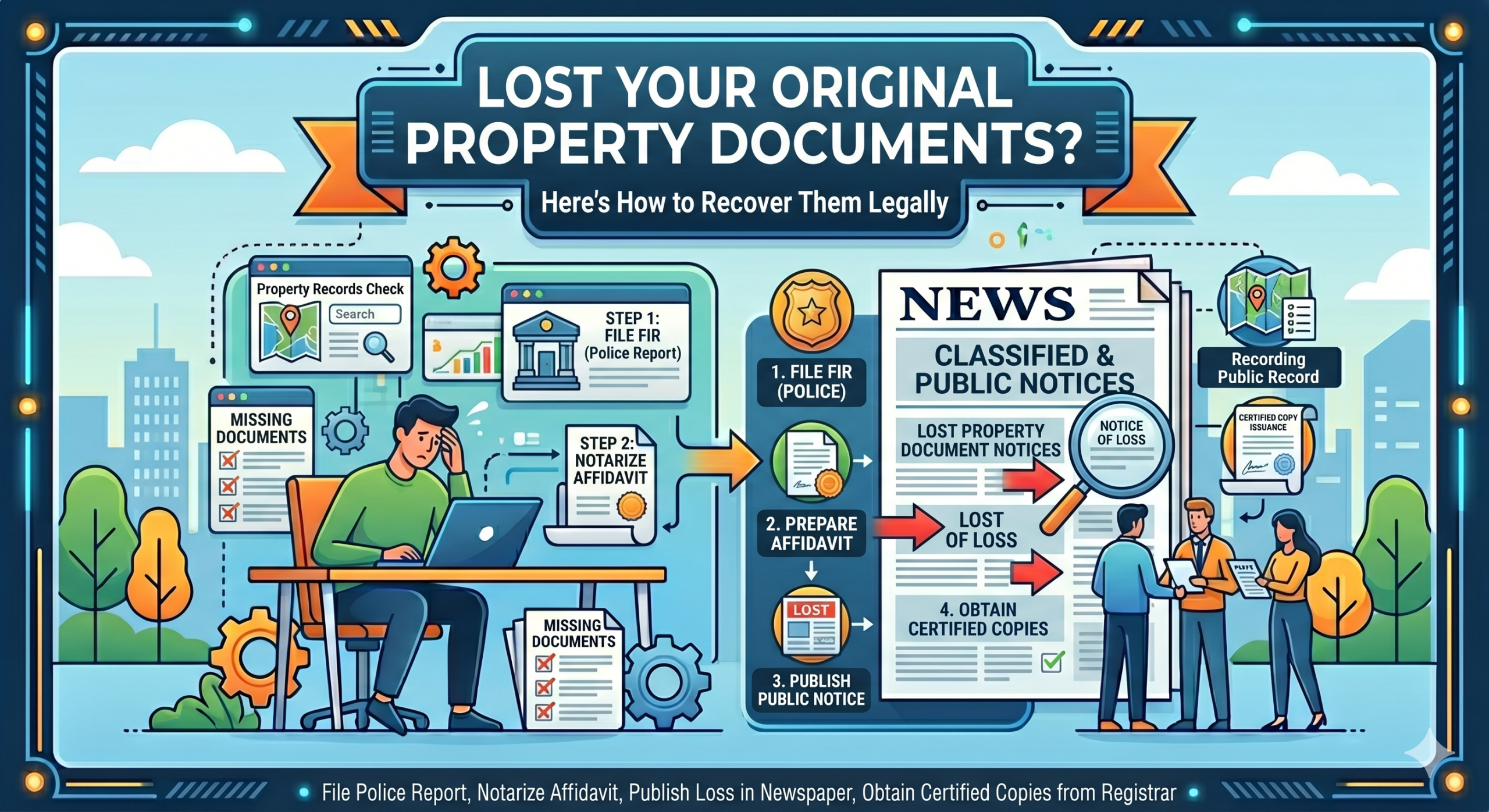
The good news? The law provides a process to restore your legal standing. Follow these four essential steps to obtain your Certified Copy.
The moment you realize the documents are gone, head to the local police station in the area where the documents were lost.
- 1. Step 1: Immediate Action — The Police Complaint
- 2. Step 2: The Mandatory Public Notice Advertisement
- 3. Step 3: Managing Share Certificates for Housing Society
- 4. Step 4: Applying for a Certified Copy
- 5. Checklist of Documents Needed to Book Your Ad
- 6. Secure Your Property's Future — Don't Wait
- 7. Frequently Asked Questions (FAQs)
Step 1: Immediate Action — The Police Complaint
The first step in the document recovery process is to visit the nearest police station and file a complaint as soon as you realise your documents are lost. That's not a formality, but a legal requirement for all the steps that follow in the process of recovering your documents. Unless you have a dated police complaint, you won't get any duplicate documents from any Sub-Registrar's office, any housing society, or any newspaper.
FIR vs. NCR — Understanding Which One You Actually Need
And this is where many people go wrong, early on, so take a minute to understand. Which police report you should file depends on how the document went missing.
If your documents are stolen - they were stolen from your house during a break and enter, they were taken from you, or they were removed from your house against your wish - you file a First Information Report (FIR). An FIR is a cognizable complaint that will trigger a police investigation and is a very serious document.
If your documents were misplaced - you relocated, you don't recall where you left the documents, or they were lost during the time of shifting or renovating - then you need to file a Non-Cognizable Report (NCR) (also referred to as a "Lost & Found" report).
The majority of cases of lost property documents are NCRs, which is perfectly acceptable. NCRs are accepted by all Sub-Registrars, societies and newspapers for duplicate document applications. What's important is that you have a police station document, dated, stamped and signed about reporting the lost document.
Submit Quickly via Online Police Portals
The majority of state police forces - such as the Delhi Police and Maharashtra Police - have online portals to report a lost document from your computer. This can be useful for NCR-related complaints. The online report you get is valid for housing societies and most newspapers. However, if there's the slightest chance of theft, be sure to visit the police station to ensure an FIR is filed as opposed to a mere complaint online.
The One Detail You Must Not Overlook
Whether you file an FIR or an online complaint, be sure to include in the complaint details of the document number, the type of document (e.g., Sale Deed, Share Certificate, Conveyance Deed), and the full address of the property. A generic complaint, "property papers are missing" will result in confusion later when the Sub-Registrar's office is searching for your document. Be precise. This one thing could be the key to a quick duplicate issuance or weeks of red tape.
Step 2: The Mandatory Public Notice Advertisement
Once you've obtained your police complaint, the next step may come as a surprise to many property owners who are going through this process for the first time: you have to run a public notice advertisement in the paper. This is mandatory, and it's not a case of red tape - it's actually highly important.
The Two-Newspaper Rule and Why It Exists
By legal standard, you need to publish your lost document notice in two newspapers - one English-language daily newspaper with regional coverage and one local language newspaper (Marathi, Hindi, Kannada, Tamil etc. - depending on your state). Why two newspapers? The answer is: to reach as many people as possible. Real estate deals have English and non-English buyers, sellers, bankers, lenders, third parties, and so on. This dual-advertisement requirement means that persons who may come into possession of your "lost" document - or who may be presented with a copy of it - are on notice that the document is in trouble.
It's this advertisement that converts your loss from a private matter to a public record. It notifies banks that they cannot accept the document as collateral for a loan, informs potential buyers that the original document is missing, and provides an opportunity to anyone who may have found the document (or fraudulently acquired it) to return it before legal issues are raised.
What Your Ad Must Say to Hold Legal Validity
The lost property document notice is not a casual thing to be worded. To be accepted by the office of the Sub-Registrar and by the housing societies, it should include: your full name as on the property document, your full current address, the nature of the lost document (sale deed, share certificate, conveyance deed, etc.), the number and the date of the executed document (where available), the complete address of the property including the survey number or flat/plot number, and a declaration inviting objections.
Most property owners end up writing this ad by themselves and fail in its rejection due to the absence of any of these elements. By going through a service such as Public-NoticeAds.in which offers ready-made legal templates tailored to the exact requirements of the type of notice you are making (or, in this case, the type of lost document notice), this risk can be completely removed and your advertisement will be printed to the precise specifications needed by the office of the appropriate Sub-Registrar.
The Fraud Prevention Function
This is what it is worth highlighting individually since it is the one that shields you the most in terms of financial loss. To the third party who sought to take a loan against your property by the use of your lost original sale deed, the fact that you have a published public notice on record is the first line of legal defense. It has always been determined by the courts that a party dealing in a document which is publicly announced as lost can not claim to be a bona fide purchaser or lender for value without a prior notice. Your shield is that newspaper cutting, which was filled in with your duplicate documents.
Step 3: Managing Share Certificates for Housing Society Members
When you have lost a share certificate of your Cooperative Housing Society, not (or as well as) a sale deed, there is an equivalent series of procedures, which runs parallel to all the above.
Formally Informing the Society's Managing Committee
The first thing that you should do is to send a formal letter to the Secretary or Manager of your housing society and report about the loss. It is not merely a courtesy, but it sets the machine of the society at work to give you a duplicate, and it safeguards you by making a record of the date on which the case was presented. The letter will indicate the certificate number, the amount of shares the certificate represents and the loss circumstances. Please attach copy of your police complaint (FIR or NCR) to this letter.
The Indemnity Bond — Non-Negotiable
Each housing society will demand that you sign a notarized indemnity bond, prior to them authorizing you to take a duplicate share certificate. This is your legal commitment to the society that you will indemnify them, that is, you will compensate and protect them against any claim, cost or loss that would occur in future should the original certificate ever be recovered, and somebody comes to assert possession. Your indemnity bond should be printed on a stamp paper of such value as is required by the stamp duty laws of your state and signed in the presence of a notary.
This is a natural demand and society is justified in demanding this. Write it or get a property lawyer to write it. An ill-framed indemnity bond may be dismissed by the society committee or worse still, it may make you have half-baked coverage.
The 15-Day Objection Period — You Must Wait It Out
Once you have put up your newspaper notices, the society will normally take 14-15 days to process your duplicate share certificate application. This window is to allow the public (and any persons who may have any claim) time to send objections to your published notice. In case no objections are received in the course of this period, the society goes on with the issue of the duplicate. In case an objection is taken, it must be settled before the duplicate can be published, and that might involve the courts. In practice, where we have real cases of loss, there can be few objections.
Step 4: Applying for a Certified Copy (Duplicate Sale Deed)
Now, having your police complaint in hand, your newspaper notices in print, and your affidavit duly notarized, you are now prepared to go to the office of the Sub-Registrar to apply to him to grant you a Certified Copy of your original sale deed or conveyance deed.
Which Sub-Registrar's Office to Visit
It is not the nearest office of the Sub-Registrar to your home, but the office of the Sub-Registrar in the jurisdiction of which your property is situated, and where the original deed was registered. The books of the office that registered the original transaction hold property registrations and only that office can produce a certified copy. When you do not know which office that is, the title number of any other papers you may have (such as those of your society, or copies taken at a bank) will give you the registration number and the office.
Your Complete Document Package
When visiting the Sub-Registrar, take the original FIR or NCR, along with self-attested copy, the original newspaper cuttings of both publications, along with self-attested copies, a notarized affidavit stating how the original was lost, and declaring that no sale, mortgage, or transfer was made using the original, your photo ID (Aadhaar or PAN card), and the application form to a certified copy.
The Legal Standing of a Certified Copy
An authorised copy provided by the office of Sub-Registrar is not a prize of any kind. A copy of a registered document when certified under the Indian Registration Act and the regulations of the transactions of the property becomes admissible in a court and is admitted by banks, lending institutions, and purchasers as a good title. Combined with your newspaper clippings and affidavit--that you took the full due process--it makes a title chain legally sound, and one on which transactions can be subsequently based.
Checklist of Documents Needed to Book Your Public Notice Ad
You should be ready before you go to a newspaper or site such as Public-NoticeAds.in to post your lost document notice before you do so. Have ready:
- A copy of your FIR or NCR (obtained at the police station)
- A photo ID issued by the government (such as your Aadhaar or PAN card)
- Documentary evidence of your relationship with the property (such as an allotment letter of your society, possession letter, a bank loan document that mentions the property address)
- A draft or note of the exact document details including type, number, and date
With such documents in place when you sit down to place the ad, you save time and the published notice will have the right information that will withstand scrutiny in the future.
Secure Your Property's Future — Don't Wait
The Hidden Risk of Delay: Why You Must Report Lost Property Documents Immediately
It is human nature to put off paperwork, especially when the issue isn't causing immediate harm. However, a misplaced property document is a growing liability. Every day that passes without a police report is a day your title deed could be misused.
If your Sale Deed, Conveyance Deed, or Share Certificate is missing—the clock is ticking. An unreported loss leaves your property vulnerable to fraudulent loans or unauthorized claims.
The 48-Hour Recovery Plan
- Day 1: Register your NCR (Non-Cognizable Report) or FIR at the local police station the moment the loss is discovered.
- Night 1: Gather your secondary paperwork (tax receipts, index II, or photocopies).
- Day 2: Book your Newspaper Public Notice to freeze any potential misuse and begin the legal reclamation process.
The Real Cost of Legal Integrity
Repairing the legal integrity of your largest asset is surprisingly affordable and efficient when handled correctly. While the process is vital, the cost in India is significantly lower than in many international markets. A complete recovery—including the dual-newspaper advertisement, notary fees, and the Sub-Registrar’s certified copy fee—typically ranges from ₹15,000 to ₹35,000 (depending on the newspapers chosen), rather than thousands of dollars.
For a fraction of your property's value, you can restore its "marketable title" in just 3 to 4 weeks.
Simplified Public Notice Booking via Public-NoticeAds.in
Navigating the specific wording required by Sub-Registrars and Housing Societies can be a minefield. Public-NoticeAds.in provides a streamlined, digital-first solution for homeowners in Maharashtra, Delhi, Karnataka, and beyond.
Why Use Our Pre-Tested Templates?
- Legally Compliant: Our templates are vetted to meet the standards of Sub-Registrars and Co-operative Housing Societies (CHS).
- Instant Ad Creation: Draft, revise, and schedule your ad in both required newspapers (English and Regional) in one sitting.
- Physical Proofing: We don't just publish; we ensure the physical newspaper clippings are sent to your doorstep for your permanent legal files.
Discovered your property documents are missing? Don't wait — book your mandatory public notice advertisement on Public-NoticeAds.in today and get your duplicate documents process started on the right legal footing.
Frequently Asked Questions
1. Is an online police complaint enough for a lost share certificate?
Yes, in most cases, an online report is legally valid for property-related advertisements. Your digitally produced Lost & Found report (or NCR) from an official portal—such as the Maharashtra Police Citizen Portal, Delhi Police Lost Report, or the Karnataka E-Lost Report app—is now widely accepted by the managing committee of housing societies and newspaper ad booking websites.
These digital documents contain a unique complaint number, a timestamped date, and a QR-coded digital signature, which provide the necessary legal verification to apply for a duplicate share certificate and book a Public Notice advertisement.
While most institutions recognize these as valid proof of loss, if your Co-operative Housing Society (CHS) or the Sub-Registrar specifically insists on a physical, stamped FIR, you can visit your local police station to seek one. However, for a standard case of lost documents, the online lost report is the most efficient way to initiate your newspaper ad booking and legal reclamation process.
2. Why do I need to publish the ad in two newspapers?
The reason for publishing the notice in two newspapers is to ensure that it reaches most people across language barriers. Real estate deals involve buyers, lenders and brokers from all walks of life and a notice published in English alone won't reach a buyer that speaks a regional language or a local moneylender who comes across your lost paper. This means that you reach all parts of the relevant community in both an English and vernacular newspaper, so that no part of the relevant public will be able to claim they did not notice the loss of the document.
3. What if I find my original document after publishing the ad?
This is a problem we want to have - but it must be managed appropriately. Notify your housing society or the Sub-Registrar's office (in writing and in a timely fashion) of this discovery, recording the date of the rediscovery. If a duplicate share certificate has already been issued, you should inform the society so that they will amend their records to identify the operative document. Presumably, the duplicate that was issued lawfully becomes the operative document from henceforth; the original document should be stamped "Found - Superseded by Duplicate No. [X]" and filed away in your permanent file as a historical record, but not used for any transaction.
4. Can someone else use my lost property papers for a loan?
This is where the public notice advertisement is critical. Publication in two newspapers creates a legal presumption that everyone (including banks and NBFCs) is "put on notice" that you have reported the loss of the document. Banks and NBFCs typically have compliance checks that pick out properties with published lost notices. More importantly, if someone takes a fraudulent loan on the basis of your lost document after the notice has been published, you will have a good legal defence and the loan defaulting party cannot argue that he or she is an innocent third party who was acting in good faith.
5. How long should I keep the newspaper cutting?
Permanently, without exception. The newspaper cutting from both newspapers should be kept in a single file with your duplicate sale deed or share certificate, your FIR or NCR, and your notarized affidavit. This file is your "due process" - proof that you have done all that is necessary to replace the lost original. Any new buyers, banks and lawyers will want to see this file, and the more complete it is the easier your future transactions will be.
6. Does the society charge a fee for a duplicate share certificate?
Yes, the majority of Cooperative Housing Societies levy a small administrative fee for issuance of a duplicate share certificate, and this fee is usually specified in the society's registered bye-laws. The amount of the fee differs between societies - it could be anything from ₹500 to as much as ₹2,000 in larger metropolitan societies. In addition to the fee, you also need to incur the cost of the stamp paper for the indemnity bond and the notary's fee for attesting it.
7. Can I sell my property using only the FIR copy?
No, and this is a crucial point to remember. An FIR or NCR is a document relating to your loss - it is not a substitute for the lost document. Selling a property requires proof of title, police complaint is not proof of title. You need the original document or the Certified Copy from the Sub-Registrar's Office to make a legal sale. This Certified Copy, along with your newspaper clippings and affidavit, is proof of title and can be used to prepare a sale deed.
8. What details are mandatory in a "Lost Document" advertisement?
To meet the criteria of Sub-Registrars and housing societies, a lost document advertisement must contain the full name of the registered owner as mentioned in the document, the full address of the property along with survey numbers, flat numbers or CTS numbers if applicable, the type of document (sale deed, share certificate, conveyance deed, etc.), the document number and date if available, a clear statement that the document is lost and reported to the police (along with the complaint number), a 15-day period for public objections (with an address to send the objections) and the address and contact details of the owner.
9. How much does it cost to get a duplicate sale deed in total?
There are three parts to the cost. Advertisement in two newspapers ranges from ₹800 to ₹1,500 depending on the city, newspaper and number of words in the advertisement. The notary's fees for the affidavit are between ₹300 and ₹600 depending on the value of the stamp paper required in your state. The government fee charged by the Sub-Registrar for a certified copy ranges from state to state but averages between ₹200 and ₹1,000. So, the entire procedure typically costs between ₹1,500 and ₹3,000, which is well worth it to avoid complications when selling a property.
10. Why book your public notice through Public-NoticeAds.in?
We at Public-NoticeAds.in cater to the critical market of public notice ads. In the case of lost property papers, the wording of your advertisement is crucial; an oversight on your part could cause the Sub-Registrar of Assurances or the Managing Committee of your Co-operative Housing Society (CHS) to reject your application.
Rather than drafting your own notice, and potentially encountering delays, our service enables you to use pre-approved templates in the format required for the major Indian states of Maharashtra, Delhi and Karnataka. This guarantees you have included all the essential components of the ad.
And our service simplifies the bureaucratic procedure: we ensure publication in both the mandatory English language newspaper and the vernacular (local) newspaper. After publication, we also provide original newspaper clippings to your doorstep, allowing you to produce tangible evidence to obtain your duplicate share certificate or certified sale deed.