Gadget Certificate Requirements & Publication Process in India: Complete Guide
Introduction: Understanding Gadget Certificates and Legal Compliance
A gadget certificate is an official government document that certifies the authenticity and specification of electronic gadgets or equipment. For some devices imported into India or used in India, a gadget certificate is mandatory for legal compliance.
A gadget certificate is, in fact, an essential requirement in the world of technology for ensuring legality. In the realm of technology, gadget certificates play a crucial role in ensuring legality.
If you are looking to import smartphones, laptops, medical gadgets, or electronic devices, or just need to register gadgets with government departments, then it is important that you know about gadget certificate requirements and the publication process.
This is an exhaustive guide for all gadget certificates in India that describes what it is, who can avail, how to get it and the entire publication process.
What Is a Gadget Certificate? Complete Definition
Definition and Purpose
A gadget certificate is an official document that is issued by a government authority or an authorized agency that certifies:
- Authenticity of an electronic device
- Technical specifications of the device
- Compliance with Indian standards (BIS, WPC, etc.)
- Safety standards and quality requirements
- Origin and manufacturing details
- Legal permission to use/import the device
Types of Gadget Certificates in India
1. BIS (Bureau of Indian Standards) Certificate
- Most common type
- Issued for electronics, appliances, lighting
- Ensures product meets Indian safety/quality standards
- Mandatory for many consumer products
2. WPC (Wireless Planning Commission) Certificate
- Issued for wireless devices
- Required for mobile phones, WiFi devices, RF equipment
- Certifies compliance with wireless frequency regulations
- Essential for smartphone sales in India
3. IMEI Registration Certificate
- Issued for mobile devices
- Registers device internationally
- Prevents counterfeit phones
- Required for device activation
4. Customs Clearance Certificate
- Issued during device import
- Certifies device has cleared customs
- Mandatory for imported electronics
- Required for entry into India
5. Environmental Compliance Certificate
- Issued for e-waste compliance
- Certifies device meets e-waste regulations
- Extended Producer Responsibility (EPR) compliance
- Required for device sales
6. Quality Assurance Certificate
- Issued by manufacturers
- Certifies device quality standards
- May be required by government offices
- Needed for official procurement
Who Needs a Gadget Certificate?
Gadget certificates are required in these situations:
Manufacturers & Importers
- Smartphone manufacturers — WPC certificate mandatory
- Electronics importers — BIS and customs certificates
- Device distributors — Compliance certificates
- Equipment manufacturers — Industry-specific certificates
Businesses Using Devices
- Government offices — Device registration and compliance
- Banks and financial institutions — Security devices
- Hospitals and medical centers — Medical equipment certificates
- Educational institutions — Lab equipment, devices
- Corporate offices — Network equipment, servers
Individuals in Specific Cases
- Importing personal electronics — Customs gadget certificate
- Registering devices with government — Government devices
- Selling used devices — Authenticity certificate may be needed
- Official device registration — Some government processes
Devices Requiring Certificates
High-priority devices:
- ✅ Mobile phones and smartphones
- ✅ WiFi routers and wireless equipment
- ✅ Medical devices and diagnostic equipment
- ✅ Radiation-emitting devices
- ✅ Imported electronics
- ✅ Network security equipment
- ✅ Testing and measurement equipment
Lower-priority devices:
- Basic accessories (cables, chargers)
- Passive components
- Simple gadgets (non-wireless)
Gadget Certificate Requirements: Complete Checklist
A set of documents and technical requirements must be collected prior to a gadget certificate application.
Technical Requirements
Device Specifications Required:
- Device model number
- Manufacturer details (company name, address)
- Manufacturing date or batch number
- Technical specifications (power, frequency, materials)
- Operating temperature range
- Safety features and certifications
- Electrical safety compliance
- Radiation/emission levels (if applicable)
- Energy consumption details
- Environmental compliance features
Documentation Requirements
For BIS Certificate:
- Application form (BIS Form)
- Company registration certificate
- Manufacturing license (if manufacturing in India)
- Technical datasheet (provided by manufacturer)
- Safety manual and operating instructions
- Test reports from accredited labs
- Declaration of compliance
- Photos of device (front, back, sides)
For WPC Certificate (Wireless Devices):
- Application form (WPC form)
- Device technical specifications
- Frequency bands details
- Power transmission details
- RF (Radio Frequency) emissions report
- Test report from accredited testing lab
- Manufacturer declaration
- Device photos and schematics
For Customs Certificate (Imports):
- Bill of Entry (customs declaration)
- Commercial invoice
- Packing list
- Certificate of Origin
- Manufacturer's certificate
- Shipping documents
- Proof of payment of duties
Compliance Requirements
Manufacturing Compliance:
- Device must be manufactured in ISO-certified facility
- Quality management system in place
- Regular testing and quality checks
- Documentation of compliance maintained
Safety Compliance:
- Electrical safety standards (IS 1363, IS 3808, etc.)
- Electromagnetic compatibility (EMC)
- Specific absorption rate (SAR) for wireless devices
- Safety features working correctly
Environmental Compliance:
- Hazardous substance restrictions met
- Energy efficiency standards met
- E-waste management plan in place
- Recyclability information provided
How to Obtain a Gadget Certificate: Step-by-Step Process
It depends on the type of gadget certificate, but the overall structure is the same.
Step 1: Determine Certificate Type (Days 1-2)
Identify which certificate you need:
Ask yourself:
- Is it a wireless device? (WPC certificate)
- Is it being imported? (Customs certificate)
- Is it a consumer product? (BIS certificate)
- Is it medical/specialized? (Specific compliance)
Research accordingly:
- WPC: Visit wpc.dot.gov.in
- BIS: Visit bis.gov.in
- Customs: Contact customs office
- Manufacturer: Get manufacturer certificate
Step 2: Gather Required Documents (Days 3-7)
Collect all necessary documentation:
For BIS Certificate:
- Fill BIS application form (Form-1)
- Collect technical datasheets from manufacturer
- Arrange laboratory testing if needed
- Prepare compliance documentation
- Gather safety certifications
For WPC Certificate:
- Fill WPC application form
- Get RF emission testing done (accredited lab)
- Collect frequency authorization from manufacturer
- Prepare technical specifications document
- Get manufacturer certification
For Customs Certificate:
- Prepare Bill of Entry
- Collect commercial invoice
- Get manufacturer certificate
- Prepare shipping documentation
Step 3: Submit Application (Days 8-10)
Submit to appropriate authority:
For BIS:
- Visit nearest BIS office, OR
- Use BIS online portal (bis.gov.in), OR
- Use BIS representative
- Submit with all required documents
- Pay application fee (₹500-2,000)
For WPC:
- Submit to WPC office (Department of Telecom)
- Can submit online at wpc.dot.gov.in
- Submit with RF testing report
- Pay fee (₹1,000-5,000 depending on device type)
For Customs:
- Submit at port of entry (customs office)
- Filed by customs broker/importer
- With Bill of Entry and documents
- Duties and taxes paid
Step 4: Laboratory Testing (Days 11-25)
For many devices, laboratory testing is required:
BIS Testing:
- Device sent to accredited laboratory
- Safety and performance tests conducted
- Environmental testing done
- Results compiled in report
- Timeline: 7-15 days
WPC Testing (for wireless devices):
- RF emissions testing mandatory
- Power transmission testing
- Frequency compliance verification
- SAR (Specific Absorption Rate) testing
- Timeline: 5-14 days
- Cost: ₹5,000-20,000
Other Testing:
- Electrical safety testing
- Environmental compliance testing
- Material composition testing
- Performance benchmarking
Step 5: Authority Review (Days 26-35)
Government authority reviews application:
BIS Review:
- Examines application completeness
- Reviews laboratory test reports
- Verifies manufacturer compliance
- May request additional information
- Timeline: 5-10 days
WPC Review:
- Reviews RF testing report
- Verifies frequency compliance
- Checks manufacturer authorization
- May conduct device inspection
- Timeline: 5-15 days
Customs Review:
- Inspects imported device
- Verifies documentation
- Checks duty/tax payment
- Clears device for entry
- Timeline: 1-3 days
Step 6: Certificate Issuance (Days 36-45)
Upon approval, certificate is issued:
Certificate contains:
- Device model and specifications
- Compliance standards confirmed
- Certificate number and date
- Valid period (if applicable)
- Issuing authority name and signature
- Official seal/stamp
- Serial number
Certificate delivery:
- Collected in person from office
- Mailed to registered address
- Digital copy provided (increasingly common)
- Physical copy (on official paper)
Step 7: Publication (if required) (Days 46-60)
Some gadget certificates require official publication:
Publication required for:
- Government device registrations
- Large batch imports
- Official procurement devices
- Publicly displayed compliance
How to publish:
- Publish certificate in government gazette
- Contact state gazette office
- Submit certificate copy
- Gazette office publishes announcement
- Timeline: 2-4 weeks
Publication components:
- Device details
- Certificate details
- Authority issuing it
- Compliance statement
Gadget Certificate Publication Process: Complete Framework
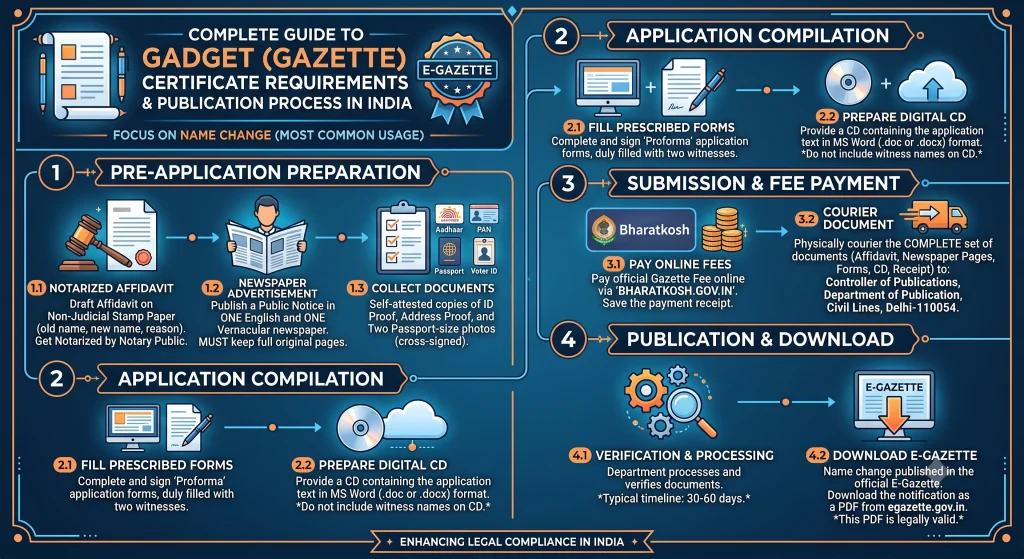
The publication process of gadget certificates (where applicable) is done as per the official gazette procedure.
When Publication Is Required
Mandatory publication for:
- Government device registrations
- Large batch imports
- Official procurement devices
- Publicly displayed compliance
Optional publication for:
- Private company devices
- Individual device ownership
- Small-value purchases
Publication Channel Selection
For Government Devices:
Primary Channel: Government Gazette
- State Gazette (most common)
- Gazette of India (if national-level)
- Cost: ₹2,000-5,000
- Timeline: 2-4 weeks
- Creates highest legal record
Secondary Channel: Newspapers
- Major newspapers (optional)
- Increases visibility
- Cost: ₹1,000-3,000
- Timeline: 1-2 weeks
Tertiary Channel: Online
- Government website
- e-Procurement portal
- Cost: Free-500
- Timeline: Same day
Complete Publication Process
Step 1: Prepare Publication Notice
NOTICE OF GADGET CERTIFICATE PUBLICATION
Notice is hereby given that the following device has been certified as per Indian standards and is hereby published for official record:
Device Details:
- Device Name: [Device Name]
- Model Number: [Model]
- Manufacturer: [Manufacturer Name]
- Manufacturing Date: [Date]
- Quantity: [Number]
Compliance Certification:
- Certificate Type: [BIS/WPC/Customs]
- Certificate Number: [Certificate ID]
- Issued By: [Authority Name]
- Certificate Date: [Date]
- Valid Until: [Date - if applicable]
Compliance Standards Met:
- Safety Standard: [Standard Number - e.g., IS 1363]
- Quality Standard: [Standard Number]
- Environmental Compliance: [Yes/No]
- Warranty: [Warranty Details]
This device has been certified and is approved for [use/sale/import] in India.
For queries, contact:
[Department/Organization Name] [Address] [Phone] [Email]Sd/
[Authority Head] [Title] [Date]Step 2: Submit to Gazette Office
- Contact gazette office
- Submit publication notice
- Provide certificate copy
- Pay publication fee
Step 3: Gazette Publication
- Published in official gazette
- Reference number provided
- Page number assigned
- Certificate of publication issued
Step 4: Collection
- Collect printed copies (10-15)
- Store for records
- Distribute as needed
Timeline for Gadget Certificate: Complete Breakdown
Total timeline from application to certificate varies significantly:
Expedited Timeline (Fastest)
| Phase | Days | Activity |
|---|---|---|
| Document gathering | 2 | Collect requirements |
| Application submission | 1 | Submit to authority |
| Authority review | 3 | Initial verification |
| Testing | 5 | Laboratory testing (if needed) |
| Final approval | 2 | Certificate approval |
| Issuance | 1 | Certificate issued |
| Total | 14 days | Quick process (standard devices) |
Standard Timeline (Most Common)
| Phase | Days | Activity |
|---|---|---|
| Document gathering | 5 | Collect and prepare docs |
| Application submission | 2 | Submit application |
| Initial review | 5 | Authority reviews |
| Testing | 10 | Laboratory testing |
| Re-verification | 3 | Authority rechecks |
| Approval | 2 | Final approval |
| Issuance | 2 | Certificate issued |
| Total | 29 days | Standard process |
Comprehensive Timeline (With Publication)
| Phase | Days | Activity |
|---|---|---|
| Document gathering | 5 | Complete preparation |
| Application submission | 2 | Submit to authority |
| Initial review | 5 | Authority reviews |
| Testing | 10 | Laboratory testing |
| Re-verification | 3 | Additional checks |
| Approval | 2 | Final approval |
| Issuance | 2 | Certificate issued |
| Publication prep | 3 | Prepare publication notice |
| Gazette publication | 21 | Published in official gazette |
| Certificate collection | 2 | Collect certificates |
| Total | 55 days | With publication |
Timeline Factors
Faster (10-20 days):
- Complete documentation
- Pre-existing manufacturer approval
- No additional testing needed
- Standard device type
- Quick authority processing
Slower (30-60 days):
- Incomplete documentation
- First-time manufacturer
- Extensive testing required
- New device type
- Slow authority processing
- Publication required
Cost Breakdown for Gadget Certificate
Complete cost analysis for obtaining a gadget certificate:
Cost by Certificate Type
BIS Certificate Cost:
| Item | Cost |
|---|---|
| Application fee | ₹500-1,000 |
| Processing fee | ₹1,000-2,000 |
| Laboratory testing | ₹2,000-10,000 (device dependent) |
| Inspection fee | ₹500-1,500 |
| Certificate issuance | ₹500-1,000 |
| Annual renewal (if required) | ₹500-1,000 |
| Total (one-time) | ₹5,000-16,500 |
WPC Certificate Cost (Wireless Devices):
| Item | Cost |
|---|---|
| Application fee | ₹1,000-2,000 |
| Processing fee | ₹2,000-3,000 |
| RF emission testing | ₹8,000-25,000 |
| Laboratory certification | ₹2,000-5,000 |
| Authority verification | ₹1,000-2,000 |
| Certificate issuance | ₹1,000-2,000 |
| Total (one-time) | ₹15,000-39,000 |
Customs Clearance Certificate (Imports):
| Item | Cost |
|---|---|
| Bill of Entry processing | ₹500-1,000 |
| Customs examination | Varies |
| Duty and taxes | % of device value |
| Broker/Agent fees | ₹2,000-5,000 |
| Clearance certificate | ₹500-1,000 |
| Total | ₹3,000-10,000+ (plus duties) |
Cost Reduction Strategies
1. Bulk Certification
- If certifying multiple devices: Lower per-unit cost
- Batch testing more economical
- Manufacturer certificate reduces individual testing
- Can save 30-50% on large volumes
2. Pre-Certified Components
- Buy pre-certified base devices
- Reduces custom testing
- Saves time and money
- Manufacturer warranties apply
3. Authorized Testing Labs
- Use authorized labs (cheaper than private)
- Government-approved rates
- May offer bulk discounts
- Timeline may be faster
4. Manufacturer-Provided Certificates
- Some manufacturers provide certificates
- Reduces need for re-testing
- Often covers global standards
- Cost already included in device price
Online vs. Offline Gadget Certification: Complete Comparison
There are online and offline opportunities in modern India for certifying gadgets.
Detailed Comparison
| Aspect | Online Certification | Offline Certification |
|---|---|---|
| Application submission | Digital via portal | Physical/in-person at office |
| Document submission | Scanned copies uploaded | Original documents needed |
| Timeline | Generally faster (14-21 days) | Slightly longer (21-30 days) |
| Cost | Slightly lower (no travel) | Slightly higher (office visits) |
| Communication | Email/SMS updates | Phone/in-person updates |
| Convenience | Very high (24/7 access) | Lower (office hours only) |
| Tracking | Real-time online status | May need to call for updates |
| Certificate delivery | Digital first, physical later | Physical pickup required |
| Acceptance | Fully accepted (digital + physical) | Fully accepted |
| Requirements | Internet connection, scanner | Travel to office |
| Best for | Businesses, bulk applications | Individuals, simple devices |
Online Gadget Certification Process
Platforms offering online certification:
BIS Online Portal:
- Website: bis.gov.in
- Online application submission
- Document upload (PDF scanned)
- Payment online (card/UPI)
- Real-time tracking
- Digital certificate issued
- Physical copy mailed
WPC Online Portal:
- Website: wpc.dot.gov.in
- Similar online process
- RF testing reports uploaded
- Payment online
- Status tracking available
- Certificate issued digitally
Process Steps:
- Register on portal
- Fill application form online
- Upload scanned documents
- Pay application fee online
- Receive reference number
- Track status online
- Receive digital certificate
- Physical certificate mailed
Timeline: 14-25 days (faster than offline)
Offline Gadget Certification Process
Traditional office-based process:
Step-by-step:
- Visit office in person
- Collect application form
- Fill form by hand or at office
- Submit with original documents
- Pay fees in cash/check
- Get receipt with reference
- Call for status updates
- Visit office to collect certificate
Timeline: 21-35 days (slightly longer)
Advantages of offline:
- Personal assistance available
- Immediate clarification possible
- Original document verification
- Face-to-face problem solving
Disadvantages of offline:
- Travel time and cost
- Limited office hours
- Slower communication
- Multiple visits may be needed
State-Wise Gadget Certificate Requirements
Processes and authority offices vary across different states.
Tier 1 States (Most Developed Systems)
Delhi:
- BIS office: Central Delhi
- WPC office: New Delhi
- Online portal: Available and preferred
- Processing time: 14-21 days
- Cost: Standard rates
Maharashtra:
- Multiple BIS offices (Mumbai, Pune, Nagpur)
- WPC office: Mumbai
- Online system well-developed
- Processing time: 14-21 days
- Cost: Standard rates
- Website: bis.gov.in (state portal available)
Karnataka:
- BIS office: Bangalore
- WPC office: Bangalore
- Good online infrastructure
- Processing time: 21-28 days
- Cost: Standard rates
Tamil Nadu:
- BIS office: Chennai
- WPC office: Chennai
- Well-organized system
- Processing time: 14-21 days
- Cost: Standard rates
- Good coordination with manufacturers
Tier 2 States (Developing Systems)
States like: Punjab, Haryana, Rajasthan, Gujarat, Madhya Pradesh, Telangana, Odisha
Common features:
- State-level BIS offices
- Coordination with central WPC
- Some online options
- Processing time: 21-28 days
- Standard fee structure
Tier 3 States (Basic System)
States like: North-East states, smaller states
Features:
- Limited local BIS presence
- May require submission to nearest metro office
- Fewer online options
- Processing time: 28-35 days
- May involve travel
Pro tip: If your state doesn't have a local office, you can submit to the nearest metro-area office of BIS or WPC.
Frequently Asked Questions About Gadget Certificates
Q1: What's the Difference Between Gadget Certificate and Manufacturer Certificate?
A:
| Aspect | Gadget Certificate | Manufacturer Certificate |
|---|---|---|
| Issued by | Government authority (BIS/WPC) | Device manufacturer |
| Authority | Government-backed, official | Manufacturer-backed |
| Scope | Certifies compliance with Indian standards | Certifies product quality/specifications |
| Legal weight | Highest for Indian use | Lower (though recognized) |
| Required for | Regulatory compliance in India | Product warranty, authenticity |
| Validity | Lifetime (or as specified) | Usually 1-3 years |
| Cost | Government fee structure | Often included in product price |
Key difference: Gadget certificate is government compliance. Manufacturer certificate is product warranty.
Q2: Can I Sell a Device Without a Gadget Certificate?
A: Depends on device type:
Cannot sell without certificate:
- ❌ Smartphones (WPC required)
- ❌ WiFi devices
- ❌ Wireless equipment
- ❌ Medical devices
- ❌ Radiation devices
Can sell without certificate:
- ✅ Basic electronics (if not covered by BIS)
- ✅ Accessories (cables, chargers - often exempt)
- ✅ Non-wireless gadgets
- ✅ Used devices (sometimes)
Best practice: Get certificate for any device you sell commercially.
Q3: Is Gadget Certificate Required for Used/Second-Hand Devices?
A: Generally no, but with conditions:
- Wireless devices (phones): IMEI already registered, no new certificate
- Imported used devices: May need customs clearance
- Resale in India: Often no new certificate needed
- Resale internationally: Original certificate usually sufficient
Best practice: Verify with buyer's requirements (some institutions require original certificate).
Q4: How Long Is a Gadget Certificate Valid?
A: Depends on certificate type:
| Certificate Type | Validity |
|---|---|
| BIS Certificate | Lifetime (or 5 years if renewal specified) |
| WPC Certificate | Lifetime (registrations don't expire) |
| Customs Certificate | One-time (for that shipment) |
| Manufacturer Certificate | 1-3 years (warranty period) |
General rule: Government-issued gadget certificates don't expire (unless specified otherwise).
Q5: Can I Get Gadget Certificate for Device Without Testing?
A: In rare cases only:
Can skip testing if:
- Device already has international certification (ISO, CE, etc.)
- Manufacturer provides equivalent testing
- Device is pre-certified
Usually requires testing if:
- First-time certification
- New manufacturer
- New device type
- Regulatory requirement
Recommendation: Plan for testing in your timeline.
Q6: What If My Device Doesn't Meet Standards?
A:
If minor deficiencies:
- Manufacturer must fix issues
- Resubmit for testing
- Retry certification process
If major non-compliance:
- Device cannot be certified
- Cannot be legally sold/imported into India
- Manufacturer must redesign
- Compliance is not optional
Q7: Can Gadget Certificate Be Obtained Retroactively?
A: Technically yes, but complicated:
Best practice: Certify before bringing device to market.
Q8: Is Gadget Certificate Portable Across States?
A: Yes, absolutely.
- Gadget certificate issued in one state is valid nationally
- No state-specific certificate needed
- Can be used for interstate sales/transfer
- Same certificate works across India
Key Takeaways
Remember these essential points about gadget certificates:
- Multiple Types Exist — BIS, WPC, Customs, IMEI, Environmental, Quality. Choose the right one for your device.
- Often Mandatory — If selling smartphones or wireless devices, gadget certificate is legally required. Not optional.
- Process Is Predictable — Timeline is typically 14-30 days from application to certificate. Plan accordingly.
- Testing Is Crucial — Laboratory testing ensures device meets Indian standards. It's not bureaucratic—it ensures safety.
- Certificates Are Portable — Once obtained in one state, valid across entire India. No re-certification needed.
- Cost Is Reasonable — ₹5,000-40,000 (depending on device) is minimal compared to device value and revenue.
- Online Is Faster — Digital certification (14-21 days) beats offline (21-35 days). Use BIS/WPC online portals.
- Publication Is Optional — Only required for government devices. Most private devices don't need publication.
Ready to Obtain Your Gadget Certificate?
Your next steps:
- Identify Type — Which gadget certificate do you need (BIS/WPC/Customs)?
- Gather Documents — Collect specifications, technical details, proofs
- Choose Portal — Online (faster) or offline (traditional)
- Submit Application — Fill form and upload/submit documents
- Arrange Testing — Coordinate lab testing if required
- Pay Fees — Submit payment for processing
- Track Status — Monitor progress via portal or phone
- Receive Certificate — Collect physical certificate
- Publish (if required) — Publish in gazette if needed for government device
- Maintain Records — Keep certificate for regulatory compliance
That's it. Your gadget certificate is now official and recognized.
Conclusion
It is essential for the importers, manufacturers, and sellers of electronic gadgets to understand the gadget certificate requirement and the publication process in India. This increased level of compliance will give consumers peace of mind and device authenticity.
As a smartphone manufacturer, importer, or government that procures smartphones, having the right gadget certificate is a legal requirement and is crucial to make sure the devices you buy are standard and compliant with Indian standards.
Use this complete guide to navigate the gadget certification process with confidence. Your compliance and device credibility await.