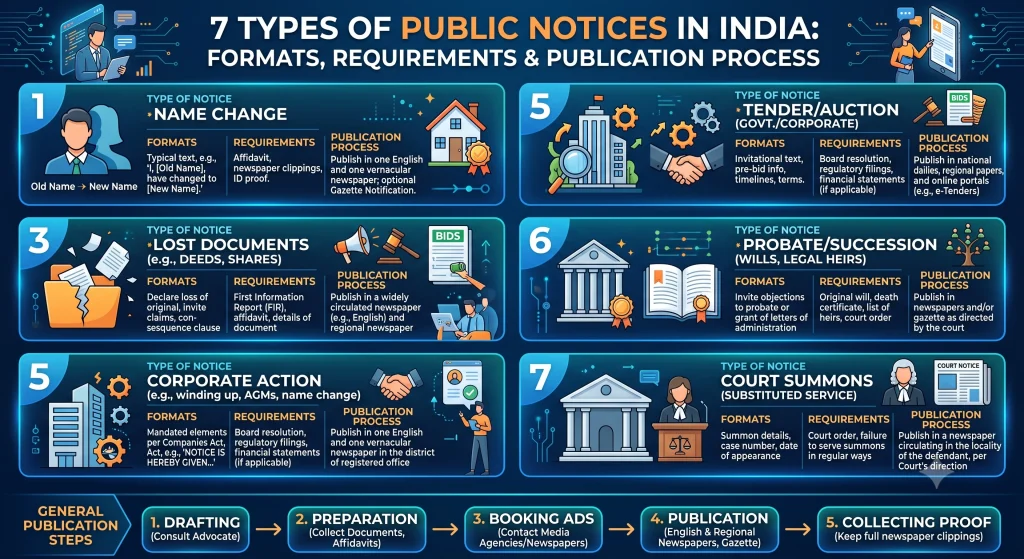
7 Types of Public Notices in India: Formats, Requirements & Publication Process
Introduction: Understanding Public Notices and When You Need One
A public notice is a notification that is put on the public record in newspapers or gazettes. It's the official way to let the public know about something important that has happened: a name change, a legal dispute, an upcoming event, or a business transaction.
The term "public notice" is a general one. Public notices come in a variety of forms and types, and each serves a different purpose, is used in different formats, and has different requirements.
This is an exhaustive guide that goes through all 7 major types of public notices in India. You will discover when and how to employ each type, as well as what they consist of and how to publish them properly.
What Is a Public Notice? The Basics
Definition
A Public Notices is a written statement printed in an official publication (newspaper, gazette, or website) to make an announcement of a legal, business, or personal nature.
Why Public Notices Matter
Legal recognition: A public notice becomes official proof that you made the public aware of.
Legal protection: Publishing is legally protected! It demonstrates that you have done the procedure correctly.
Transparency: It means everyone is on the same level of information to make sure it is fair.
Court acceptance: Disputes, inheritances, and legal issues require public notices.
Where Public Notices Are Published
- Official gazettes (state and national)
- Major newspapers
- Government websites
- Organization websites
- Online legal notice portals
The 7 Types of Public Notices in India
Type 1: Legal Notices
What it is: A sort of formal legal letter that is sent in advance of legal proceedings. An official order or caution to someone to do or not do something
When you use it:
- Before suing someone for breach of contract
- Before evicting a tenant
- Before demanding payment
- Before filing defamation lawsuit
- Before taking legal action
Why it matters:
- Shows you made a genuine effort to settle
- Required by law in many situations
- Courts view it favorably
- Creates legal record
Format requirements:
- Formal letterhead (typically from lawyer)
- Recipient's name and address
- Dated
- Clear statement of problem
- Specific demand (what you want)
- Deadline (typically 15-30 days)
- Consequences if ignored
- Lawyer signature (often required)
Example:
[LAWYER LETTERHEAD]LEGAL NOTICE
To,
Mr. XYZ,
[Address],
Subject: Legal Notice Under Section 138 NI Act
Dear Sir,
Our client, [Name], issued a cheque no. [XXX] dated [date] for ₹[amount]
to you/your business. The cheque was dishonored on [date]. Despite
multiple requests, you have not honored the cheque.
This is to demand payment of ₹[amount] within 15 days of receipt of this notice.
If the amount is not paid, we will file a criminal case against you.
Yours faithfully,
[Lawyer Name][Bar Council ID]
[Date]
Cost: ₹1,000-5,000 (if using lawyer), ₹500-1,500 (if self-drafted)
Timeline: Must reach recipient; 15-30 days response time
Cluster content: See "Legal Notices: Definitions, Templates, Examples"
Type 2: Public Notices (General Announcements)
What it is: It is an official notice, usually given to the public at large. It makes an important announcement to the public.
When you use it:
- General announcements
- Important information for the public
- Personal announcements
- Business announcements
Type 3: Court Notices
Format requirements:
- Issued by court or court-appointed officer
- Contains court case number
- Contains date of hearing
- Contains specific directions
- Official court stamp and signature
Who publishes it:
- Usually the court publishes it
- Sometimes you're required to publish it (court will direct)
- Published where court directs
Cost: Varies (sometimes free, sometimes ₹100-500)
Timeline: As per court direction
Type 4: Auction Notices and Property Sale Notices
What it is: An official statement that an asset or property is being put up for auction. Typically given at the time of the sale of government property, property that has been seized, or foreclosed property.
When you use it:
- Selling government property
- Bank auctioning seized property
- Court-ordered property sales
- Municipal property auctions
- Public sector selling equipment
Why it matters:
- Invites public bids
- Shows fair and transparent process
- Legally required by auction rules
Format requirements:
- Clear description of property/asset
- Location (exact address)
- Estimated value/reserve price
- Auction date and time
- Place of auction
- Terms and conditions
- How to bid
- Contact for inspection
Example:
AUCTION NOTICE
The following property is offered for sale by auction:
Property: Land measuring 1000 sq.ft. at [Location], [City]
Reserve Price: ₹[Amount]
Auction Date: [Date and Time]
Venue: [Location]
Terms: Sale on as-is-where-is basis. Intending bidders may inspect the property on [dates] between [time] at [location].
For details, contact:
[Officer Name]
[Address]
[Phone]
Sd/
[Authority]
Date: [Date]
Cost: ₹2,000-5,000 (depending on property value)
Timeline: 2-4 weeks notice period
Cluster content: See "Auction Notices and Public Property Sales"
Type 5: Deed of Sale and Property Transfer Notices
What it is: An announcement of a sale or transfer of property or business. It is published at the time of the official transfer of ownership of a property.
When you use it:
- After buying property (announce new ownership)
- After selling business (announce change of ownership)
- When transferring shares in company
- When changing business partnership
Why it matters:
- Creates public record of transfer
- Protects buyer/new owner
- Protects old owner (shows they're no longer responsible)
- Used for government authorization
Format requirements:
- Details of property/asset
- Previous owner's name
- New owner's name
- Date of transfer
- Reason (sale, gift, inheritance)
- Relevant document reference (sale deed number, date)
Example:
PUBLIC NOTICE
Notice is hereby given that the property described below has been transferred from the previous owner to the new owner:
Previous Owner: [Name]
New Owner: [Name]
Property: Land bearing Sy. No. [____], measuring [____] sq.m at [location]
Sale Deed No.: [____]
Date of Sale Deed: [Date]
The new owner is authorized to use and enjoy the property from this date.
New Owner will not be responsible for any obligations of previous owner after the date of sale.
Date: [Date]
New Owner Signature: [Signature]
Name: [Name]
Contact: [Phone]
Cost: ₹500-2,000
Timeline: After transfer, publish within 30 days
Cluster content: See "Deed of Sale vs. Public Notice: What's the Difference?"
Type 6: Company or Business Registration Notices
What it is: Notices of company incorporation, conversion, or business changes. These are used to communicate big changes in the status of a company or a business.
When you use it:
- Converting private company to public company
- Converting public company to private company
- Changing company name
- Merging companies
- Dissolving a company
- Changes in directors or partners
Why it matters:
- Informs stakeholders of changes
- Legally required in many cases
- Creates record for company registrar
- Protects company legally
Example: Public to Private Conversion
NOTICE OF CONVERSION
Notice is hereby given that the Board of Directors, in its meeting held on [date], approved conversion of [Company Name] from a public company to a private company.
Particulars of the Company:
CIN: [____]
Company Name: [____]
Registered Office: [Address]
Director(s): [Names]
The conversion will take effect from [date].
All shareholders are informed of this conversion. Any objections/questions should be submitted within 30 days.
Sd/
Company Secretary
Date: [Date]
Cost: ₹2,000-5,000
Timeline: 2-4 weeks notice
Cluster content: See "Conversion of Public Company into Private Company Notices"
Type 7: Government and Regulatory Notices
What it is: Messages given by government organizations, regulators, or authorities. These are used to notify of government action, regulation, or requirement.
When published:
- Government announcing policy changes
- Regulatory body issuing notices
- Municipal corporation announcements
- Tax or revenue department notices
- Labor department announcements
Who issues it:
- Government agencies (central/state)
- Municipal corporations
- Regulatory bodies
- Public sector organizations
Why it matters:
- Legally binding (failure to comply has penalties)
- Affects public and businesses
- Creates official record
Format examples:
Municipal Notice:
MUNICIPAL CORPORATION NOTICE
Notice is hereby given that [Municipal Corporation] proposes to [action].
Affected Properties: [Details]
Reason: [Reason for action]
Timeline: [Action will take place on/before date]
Objections, if any, may be submitted to [office] within 15 days.
Municipal Commissioner
Date: [Date]
Government Order:
GOVERNMENT ORDER
The Government of [State] hereby notifies that [regulation/policy/requirement].
Effect Date: [Date]
Applicability: [Who it applies to]
Details: [Full details]
For clarification, contact [office address].
Sd/
Secretary
Date: [Date]
Cost: Free (government issues)
Timeline: Varies (as per government direction)
Public Notice vs. Legal Notice: What's the Difference?
Many people confuse public notices with legal notices. They're quite different.
Detailed Comparison
| Feature | Public Notice | Legal Notice |
|---|---|---|
| Purpose | Announce something to public | Formal demand/warning before court action |
| Legal requirement | Sometimes | Often |
| Tone | Informational | Formal/demanding |
| Content | Facts, what happened | Problem, demand, deadline, consequences |
| Recipient | General public | Specific person/party |
| Response required | No | Yes (usually 15-30 days) |
| Consequences if ignored | Minimal | Serious (legal action follows) |
| Examples | Lost passport, property sale | Breach of contract, eviction demand |
| Who can issue | Anyone | Typically lawyer (though anyone can) |
| Publication method | Newspaper, website | Newspaper, gazette, delivered by hand |
Key difference: A public notice is an announcement. A legal notice is a demand with consequences.
See detailed cluster content: "Public Notices vs. Legal Notices: What's the Difference?"
Regional Languages: Publishing Public Notices in Marathi, Hindi, and Other Languages
In India, public notices can be published in regional languages. Many states require or prefer regional language publication.
Why Publish in Regional Languages?
- Legal requirement: Some states require regional language publication
- Broader reach: More people can understand
- Government preference: Many government offices prefer regional language
- Court acceptance: Courts accept regional language notices
- Fairness: Ensures all citizens can understand
Regional Language Publication by State
Maharashtra:
- Preferred language: Marathi + English
- Example notice:
सार्वजनिक सूचना
मी, [नाव], ने माझा पासपोर्ट क्रमांक [\_\_\_], जारी दिनांक [\_\_\_] गमावला आहे.
पासपोर्ट आता वैध नाही. हा पासपोर्ट जर कोणाला मिळे तर तो जवळच्या
पोलीस स्टेशनला हस्तांतरित करावा किंवा मला [फोन नंबर] वर संपर्क करावा.
दिनांक: [तारीख]
स्वाक्षर: [स्वाक्षर]
Tamil Nadu:
- Preferred language: Tamil + English
- Tamil language notices widely accepted
Delhi:
- Preferred language: Hindi + English
- Hindi language notices common for government
Karnataka:
- Preferred language: Kannada + English
- Kannada language increasingly required
Punjab:
- Preferred language: Punjabi + English
- Punjabi language newspapers common
Multilingual Public Notice Template
English Version:
PUBLIC NOTICE
Notice is hereby given that I, [Name], have lost my [item], bearing reference number [____]. The [item] is no longer valid.
Anyone finding the same should contact:
Name: [Name]
Address: [Address]
Phone: [Number]
Date: [Date]
Hindi Version:
सार्वजनिक सूचना
सूचित किया जाता है कि मैं, [नाम], ने अपना [वस्तु], संदर्भ संख्या [____] गंवा दिया है। [वस्तु] अब वैध नहीं है।
यदि कोई इसे खोजे तो कृपया संपर्क करें:
नाम: [नाम]
पता: [पता]
फोन: [नंबर]
दिनांक: [तारीख]
Marathi Version:
सार्वजनिक सूचना
माहिती द्यावी की मी, [नाव], ने माझा [वस्तु], संदर्भ क्रमांक [____] गमावला आहे.
[वस्तु] आता वैध नाही.
जर कोणाला हे मिळे तर कृपया संपर्क करा:
नाव: [नाव]
पता: [पता]
फोन: [नंबर]
दिनांक: [तारीख]
"Notice Issued by Government Generally Appears In": Educational Context
You may have seen this exact phrase in educational materials: "Notice issued by government generally appears in..." This is a common exam question in schools and colleges. Let's answer it comprehensively.
Answer: "Notice Issued by Government Generally Appears In..."
Government notices generally appear in:
- Official State/National Gazettes (primary)
- Major Newspapers (secondary)
- Government Websites/Portals (increasingly primary)
- Official Department Websites
- Public Notice Boards (municipal corporation, panchayat offices)
Why Government Uses These Channels
Official Gazettes:
- Creates official legal record
- Ensures proper documentation
- Meets audit and compliance requirements
- Permanent archive
Newspapers:
- Reaches wider public
- Creates public awareness
- Shows transparency
- Meets transparency requirements
Government Websites:
- Real-time visibility
- Reduces costs
- Ensures accessibility
- Modern approach
Official Notices Boards:
- Local reach
- Direct information
- Community awareness
How This Is Tested in Schools
Sample exam question: "Notice issued by government generally appears in ______."
- (A) Social media only
- (B) Official gazette and newspapers ✓ (correct)
- (C) Internet only
- (D) Word of mouth
Why this matters for students:
- Tests understanding of legal/formal procedures
- Tests knowledge of government communication
- Tests awareness of official channels
Complete Templates for All 7 Notice Types
Template 1: Legal Notice Template
[LETTERHEAD - preferably lawyer's]LEGAL NOTICE
To,
[Recipient Full Name]
[Recipient Address]
[City, Pin Code]
Date: [Date]
Sub: Legal Notice for [Subject of dispute]
Dear Sir/Madam,
Our client, [Your Full Name], hereby issues this legal notice against you for [specific grievance/issue].
FACTS:
- [Fact 1 regarding the dispute]
- [Fact 2 regarding the dispute]
- [Fact 3 regarding the dispute]
LEGAL BASIS:
Our client has [legal right/claim] under [applicable law/contract/agreement].
DEMAND:
Our client demands [specific relief/payment/action] within 15 days of receipt of this notice.
CONSEQUENCES:
If you fail to comply with this demand, our client will pursue all legal remedies available under law, including filing a case against you without any further notice.
Please acknowledge receipt of this notice.
Yours faithfully,
[Sender Name][Designation/Title]
[Contact Details]
[Signature]
Note: Send by registered mail, email, and/or personal delivery. Keep proof.
Template 2: Public Notice Template
PUBLIC NOTICE
[Your Name/Organization Name] [Write headline based on type]Notice is hereby given that [your statement/announcement].
[Main details/content - 2-5 lines]For further information, contact:
Name: [Your Name]
Address: [Your Address]
Phone: [Your Phone]
Email: [Your Email]
Date: [Date]
Signature: [Your Signature]
Template 3: Lost Item Public Notice
PUBLIC NOTICE
LOST DOCUMENT/ITEM NOTICE
This is to inform that I have lost my [item description - e.g., "Pan Card"], bearing reference number [___], issued on [date].
This document is no longer valid. Anyone finding the same should contact me immediately or hand it over to the nearest police station.
Lost Item Details:
- Item Type: [Type]
- Reference Number: [Number]
- Issued by: [Authority]
- Issue Date: [Date]
Contact Details:
Name: [Your Name]
Address: [Your Address]
Phone: [Your Phone]
Email: [Your Email]
I am not responsible for any misuse of this document after publication of this notice.
Date: [Date]
Signature: [Your Signature]
Name: [Your Name]
Template 4: Auction Notice
AUCTION NOTICE
The following property/asset is offered for sale by public auction:
PROPERTY DETAILS:
Description: [Detailed description]
Location: [Complete address]
Area: [Measurement]
Reserve Price: [Amount]
AUCTION SCHEDULE:
Auction Date: [Date]
Auction Time: [Time]
Venue: [Location with address and contact]
INSPECTION:
Intending bidders may inspect the property on:
- Date(s): [Dates]
- Time: [Timings]
- Contact: [Officer name and phone]
TERMS & CONDITIONS:
- Sale is on 'as-is-where-is' basis
- [Other terms...]
- [Other terms...]
HOW TO BID:
Bids to be submitted: [In person/Online/By mail]
Bid submission deadline: [Date and time]
For details: [Contact information]
FOR FURTHER INFORMATION:
[Officer/Authority Name][Address]
[Phone]
[Email]
Sd/
[Authority]
Date: [Date]
Template 5: Property Transfer Notice
NOTICE OF PROPERTY TRANSFER
Notice is hereby given that the property described below has been transferred from the previous owner to the new owner as per sale deed.
PROPERTY DETAILS:
Description: [Detailed property description]
Location: [Complete address]
Area: [Measurement]
Survey Number: [If applicable]
TRANSFER DETAILS:
Previous Owner: [Full name]
New Owner: [Full name]
Sale Deed Number: [Number]
Sale Deed Date: [Date]
Transfer Date: [Date]
The above-mentioned property now belongs to [New Owner Name]. The new owner is authorized to use, enjoy, and dispose of the property from the date of this notice.
Previous owner will not be responsible for any liabilities related to the property after the date of this notice.
Date: [Date]
New Owner Signature: [Signature]
Name: [Name]
Address: [Address]
Contact: [Phone]
Template 6: Company Conversion Notice
NOTICE OF COMPANY CONVERSION
Notice is hereby given that:
CONVERSION DETAILS:
Previous Status: Public Company
New Status: Private Company
Approval Date: [Date of board resolution]
Effective Date: [Date of conversion]
This conversion has been approved by the Board of Directors in their meeting held on [date].
The company is now a private company as per applicable laws. All shareholders and stakeholders are hereby informed.
Any objections or queries regarding this conversion may be submitted to the Company Secretary within 30 days of publication of this notice.
COMPANY DETAILS:
Company Secretary: [Name]
Contact: [Phone]
Email: [Email]
Address: [Address]
Sd/
Company Secretary
Date: [Date]
Company Seal: [Seal]
Template 7: Government and Regulatory Notice
GOVERNMENT / REGULATORY NOTICE
Notice is hereby given that [Government Department/Regulatory Authority] has issued the following notice:
[Details of government action, regulation, policy, or requirement]Effective Date: [Date]
Applicability: [Who it applies to]
For further details and clarification, contact:
[Department/Authority Name][Address]
[Phone]
[Email]
Sd/
Authorized Officer
Date: [Date]
State-Wise Public Notice Publication Requirements
Different states have different preferences and requirements for public notice publication.
Major States' Preferences
Maharashtra:
- Preferred: Marathi + English newspapers
- Gazette: Maharashtra State Gazette
- Cost: ₹500-1,500
- Timeline: 7-14 days
Delhi:
- Preferred: Hindi + English newspapers
- Gazette: Delhi Gazette
- Cost: ₹500-1,200
- Timeline: 7-14 days
Tamil Nadu:
- Preferred: Tamil + English newspapers
- Gazette: Tamil Nadu State Gazette
- Cost: ₹500-1,500
- Timeline: 7-14 days
Karnataka:
- Preferred: Kannada + English newspapers
- Gazette: Karnataka State Gazette
- Cost: ₹500-1,500
- Timeline: 7-14 days
Punjab:
- Preferred: Punjabi + English newspapers
- Gazette: Punjab State Gazette
- Cost: ₹400-1,000
- Timeline: 7-14 days
Complete Public Notice Publishing Checklist
Before publishing, use this checklist:
- Determined notice type (which of 7 types?)
- Prepared notice content (clear and complete)
- Decided publication channel (gazette, newspaper, online)
- Checked state-specific requirements
- Decided language (English, regional, or bilingual)
- Prepared multiple copies (for records)
- Obtained necessary approvals (if required)
- Arranged payment (if chargeable)
- Submitted to publication (gazette office or newspaper)
- Got receipt and publication date
- Confirmed publication on due date
- Collected published copies (at least 10)
- Kept proof of publication (scanned/photographed)
- Delivered notice to recipient (if required)
- Maintained records (for future reference/audit)
Frequently Asked Questions About Public Notices
Q1: What's the Difference Between Public Notice and Legal Notice?
A:
- Public Notice: Announcement to general public. Informational.
- Legal Notice: Formal demand to specific person. Has legal consequences.
See detailed comparison in section "Public Notice vs. Legal Notice."
Q2: Can I Publish Public Notice Online Only?
A: Depends on situation:
- Government notices: Must use gazette + newspapers
- Personal notices: Online is increasingly accepted
- Business notices: Gazette or newspaper preferred
- Legal notices: Must use traditional methods (newspaper/gazette)
Best practice: Use both traditional and online methods.
Q3: How Much Does It Cost to Publish a Public Notice?
A:
- Lost item notice: ₹300-1,000
- Name change: ₹500-1,500
- Legal notice: ₹500-2,000
- Business notice: ₹1,000-3,000
- Property/auction: ₹2,000-5,000
- Government notice: ₹2,000-10,000
Q4: Which Newspaper Should I Use?
A: Use major newspapers:
- Times of India, Indian Express, Hindu, Business Standard
- Regional language newspapers (if required)
Avoid small/local papers (may not be recognized).
Q5: How Long Until My Notice Gets Published?
A:
- Newspaper: 7-14 days
- Gazette: 3-4 weeks (publication) + 1-2 weeks (certificate)
- Online portals: Same day or 1-2 days
- Government website: 1-3 days
Q6: Is a Lawyer Required for Public Notice?
A: No, not always:
- Not required for: Name change, lost items, general announcements
- Often required for: Legal notices (recommended), company notices
- Recommended for: Court proceedings, formal business matters
Q7: Can I Update or Cancel a Published Notice?
A: Usually not, but you can:
- Publish a corrigendum (correction notice)
- Publish a withdrawal notice
- Issue an updated/new notice
Must use same publication channel.
Q8: What If I Publish Wrong Information?
A:
- Publish a corrigendum immediately
- Explain the error in the correction
- Publish on same channel as original
- Notify recipient (if applicable)
- Maintain both notices for records
Key Takeaways
Remember these essential points about types of public notices:
- 7 Main Types Exist — Legal, general announcements, court-ordered, auction, property transfer, company, and government notices. Each has different requirements.
- Different Purposes — A legal notice is a demand with consequences. A public notice is an announcement. Know which you need.
- Publication Requirements Vary — Some require gazette, some require newspapers, some work online. Check your state's requirements.
- Regional Languages Accepted — Marathi, Hindi, Tamil, Kannada, and other regional language notices are legally valid and often preferred.
- Templates Available — Use templates to ensure you include all required information and proper format.
- Keep Documentation — Maintain proof of publication and keep records for legal purposes.
- Mistakes Can Be Corrected — If you publish wrong information, issue a corrigendum immediately.
Ready to Publish Your Public Notice?
Your next steps:
- Identify Type — Which of the 7 types do you need?
- Prepare Content — Use appropriate template
- Choose Channel — Gazette, newspaper, or online?
- Decide Language — English, regional, or bilingual?
- Submit — Contact publication with your notice
- Wait — Timeline depends on channel (1-4 weeks)
- Collect Copies — Get printed copies for your records
- Maintain Records — Keep proof of publication
That's it. Your public notice will be formally published and recognized.
Conclusion
If you are familiar with the various types of public notices in India, you will be able to select the appropriate type of public notice, publish it properly, and accomplish your legal or business objectives.
This detailed guide explains the 7 types of public notices, including templates, examples, and state-specific details, and is perfect for publishing a lost notice, announcing business changes, or serving a legal demand.
Start your public notice today. Use the right type, follow the format, and publish in the correct channels.