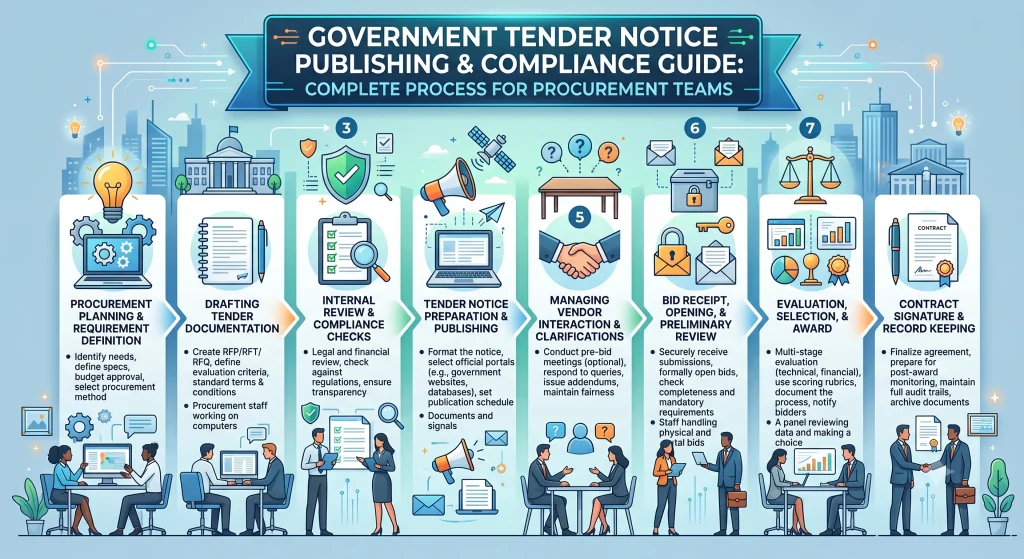
Government Tender Notice Publishing & Compliance Guide: Complete Process for Procurement Teams:
Introduction: Why Tender Notice Publishing Is Mandatory for Governments and Corporations:
Your organization needs to procure a product, service, equipment, construction work, or any other valuable asset.
Indian procurement rules require government organizations, public sector enterprises, and government-funded corporations to invite eligible suppliers through a public tender notice. They cannot rely on private supplier contacts when the law requires open bidding.
Failing to publish a tender notice can result in:
- ❌ Government audit failure.
- ❌ CAG (Comptroller & Auditor General) disallowance.
- ❌ Legal challenges from vendors.
- ❌ Tender cancellation by courts.
- ❌ Financial penalties.
- ❌ Professional liability for procurement officers.
This guide covers the complete process of publishing government tender notices in India. It explains the requirements and best practices for government agencies, PSUs, and corporations.
What Is a Tender Notice and Why It Matters:
Definition of Tender Notice:
A tender notice, also known as a government notice publication or public tender, announces a procurement opportunity and invites eligible suppliers to submit competitive bids. It serves as the official notice that your organization seeks offers for a specific requirement.
Components of a tender notice:
- What you're buying (goods, services, works).
- How much you're buying.
- Deadline for bids (when bids must be submitted).
- Eligibility criteria (who can bid).
- How bidders will be selected (evaluation criteria).
- Contact details for more information.
- Where and how to bid (submission method).
- Important dates (publication, bid opening, award).
Why Tender Notices Are Legally Mandatory:
In India, publishing a tender notice is a legal requirement for procurements that fall under the applicable public procurement rules. Organizations cannot treat it as an optional step.
Who MUST publish tender notices:
- ✅ All government departments.
- ✅ All government agencies.
- ✅ All states and union territories.
- ✅ All central public sector enterprises (PSUs).
- ✅ All corporations receiving government funds.
- ✅ All organizations with government contracts.
Legal basis:
- General Financial Rules (GFR) 2017 — Central government guideline.
- State procurement rules — Varies by state.
- Public Procurement Act — If applicable to your sector.
- CAG audit requirements — All government purchases audited.
What happens if you don't publish:
| Violation | Consequence |
|---|---|
| No tender notice published | Audit disallowance (entire purchase amount) |
| Insufficient notice period | CAG comment, potential fine |
| Wrong publication format | Tender rejected by court |
| Missing required details | Tender cancelled, retendering required |
| Inadequate evaluation criteria | Vendor legal challenge sustained |
Cost of non-compliance: Penalties and related costs can reach 10-50 times the expense of publishing a tender notice.
Types of Tenders and Tender Notices:
Every procurement follows its own requirements. The type of purchase determines which tender notice format you need.
By Purchase Type:
1. Goods Tender:
- Buying physical items (equipment, supplies, vehicles).
- Example: "Tender for Supply of Office Furniture".
- Simpler evaluation criteria (price, quality, delivery).
- Typical timeline: 30-60 days.
2. Services Tender:
- Hiring service providers (consulting, maintenance, training).
- Example: "Tender for IT Maintenance Services".
- Technical evaluation required.
- Typical timeline: 45-90 days.
3. Works Tender:
- Construction, renovation, or project-based work.
- Example: "Tender for Road Construction".
- Requires technical qualification and bid security.
- Typical timeline: 60-120 days.
4. Hybrid/Combined Tender:
- Goods + services combined.
- Example: "Tender for Supply and Installation of Solar Panels".
- More complex requirements.
- Typical timeline: 60-120 days.
By Bidding Scope:
1. Open Tender (Advertised Tender):
- Published publicly.
- Anyone can bid.
- Most common type.
- Requires widest government notice publication.
2. Limited Tender:
- Only invited suppliers can bid.
- Used when few suppliers are available.
- Requires limited notice publication.
- Justification required.
3. Single Tender:
- Only one supplier invited (emergencies).
- Requires government approval.
- Minimal notice required.
- Exceptions only.
By Estimated Value (Cost-Based):
Tier 1: Small Value Purchases (₹5 lakhs - ₹50 lakhs):
- Local tender notice publication (state gazette).
- 2-week notice period.
- Single-stage bid evaluation.
- Simplified process.
Tier 2: Medium Value (₹50 lakhs - ₹5 crores):
- State + national government tender notice publication.
- 3-week notice period.
- Two-stage evaluation (technical + financial).
- Standard process.
Tier 3: High Value (₹5 crores and above):
- National gazette + portals (GeM, National Portal).
- 4-6 week notice period.
- Multiple evaluation stages.
- Highest transparency requirements.
Tender Notice vs. Public Notice: What's the Difference?
Many people confuse tender notices with public notices. The two serve different purposes and follow different requirements.
Comparison Table:
| Feature | Tender Notice | Public Notice |
|---|---|---|
| Purpose | Invite bids for purchase | General announcement/information |
| Legal requirement | Mandatory for purchases | Optional/varies by situation |
| Content | Detailed bid requirements | Simple announcement |
| Bid evaluation | Detailed scoring required | N/A |
| Publication method | Gazette + newspapers + online | Newspapers only |
| Timeline | 2-6 weeks | 7-14 days |
| Complexity | High (bid documents, terms, conditions) | Low (simple text) |
| Cost | Higher (detailed publication) | Lower |
| Who publishes | Governments, corporations | Anyone (name changes, legal notices) |
| Examples | "Supply of stationery", "Road construction" | "Name change notice", "Lost and found" |
Key difference: A tender notice invites bids and starts an evaluation process. A public notice communicates information without seeking bids.
Where and How to Publish Tender Notices:
Your government tender notice publication must meet specific rules that determine where you need to publish the notice.
Publishing Channel 1: Official Government Gazette:
What it is: The official gazette of your state or the Gazette of India. This channel carries the highest level of formality.
How to publish:
- Submit the tender document to the gazette office.
- They publish as-is.
- No editing or changes.
- Official government record.
Timeline:
- Submission: 1-2 days processing.
- Publication: 3-7 days.
- Certificate: 2-3 days after publication.
Cost:
- ₹1,000-3,000 depending on notice length.
- Included in procurement budget.
- Non-negotiable cost.
Which tenders:
- All government tender notices should be in the gazette.
- Mandatory for values above ₹50 lakhs.
- Best practice for all sizes.
Acceptance:
- Universally accepted.
- Strongest legal proof.
- Preferred by audit authorities.
- Courts recognize highest credibility.
Publishing Channel 2: Major Newspapers:
What it is: Publishing your tender notice in major newspapers to reach a wider pool of potential bidders.
How to publish:
- Contact the newspaper classified section.
- Submit tender text.
- Pay publication fee.
- Published within 3-7 days.
Cost:
- ₹2,000-5,000 per newspaper.
- Multiple newspapers recommended (₹5,000-15,000).
- Newspaper charges based on content length.
Timeline:
- Submission to publication: 3-7 days.
- Most common: 5-7 days.
Which tenders:
- All government tenders (best practice).
- Especially important for medium to high value.
- Increases bidder participation.
- Reduces audit questions.
Newspapers to use:
- Times of India.
- Indian Express.
- Hindu.
- Business Standard.
- Regional language newspapers (if applicable).
Acceptance:
- Legally accepted.
- Shows good procurement practice.
- Increases transparency.
- Reduces legal challenges.
Publishing Channel 3: Online Portals:
What it is: Publishing your tender notice on official government procurement portals and websites.
Major portals:
- GeM (Government e-Marketplace) — For central government.
- National Portal of India — For national-level tenders.
- State e-Procurement Portals — For state government tenders.
- CPSE Portal — For public sector enterprises.
- Your organization's website.
How it works:
- Most portals auto-publish when you create a tender.
- Some require manual upload.
- Automatic notification to registered bidders.
- Real-time visibility.
Cost:
- Mostly free or minimal fee (₹100-500).
- GeM portal: Free for government users.
- State portals: Varies by state.
Timeline:
- Immediate (can publish same day).
- Auto-visible to registered users.
- Fastest publishing method.
Which tenders:
- All government tenders.
- Mandatory on GeM for central government.
- Mandatory on state portals for state government.
- Increasingly preferred.
Acceptance:
- Universally accepted.
- Meets legal requirements.
- Increasingly preferred.
- Most transparent method.
Publishing Channel 4: Your Organization's Website:
What it is: Publishing the tender notice on your organization's official website.
How it works:
- Post the tender document on the website.
- Email notification to registered vendors.
- Download available for interested parties.
Cost:
- Free (web hosting cost only).
Timeline:
- Immediate publication.
- Easily searchable by vendors.
Which tenders:
- All tenders (good practice).
- Supplementary to other methods.
- Not sufficient alone.
Acceptance:
- Accepted as a supplementary channel.
- Not sufficient as a primary channel.
- Good for transparency.
Complete Step-by-Step Process for Publishing Tender Notices:
Here is the complete process for publishing a government tender notice, from preparation through publication.
Phase 1: Preparation (Days 1-5):
Step 1: Determine Your Requirements:
- What are you buying? (goods, services, works).
- How much do you need?
- What's the estimated cost?
- What's your timeline?
- What's your budget?
Step 2: Check Procurement Rules:
- Review your government's procurement policy.
- Check minimum notice period requirements.
- Verify publication channel requirements.
- Understand the evaluation criteria framework.
Step 3: Prepare Tender Document: Include:
- Tender announcement (what you're buying).
- Eligibility criteria (who can bid).
- Bid submission requirements.
- Evaluation criteria.
- Terms and conditions.
- Schedule of requirements.
- Important dates and deadlines.
Step 4: Get Internal Approvals:
- Approval from procurement committee.
- Budget verification.
- Technical specifications approval.
- Compliance officer sign-off.
Phase 2: Publication (Days 6-14):
Step 5: Prepare Publication Content. Create the tender notice announcement:
- Tender number/ID.
- Brief description (2-3 lines).
- Tender type (goods/services/works).
- Estimated value (if disclosed).
- Bid submission deadline.
- Key dates.
- Where tender document is available.
- Contact details.
Step 6: Publish on Gazette:
- Submit to state gazette office.
- Include: tender notice, bid document, terms.
- Pay publication fee.
- Get receipt and publication date.
- Request 10-20 printed copies.
Step 7: Publish on Online Portals:
- If central government: Upload to GeM.
- If state government: Upload to state e-procurement portal.
- If PSU: Upload to organization portal.
- Also upload to your website.
Step 8: Publish in Newspapers:
- Contact 2-3 major newspapers.
- Submit tender announcement (not full document).
- Confirm publication date.
- Arrange payment.
- Get published copies.
Step 9: Send Notifications:
- Email to registered vendor list (if available).
- Notification on organization website.
- WhatsApp/SMS alerts (optional).
- LinkedIn/Twitter announcements (optional).
Phase 3: Bidding Period (Days 15-45):
Step 10: Manage Inquiries:
- Monitor email for vendor questions.
- Provide clarifications promptly.
- Post FAQs on tender portal.
- Extend deadline if needed (rarely).
Step 11: Issue Corrigendum if Needed. If changes are required:
- Publish corrigendum on same channels.
- Same timeline as original notice.
- Extend bid deadline by 1 week minimum.
Step 12: Pre-Bid Conference (Optional):
- For complex tenders.
- Hold meeting for interested bidders.
- Answer questions.
- Site visit if needed.
Phase 4: Bid Opening and Evaluation (Days 46-90):
Step 13: Conduct Bid Opening:
- On the scheduled date, open bids.
- Record bid amounts.
- Note technical compliance.
- Document everything.
Step 14: Evaluate Bids:
- Technical evaluation (Pass/Fail).
- Financial evaluation (scoring).
- Comparative evaluation.
- Committee decision.
Step 15: Issue Award:
- Announce successful bidder.
- Provide reasons (transparency).
- Handle unsuccessful bidder appeals.
- Issue purchase order.
Timeline for Tender Publication and Award:
Understanding realistic timelines:
Small Value Tender (₹5-50 lakhs):
| Activity | Timeline | Duration |
|---|---|---|
| Preparation | Days 1-5 | 5 days |
| Publication (gazette) | Days 6-10 | 4 days |
| Publication (newspaper) | Days 6-14 | 8 days |
| Bid submission period | Days 15-40 | 25 days |
| Bid evaluation | Days 41-50 | 10 days |
| Award | Day 51 | 1 day |
| Total | 51 days |
Medium Value Tender (₹50 lakhs - ₹5 crores):
| Activity | Timeline | Duration |
|---|---|---|
| Preparation | Days 1-7 | 7 days |
| Publication (gazette) | Days 8-14 | 6 days |
| Publication (portals/newspapers) | Days 8-21 | 13 days |
| Bid submission period | Days 22-55 | 33 days |
| Pre-bid conference | Days 25-35 | 10 days |
| Technical evaluation | Days 56-70 | 15 days |
| Financial evaluation | Days 71-80 | 10 days |
| Award | Days 81-85 | 5 days |
| Total | 85 days |
High Value Tender (₹5 crores+):
| Activity | Timeline | Duration |
|---|---|---|
| Preparation | Days 1-10 | 10 days |
| Publication (all channels) | Days 11-25 | 14 days |
| Bid submission period | Days 26-70 | 44 days |
| Pre-bid conferences | Days 30-50 | Multiple dates |
| Technical evaluation | Days 71-100 | 30 days |
| Financial evaluation | Days 101-120 | 20 days |
| Final approval | Days 121-130 | 10 days |
| Award | Days 131-135 | 5 days |
| Total | 135 days |
Key insight: Larger tenders require more time, but the timeline remains predictable and follows mandatory procurement rules.
Cost Comparison: Different Tender Publication Channels:
Complete cost breakdown for publishing a tender notice:
Channel 1: Gazette Only:
| Item | Cost | Notes |
|---|---|---|
| Gazette publication | ₹1,500-3,000 | Per insertion |
| Printed copies | ₹500 | 10-20 copies |
| Total | ₹2,000-3,500 | Minimal cost |
When sufficient: Small-value tenders, state-level purchases, or procurements that do not require broad competition.
Channel 2: Gazette + Newspaper:
| Item | Cost | Notes |
|---|---|---|
| Gazette publication | ₹2,000-3,000 | Main gazette insertion |
| Newspaper (1 major) | ₹3,000-5,000 | Large circulation newspaper |
| Newspaper (2 more) | ₹5,000-8,000 | Regional/specialized papers |
| Printed copies | ₹1,000 | All publications |
| Total | ₹11,000-17,000 | Standard practice |
When sufficient: Medium-value tenders, multi-state projects, or procurements that require broader bidder participation.
Channel 3: Gazette + Newspaper + Online Portals:
| Item | Cost | Notes |
|---|---|---|
| Gazette publication | ₹2,000-3,000 | All state/national gazettes |
| Newspapers (3-4) | ₹8,000-12,000 | Multiple major papers |
| GeM/National Portal | ₹500-1,000 | If applicable |
| State e-Procurement Portal | Free-500 | Varies by state |
| Website hosting | Free | Own website |
| Printed copies | ₹1,500 | Bulk copies |
| Total | ₹12,000-17,500 | Comprehensive approach |
When needed: High-value tenders, national-level, maximum transparency required
Channel 4: Premium (All Channels + Professional Services):
| Item | Cost | Notes |
|---|---|---|
| Gazette publications (all) | ₹5,000-8,000 | National + state gazettes |
| Major newspapers (5-6) | ₹15,000-25,000 | Premium publications |
| Online portals | ₹2,000-3,000 | All applicable portals |
| Professional publication service | ₹10,000-25,000 | Agency handling all publications |
| Vendor notifications | ₹2,000-5,000 | Email/SMS campaigns |
| Total | ₹34,000-66,000 | Full-service approach |
When needed: Very high value, complex tender, full transparency and reach needed
Tender Notice State-by-State Requirements:
Each state follows its own requirements for government tender notice publication.
Tier 1 States (Strict Requirements):
Delhi:
- Gazette + 2 newspapers mandatory.
- National portal (GeM) mandatory for central govt.
- Delhi e-Procurement portal if applicable.
- Minimum notice: 3 weeks.
- Cost multiplier: 1.2x (higher newspaper costs).
Maharashtra:
- Maharashtra State Gazette mandatory.
- 2 major newspapers required.
- Maharashtra e-Procurement portal.
- Minimum notice: 3 weeks.
- Cost multiplier: 1.0x (standard).
Karnataka:
- Karnataka State Gazette mandatory.
- 2 newspapers (English + Kannada preferred).
- Karnataka e-Procurement portal.
- Minimum notice: 2-3 weeks.
- Cost multiplier: 1.0x (standard).
Tamil Nadu:
- Tamil Nadu State Gazette mandatory.
- 2 newspapers (Tamil + English preferred).
- Tamil Nadu e-Procurement portal.
- Minimum notice: 2-3 weeks.
- Cost multiplier: 1.1x (regional paper costs).
Tier 2 States (Standard Requirements):
States like: Punjab, Haryana, Rajasthan, Gujarat, Madhya Pradesh, Telangana
Typical requirements:
- State gazette mandatory.
- 1-2 newspapers.
- State e-Procurement portal if available.
- Minimum notice: 2 weeks.
- Cost multiplier: 1.0x (standard).
Tier 3 States (Flexible Requirements):
States include: North-Eastern states, smaller states, and Himalayan states.
Typical requirements:
- State gazette OR major newspaper.
- 1 newspaper minimum.
- Website publication.
- Minimum notice: 1-2 weeks.
- Cost multiplier: 0.8x (lower costs).
How to Search Existing Tender Notices:
Vendors and procurement teams often need to find existing government tender notices.
Official Government Portals:
1. GeM (Government e-Marketplace):
- Website: gem.gov.in.
- Coverage: Central government, PSUs.
- Search by: Product, organization, value.
- Filters: Active/closed tenders.
2. National Portal of India (NPI):
- Website: portal.gov.in.
- Coverage: National-level tenders.
- Search by: Department, keyword.
- Advanced search available.
3. State e-Procurement Portals:
- Search by state name + "e-procurement".
- Coverage: State government tenders.
- Search by: Department, value range.
- Real-time updates.
4. Individual Organization Websites:
- Most government organizations publish tenders on their own sites.
- Often under the "Procurement" or "Tender" section.
- May also have email subscription.
Searching Tips:
Effective search:
- Use specific keywords (product name, not generic terms).
- Search by organization name.
- Set value range filters.
- Subscribe to email alerts.
- Save searches for recurring purchases.
Recording tenders:
- Note tender ID.
- Save deadline dates.
- Download full tender document.
- Track bid amounts for future reference.
Tender Notice Templates and Formats:
Use these templates to prepare your tender notice for publication.
Simple Tender Announcement Template:
TENDER NOTICE
[Organization Name] invites sealed bids for the supply of [ITEM/SERVICE].Tender Number: [TN-2024-XXX]
Tender Description: [2-3 line description]
Estimated Value: [₹XX, XX, XXX] (if disclosed)
Bid Submission Deadline: [Date and Time]
Important Dates:
- Tender Issue Date: [Date]
- Pre-Bid Conference: [Date, Time, Location - if applicable]
- Bid Submission Deadline: [Date and Time]
- Bid Opening Date: [Date and Time]
Eligibility:
- Registered suppliers with [GST/registration]
- Minimum [X years] experience
- No pending litigation
Bid Document Available At:
- Website: [URL]
- Organization: [Address and contact]
- Cost: [₹ Amount - if chargeable]
Contact for Queries:
Name: [Name]
Phone: [Number]
Email: [Email]
Address: [Organization Address]
Tender Document Link: [URL]
[Organization Name]
[Date]
[Signature]
Detailed Tender Announcement Template:
[ORGANIZATION LETTERHEAD]TENDER NOTICE
Government/Open Tender
Sealed bids are invited for [detailed description].
1. TENDER DETAILS
Tender ID: [TN-2024-XXX]
Tender Name: [Full name]
Tender Type: [Goods/Services/Works]
Category: [Category]
Estimated Value: [₹XX lakhs]
GST Applicability: [Yes/No - rates]
2. TENDER SCHEDULE
Tender Issue Date: [Date]
Clarification Deadline: [Date]
Pre-Bid Conference: [Date, Time]
Bid Submission Deadline: [Date, Time]
Bid Opening Date: [Date, Time]
Award Date: [Approx. Date]
3. ELIGIBILITY CRITERIA
- Annual turnover: [₹XX lakhs minimum]
- Experience: [X years in field]
- Certifications: [ISO/quality certifications required]
- Registration: [GST/business registration]
- Financial health: [Solvency certificate requirements]
4. BID EVALUATION CRITERIA
Technical Evaluation:
- Experience in similar work: [30%]
- Proposed quality measures: [20%]
- Resource capability: [20%]
- Past performance: [30%]
Financial Evaluation:
- Lowest bid scoring formula
- Price comparison with technical bid
5. TERMS & CONDITIONS
- Payment Terms: [As per contract]
- Delivery Timeline: [X days from order]
- Warranty: [X years/months]
- Performance Security: [X% of contract value]
- Bid Security: [₹XX lakhs]
6. CONTACT & SUBMISSION
Tender document available at:
- GeM Portal: [Link]
- Organization Website: [Link]
- Physical office: [Address]
Bids to be submitted:
- Online: [Portal link]
- OR Physical: [Address, contact]
Enquiries:
Contact: [Name/Department]
Email: [Email]
Phone: [Phone]
Office Hours: [Timing]
7. AUTHORITY
Issued by: [Authority name]
Date: [Date]
Signature: [Authorized signatory]
Seal: [Organization seal]
Compliance Requirements for Tender Publication:
Government tender notices must comply with strict legal and procurement requirements.
Legal Compliance Checklist:
- Notice published in official gazette.
- Notice published in newspapers (if required).
- Notice published on GeM/government portal.
- Notice available on organization website.
- Minimum notice period met (check rules).
- All required details included (scope, schedule, criteria).
- Bid evaluation criteria transparent.
- Bid security amount justified.
- Performance security defined.
- Terms and conditions clear.
- Tender document complete and consistent.
- Contact details provided.
- Corrigendum (if needed) published on same channels.
- Audit trail maintained (publication proof).
- CAG requirements followed.
- State-specific rules complied.
Documentation to Maintain:
For each tender, keep:
- Published gazette copies (5+).
- Newspaper clippings (original or scanned).
- Online portal screenshots (publication proof).
- Website hosting proof.
- Vendor notification records.
- Inquiry/clarification record.
- Bid opening minutes.
- Evaluation committee records.
- Award decision file.
- CAG audit file.
Common Questions About Tender Notice Publication:
Q1: Is Publishing a Tender Notice Mandatory?
A: Yes. Government and public sector purchases that fall under applicable procurement rules require a tender notice. Organizations cannot bypass the required tender process.
Exceptions (extremely rare):
- Emergencies (disaster response, national security).
- Single-source procurement (when only one supplier is available).
- Requires special government approval.
- Documentation required.
- Audit scrutiny will be high.
Q2: What's the Minimum Notice Period?
A: Depends on purchase value:
- Small purchases (₹5-50 lakhs): 2 weeks minimum.
- Medium purchases (₹50 lakhs-₹5 crores): 3 weeks minimum.
- Large purchases (₹5+ crores): 4-6 weeks minimum.
Check your government's procurement rules for exact requirements.
Q3: Can I Extend the Bid Deadline?
A: Yes, but with conditions:
You can extend if:
- Few bids received (less than 3).
- Bidders request more time.
- Technical issues in the portal.
- Force majeure events.
How to extend:
- Issue corrigendum.
- Publish on the same channels as the original notice.
- Extend by a minimum of 1 week.
- Notify registered vendors.
- Update all portals.
You cannot extend if:
- Bid deadline already passed.
- Bids already opened.
Q4: What If No One Bids?
A: You have options:
Option 1: Reissue Tender:
- Cancel current tender.
- Analyze why no bids.
- Change bid requirements, timeline, or terms.
- Re-publish notice.
Option 2: Extend Deadline:
- Issue corrigendum extending deadline.
- May attract late bidders.
- Extend by 1-2 weeks.
Option 3: Reduce Reserve Price:
- If you set a price ceiling, reduce it.
- Re-issue corrigendum.
- May attract price-sensitive bidders.
Most common: Reissue with revised requirements.
Q5: How Much Should I Allocate for Publication Costs?
A: Budget:
- Small tender: ₹2,000-5,000.
- Medium tender: ₹10,000-20,000.
- Large tender: ₹25,000-50,000.
Include in bid document: Yes, publication cost should be stated upfront.
Q6: Can I Publish Tender Without Disclosing Value?
A: Yes, but it is not recommended.
You can omit:
- Estimated value (if sensitive).
- Budget allocation (if confidential).
You must disclose:
- Scope of work (what you're buying).
- Timeline.
- All other details.
Recommendation: Disclose estimated value. Transparency increases competition.
Q7: Which Publication Channel Is Most Important?
A: Ranked by priority:
- Official gazette (mandatory, legally strongest).
- GeM/Government portals (for central govt, mandatory).
- State e-Procurement portal (for state govt, increasingly mandatory).
- Newspapers (reaches broader audience).
- Organization website (supplementary).
Q8: What If I Publish But No One Qualifies?
A: You must:
- Re-analyze eligibility criteria (were they too strict?).
- Issue corrigendum relaxing criteria.
- Extend bid deadline.
- Re-publish notice.
- Retry procurement.
Cannot proceed with an unqualified bidder.
Ready to Publish Your Tender Notice?
Your next steps:
- Check Requirements — Review your government's procurement rules.
- Prepare Documents — Create a detailed tender document with all specifications.
- Get Approvals — Committee approval before publication.
- Publish Widely — Gazette + newspapers + portals + website.
- Manage Bidding Period — Answer clarifications, extend if needed.
- Evaluate Fairly — Follow published criteria, document decisions.
- Award Transparently — Announce winner with reasons, handle appeals.
That's it. Your government tender notice creates a transparent and legally compliant procurement process.
Conclusion:
Publishing a government tender notice is mandatory, but you can complete the process with the framework in this guide.
Summary:
- Gazette publication: ₹2,000-3,000.
- Newspaper publication: ₹5,000-15,000.
- Online portals: Free-1,000.
- Timeline: 50-135 days (depending on value).
- Result: Fair, transparent, legally compliant procurement.
You protect your organization, treat vendors fairly, and maintain audit compliance through the process.
Start your tender publication process. A clear process, proper compliance, and transparent bidding can help your organization avoid audit problems.
Next Steps:
Explore the cluster content for your specific need:
- Want detailed steps? See "Steps to Publish in Indian Official Gazette".
- Want to compare options? See "Gazette vs. Newspaper vs. Online Portals".
- Want timeline details? See "Tender Publication Timeline by Value".
- Need a template? See "Tender Notice Templates and Formats".
- State-specific? See "State-wise Tender Requirements".
Your complete tender guide is ready to support your procurement work. Refer to it whenever you plan a new procurement.